
Lakshmi Narayana
Dual·India·Sri Vaishnavism, Swaminarayan Sampradaya
Lakshmi Narayana represents the divine union of Vishnu (Narayana) and his consort Lakshmi, the goddess of wealth and prosperity. This dual representation signifies the interconnectedness of existence and attributes within the Brahman. They are prominently worshipped in Vaishnavism, symbolizing cosmic order and bestowing welfare, success, and prosperity upon devotees.
Key Facts
- ›Lakshmi Narayana is the combined form of Vishnu (Narayana) and his consort Lakshmi.
- ›Lakshmi is the goddess of wealth, prosperity, and auspiciousness, while Narayana is the supreme being in Vaishnavism.
- ›Their union represents the Brahman, the eternal one, where Narayana is existence and Lakshmi is its attribute.
- ›Lakshmi is often depicted standing beside Vishnu, who holds his attributes like the Sudarshana Chakra.
- ›In one depiction, Lakshmi serves Narayana as he reclines on the serpent Shesha in the Ocean of Milk.
- ›Lakshmi is believed to incarnate alongside Vishnu in his avatars, such as Sita with Rama and Radha/Rukmini with Krishna.
Lakshmi Narayan, Lakshmīnārāyaṇa
- Vishnu Holding Panchajanya , Kaumodaki , Padma , and Sudarshana Chakra
- Lakshmi In Service of Narayana
- Narayana Reclining On the Serpent Shesha
- Lakshmi Standing In A Blossoming Lotus With A Lotus In Her Hand
Ramayana, Mahabharata, Vishnu Purana, Bhagavata Purana, Brahma Vaivarta Purana, Skanda Purana, Purushottama Mahatmya of Skanda Purana, Vishnurahasya
- Vaikuntha
- Kshira Sagara
- Tirumala
- Shri Swaminarayan Mandir, Vadtal
- Swaminarayan Mandir, Gadhada
- Golden Temple, Sripuram
- Pancha Bhargavi Kshethram
- Lakshmi Narayan Temple, Agartala
- Laxminarayan Temple
- Divya Desam
- Sreevaraham Lakshmi Varaha Temple, Thiruvananthapuram
- Chottanikkara Temple
Sudarshana Chakra
Shesha
Divine Couple
About Lakshmi Narayana
Lakshmi Narayana is the divine representation of the Hindu deities Vishnu, also known as Narayana, and his consort Lakshmi. This dual form is central to Vaishnavism, the tradition that venerates Vishnu as the supreme deity.
Legends and Significance
The union of Lakshmi and Narayana is deeply significant, symbolizing the inseparable nature of existence and its attributes. In the epic Samudra Manthana, Lakshmi emerges from the churning of the Ocean of Milk and is united with Vishnu, a union that restores cosmic order and signifies prosperity and auspiciousness. Another important legend involves the sage Bhrigu, whose disrespectful act towards Vishnu leads to Lakshmi's descent to Earth as Padmavati, followed by Vishnu's incarnation as Srinivasa, ultimately reinforcing their divine bond.
Iconography and Interpretations
Lakshmi Narayana is typically depicted with Vishnu holding his iconic attributes such as the Panchajanya conch, Kaumodaki mace, Padma lotus, and Sudarshana Chakra. Lakshmi, the goddess of wealth and prosperity, is often shown standing beside him. In some representations, Narayana reclines on the serpent Shesha, floating in the Ocean of Milk, with Lakshmi attending to him. This dual manifestation is also interpreted as Brahman, with Narayana as the essence of existence and Lakshmi as its attribute or 'be-ness'.
Incarnations and Worship
Lakshmi is believed to incarnate on Earth alongside Vishnu's avatars. For instance, she appeared as Sita when Vishnu became Rama, and as Radha and Rukmini when he was Krishna. Their next incarnation, Kalki, will be wed to Padmavati, another form of Lakshmi. Worship of Lakshmi Narayana is popular among Vaishnavas, who believe that venerating the divine couple brings blessings of welfare, success, prosperity, and a fulfilled life. Temples dedicated to them are found across India, and their union is celebrated in various scriptures and traditions, including Sri Vaishnavism and the Swaminarayan Sampradaya.
Source: Wikipedia ↗
Frequently Asked Questions
Who are Lakshmi Narayana?
Lakshmi Narayana is the dual representation of the Hindu deities Vishnu, also known as Narayana, and his consort, Lakshmi. Lakshmi is the goddess of wealth and prosperity, while Narayana is a principal deity in Hinduism, often identified with Vishnu.
What is the significance of Lakshmi Narayana?
Their union symbolizes the essential unity of existence and attributes, representing Brahman itself. Worshipping Lakshmi Narayana is believed to bestow welfare, success, prosperity, and a fulfilled life upon devotees and their families.
What are some key legends associated with Lakshmi Narayana?
A significant legend is the Samudra Manthana, where Lakshmi emerges from the Ocean of Milk and is wed to Vishnu to restore cosmic order. Another legend details sage Bhrigu's encounter with Vishnu and Lakshmi, leading to Vishnu's worship and Lakshmi's descent to earth as Padmavati.
How are Lakshmi and Narayana depicted together?
They are often shown with Lakshmi standing beside Vishnu, who holds his symbolic weapons and attributes like the Sudarshana Chakra. Another common depiction shows Narayana reclining on the serpent Shesha, with Lakshmi in attendance.
In which scriptures is Lakshmi Narayana prominently featured?
The dual manifestation of Lakshmi and Narayana is explored in various scriptures, including the Ramayana, Mahabharata, Vishnu Purana, Bhagavata Purana, Brahma Vaivarta Purana, and Skanda Purana.
What epithets are used for Lakshmi and Narayana based on their relationship?
Vishnu is called Lakshmipati, meaning husband of Lakshmi, while Lakshmi is referred to as Vishnupriya, the favorite of Vishnu, and also Vaishnavi and Narayani, signifying her divine connection and power as Vishnu's Shakti.
Related Hindu deities
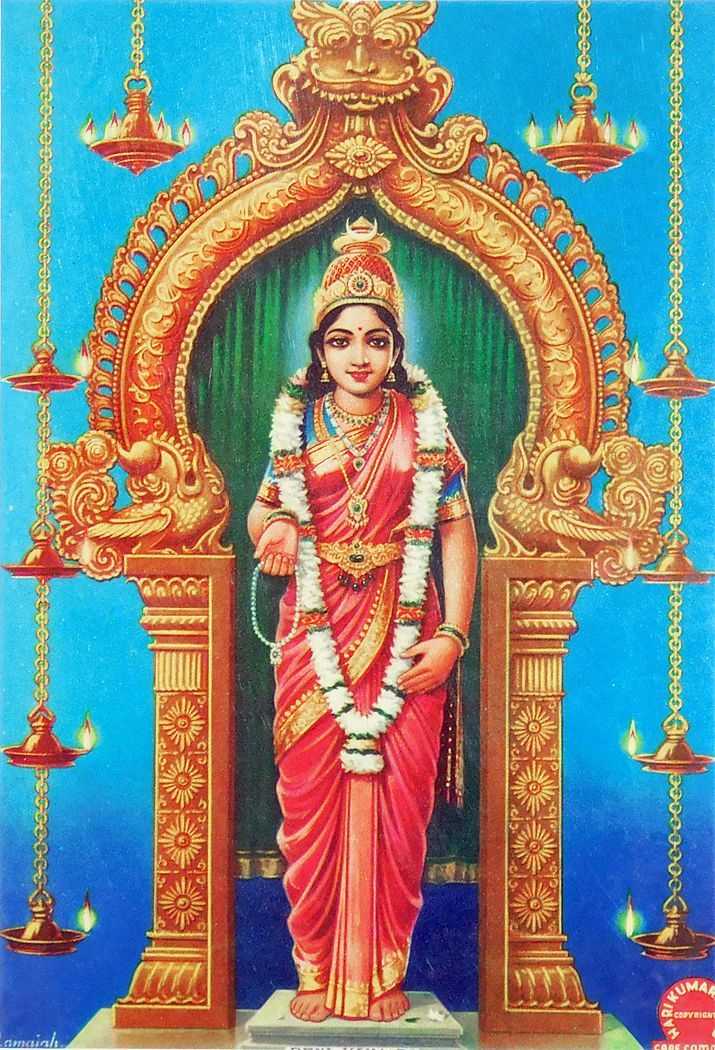
Devi Kanya Kumari
Devi Kanya Kumari is a prominent Hindu goddess, a manifestation of Mahadevi in the form of an adolescent girl. She is revered as a form of Parvati or Lakshmi, and is particularly known for her role in slaying the demon Banasura. Her worship is deeply tied to the town of Kanyakumari at the southernmost tip of India.

Chandraghanta
Chandraghanta is a powerful form of the Hindu goddess Mahadevi, revered as the destroyer of demons and the protector of her devotees. She is the third of the Navadurga and is prominently worshipped on the third day of Navaratri. Her name, meaning 'adorned with the moon as her bell,' refers to the crescent moon on her forehead, and she is depicted with ten arms holding various weapons and a bell.
Dakshinamurti
Dakshinamurti is a South-facing aspect of the Hindu god Shiva, embodying him as the ultimate guru, the personification of supreme awareness, understanding, and knowledge. He is revered as the god of wisdom and meditation, teaching yoga, music, and the Shastras, and is depicted as the destroyer of ignorance. His iconography often features four arms, seated under a banyan tree, with a mudra signifying knowledge, and his presence is a significant element in Shiva temples.