
Narayana
Narayana is a significant form and epithet of the Hindu deity Vishnu, often depicted in yogic slumber on the cosmic ocean. He symbolizes the masculine principle and is revered as the Supreme Being in Vaishnavism, also known as Purushottama. His name is associated with the primordial waters and his role as the foundation of all existence.
Key Facts
- ›Narayana is a form of Vishnu, also known as Purushottama.
- ›His name derives from Sanskrit 'narah' (water/man) and 'yana' (abode/vehicle).
- ›He is depicted in yogic slumber on the celestial ocean, symbolizing creation.
- ›In Hindu scriptures, he is considered the Supreme being and the 'Guru of the Universe'.
- ›Narayana is associated with the creation, preservation, and destruction of the universe.
- ›In Jainism, Narayana is a powerful figure who appears with Balabhadra and rules half the earth.

Purushottama, Supreme Being, Nara-Narayana
- Four-Armed
- Holds Padma , Kaumodaki Gada , Panchajanya Shankha , and Sudarshana Chakra
- Divine Blackish-Blue Color of Water-Filled Clouds
- Depicted In Yogic Slumber On the Celestial Ocean
Laws of Manu, Mahabharata, Vishnu Purana, Bhagavata Purana, Garuda Purana, Padma Purana, Bhagavad Gita, Purusha Sukta, Narayana Sukta, Narayana Upanishad, Mahanarayana Upanishad, Nrisimha Tapaniya Upanishad, Pancharatras, Lalitavistara SūTra, KāRaṇḍAvyūHa SūTra, SarvapuṇYasamuccayasamāDhi SūTra, NāRāYaṇAparipṛCchā DhāRaṇī, MahāSamaya Sutta, VeṇḍU Sutta
Consort of Sri, Bhumi, and Nila
Vaikuntha, Kshira Sagara
Sudarshana Chakra, Kaumodaki Gada, Panchajanya Shankha
Shesha
Supreme Godhead
About Narayana
Narayana is a prominent form and epithet of the Hindu deity Vishnu, widely revered as the Supreme Being within Vaishnavism. Often depicted in a state of yogic slumber upon the celestial ocean, Narayana symbolizes the masculine principle and plays a crucial role in the cosmic cycles of creation, preservation, and destruction.
Etymology and Symbolism
The name 'Narayana' is derived from Sanskrit, with 'narah' signifying 'water' or 'man' and 'yana' meaning 'abode' or 'vehicle.' This etymology suggests a connection to the primordial waters, where the deity resides, and his foundational presence in all existence. Ancient texts like the Laws of Manu explain that as the waters were his first residence, he came to be known as Narayana. This understanding is echoed in later scriptures such as the Mahabharata and the Vishnu Purana.
Divine Attributes and Role
Iconographically, Narayana is often depicted with a dark, water-filled cloud-like complexion and four arms, holding sacred objects like the lotus (Padma), mace (Kaumodaki gada), conch shell (Panchajanya shankha), and discus (Sudarshana chakra). He is considered the 'Guru of the Universe' and the ultimate soul, from whom all things emanate and to whom they return. The texts state that Narayana sustains the universe as Vishnu and annihilates it as Kalagni Rudra. His supreme abode, Vaikuntha, is a realm of eternal bliss beyond the material universe.
Significance Across Traditions
Narayana features prominently in various Hindu scriptures, including the Vedas, Upanishads, and Puranas. His significance extends beyond Hinduism; in Mahayana Buddhism, he is recognized as Nārāyaṇa, a guardian deity with attributes of strength. In Jainism, Narayana is a powerful figure who, along with Balabhadra, rules half the earth, embodying immense strength and righteousness.
Devotion and Worship
Devotion to Narayana is central to Vaishnavism. Scriptures highlight the salvific power of chanting his name, even at the moment of death. Ramanuja's prayer of surrender to Narayana in the Sharanagati Gadyam is a seminal text for Sri Vaishnava adherents, establishing Narayana as the refuge of all creation and the dispeller of devotees' miseries.
Source: Wikipedia ↗
Frequently Asked Questions
What is the meaning of the name Narayana?
The name Narayana is derived from the Sanskrit words 'narah,' meaning 'water' or 'man,' and 'yana,' meaning 'abode' or 'vehicle.' It is often interpreted as the 'primeval man' or the 'Supreme Being who is the foundation of all men,' and also as the one who rests on the waters.
How is Narayana depicted in Hindu iconography?
Narayana is typically described as having a divine blackish-blue color, similar to water-filled clouds. He is depicted with four arms, holding a lotus (Padma), a mace (Kaumodaki gada), a conch shell (Panchajanya shankha), and a discus (Sudarshana chakra).
What is Narayana's role in the creation and destruction of the universe?
Narayana is considered the Supreme Personality of Godhead who engages in the creation of the universe. He sustains and preserves it as Vishnu, and annihilates it at the end of a Maha-Kalpa as Kalagni Rudra.
Is Narayana a Vedic deity?
Narayana is mentioned in Vedic texts such as the Narayana Sukta and the Narayana Upanishad. These texts hail him as the ultimate soul and the supreme force or essence of all.
How is Narayana viewed in Buddhism and Jainism?
In Mahayana Buddhism, Narayana (often called Nārāyaṇa) is depicted as a Vajradhara and one of the twelve guardian devas. In Jainism, Narayana is a mighty half-brother who appears in each half of the time cycles and rules half the earth as a half-chakravarti.
Related Hindu deities
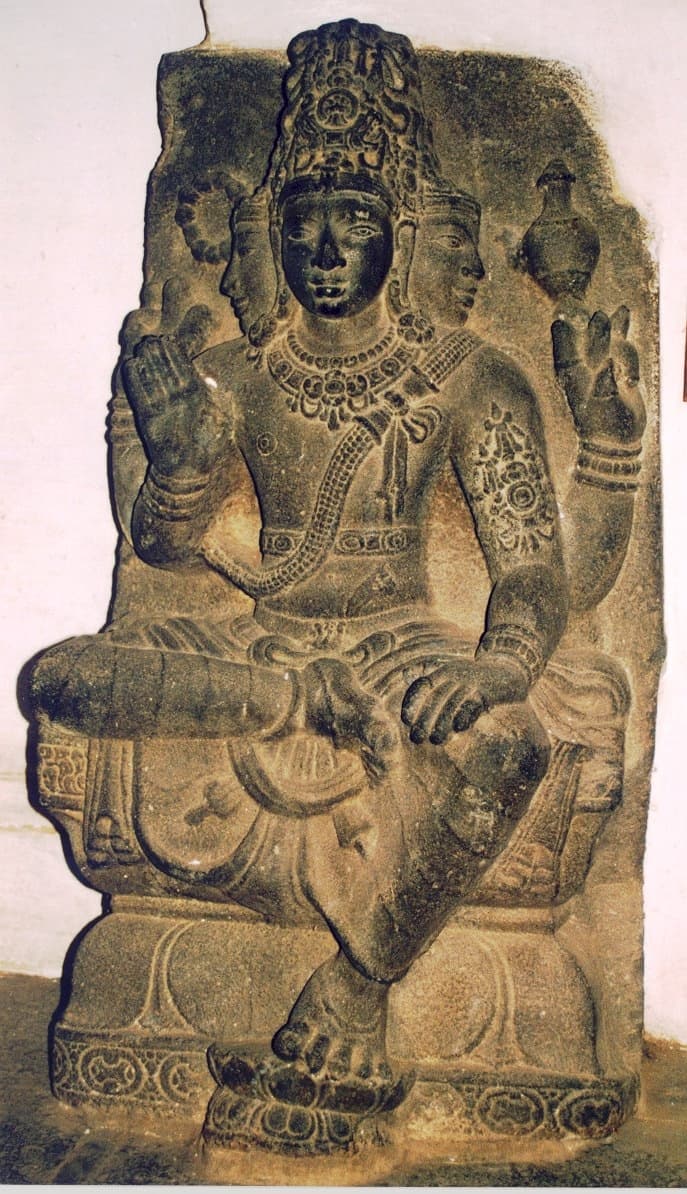
Prajapati
Prajapati is a significant deity in ancient Vedic religion, primarily known as a creator god and often identified with Brahma. The name "Prajapati" translates to "Lord of the people" or "lord of all born beings" and was applied to various figures in Hindu creation myths, including deities like Agni, Indra, and Vishwakarma, as well as celestial sages. In later traditions, Prajapati also represents the metaphysical concept of Brahman as the primordial matter from which creation arises.

Hari
Hari is a significant epithet for the Hindu deity Vishnu, meaning 'the one who takes away,' primarily referring to the removal of sins, darkness, and illusion. It is considered one of Vishnu's 1000 names in the Vishnu Sahasranama and holds immense importance in Vaishnavism, emphasizing Vishnu's role as the preserver and remover of obstacles.

Matsya
Matsya is the fish avatar of the Hindu god Vishnu, often considered the first of his ten primary incarnations. He is primarily known for rescuing the first man, Manu, from a great deluge and for saving the sacred Vedas from a demon. Matsya plays a significant role in Hindu mythology, symbolizing divine protection and the preservation of knowledge and humanity.