
Chandraghanta
Chandraghanta is a powerful form of the Hindu goddess Mahadevi, revered as the destroyer of demons and the protector of her devotees. She is the third of the Navadurga and is prominently worshipped on the third day of Navaratri. Her name, meaning 'adorned with the moon as her bell,' refers to the crescent moon on her forehead, and she is depicted with ten arms holding various weapons and a bell.
Key Facts
- ›She is the third goddess of the Navadurga, a group of nine forms of Durga.
- ›Chandraghanta is worshipped on the third day of the Navaratri festival.
- ›Her name signifies the crescent moon adorned on her forehead, resembling a bell.
- ›She is depicted with ten arms holding divine weapons and a bell.
- ›Her vahana is a lion, symbolizing bravery and courage.
- ›She is known for destroying demons and protecting her devotees.

Candraghaṇṭā
- Crescent Moon Shaped Like A Bell On Her Forehead
- Ten Hands
- Trident
- Mace
- Bow and Arrow
- Sword
- Lotus Flower
- Bell
- Waterpot
- Abhayamudra
- Third Eye On Her Forehead
- Golden Complexion
Shiva Purana
Shakti of Shiva, Form of Mahadevi, Form of Parvati
Navaratri
Trident, Mace, Bow and Arrow, Sword
About Chandraghanta
Who is Chandraghanta?
Chandraghanta is a significant form of the Hindu goddess Mahadevi, revered as a powerful deity who destroys demons and protects her devotees. She holds the position of the third goddess among the Navadurga, a group of nine manifestations of Durga, and is specifically worshipped on the third day of the Navaratri festival. Her name, which translates to 'adorned with the moon as her bell,' directly references the distinct crescent moon that graces her forehead, resembling a bell.
Legend and Significance
According to the Shiva Purana, Chandraghanta is the shakti of Shiva, manifesting in his form as Chandrashekhara. Two prominent legends illustrate her power and purpose. In one, she transforms into Chandraghanta to bring balance and protect her family's honor during her wedding to Shiva, who appeared in a terrifying form. In another, she battles the formidable asura Jatukasura and his army of giant bats, restoring peace to the universe with her divine might. Her worship is associated with granting fearlessness to her devotees, embodying both serenity and fierce maternal protection.
Iconography and Attributes
Chandraghanta is iconographically depicted with ten powerful arms, each wielding divine weapons such as a trident, mace, bow and arrow, and sword. She also carries a lotus flower and a bell, with one hand typically in the 'abhayamudra,' signifying fearlessness. Her ride is a lion, symbolizing bravery and courage. Her golden complexion and the prominent crescent moon on her forehead are her defining visual characteristics. She is believed to reside in the Manipura chakra and is considered an embodiment of beauty, charm, and grace, while also being a ready warrior.
Source: Wikipedia ↗
Frequently Asked Questions
Who is Chandraghanta?
Chandraghanta is a form of the Hindu goddess Mahadevi, venerated as the destroyer of demons and protector of her devotees. She is the third of the Navadurga and is worshipped on the third day of Navaratri.
What does Chandraghanta's name mean?
Her name, Chandraghanta, literally means 'adorned with the moon as her bell.' This refers to the crescent moon shaped like a bell that adorns her forehead.
What is Chandraghanta known for?
Chandraghanta is known for her fierce form that destroys demons and her compassionate nature towards her devotees. The sound of her bell is said to paralyze demons.
What are Chandraghanta's key iconographic features?
She is depicted with ten hands, holding weapons such as a trident, mace, bow and arrow, sword, and lotus. She also holds a bell and her hand is often in the 'abhayamudra' (fear-dispelling gesture). A crescent moon adorns her forehead, and she rides a lion.
What is the significance of Chandraghanta in Navaratri?
Chandraghanta is the third of the nine goddesses worshipped during the Navaratri festival. Her worship on the third day is considered important for seeking protection and courage.
What legends are associated with Chandraghanta?
Two prominent legends involve her transformation to protect her family during her wedding to Shiva and her battle against the demon Jatukasura, who unleashed an army of giant bats.
Related Hindu deities

Kaushiki
Kaushiki is a Hindu goddess who emerged from the sheath of Parvati. She is primarily known for her role in defeating the asura brothers Shumbha and Nishumbha, and her emergence also led to the creation of the Matrikas. Kaushiki is considered an incarnation of Mahasaraswati and is also known by epithets such as Ambika and Chandika.
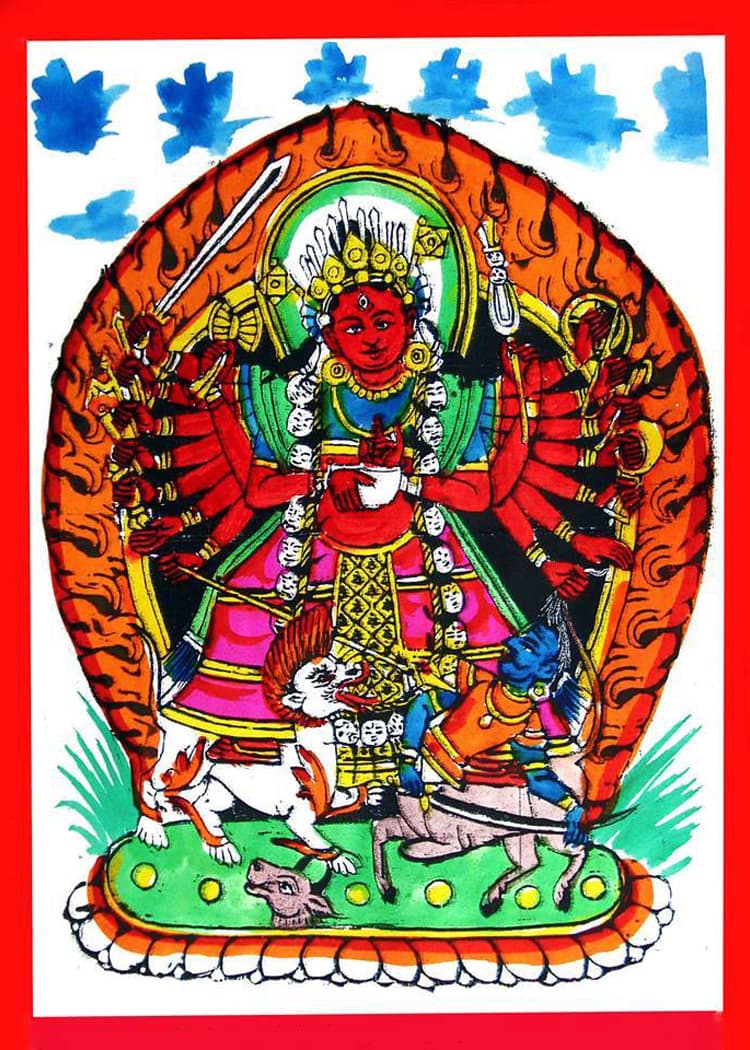
Chandi
Chandi, also known as Chandika, is a fierce Hindu goddess revered as a form of Durga and an incarnation of Chamunda. Derived from the Sanskrit word for "fierce," she is celebrated for vanquishing demons and embodying divine wrath. Chandi is particularly significant in the Shakta tradition and is widely worshipped in West Bengal and Gujarat.

Katyayani
Katyayani is a formidable form of the Hindu goddess Mahadevi, primarily venerated as the slayer of the tyrannical asura Mahisha. She is recognized as the sixth of the Navadurga and is a significant deity in Shaktism, embodying the fierce warrior aspect of the divine feminine. Her worship is particularly prominent during the Navaratri festival.