
Ganden
Tibetan Buddhism·Tibet·Partially rebuilt, active community in India·15th century
Ganden Monastery, founded in 1409 by Je Tsongkhapa, is one of the three principal Gelug university monasteries of Tibet. Located northeast of Lhasa, it served as the seat of the Ganden Tripa, the head of the Gelug school, and housed significant religious traditions and educational colleges. Although largely destroyed in 1959 and during the Cultural Revolution, it has been partially rebuilt and a similar monastery was established by Tibetan exiles in India.
Key Facts
- ›Founded in 1409 by Je Tsongkhapa Lozang-dragpa, the founder of the Gelug order.
- ›One of the "great three" Gelug university monasteries, alongside Sera and Drepung.
- ›The monastery was the seat of the Ganden Tripa, the spiritual head of the Gelug school.
- ›Completely destroyed during the 1959 Tibetan uprising and the Cultural Revolution, with partial rebuilding efforts initiated in the 1980s.
- ›A new Ganden Monastery was established in Karnataka, India, by Tibetan exiles in 1966.
- ›Its full name is Ganden Namgyal Ling, meaning "joyful victorious temple."

- Tsongkhapa's Preserved Body Entombed In A Silver and Gold Encrusted Tomb .
- the Tongwa Donden Chorten, A Reconstruction of Ganden's Sanctum Sanctorum Containing Tsongkapa's Reliquary.
- the Tsokchen Assembly Hall.
- the Ngam Cho Khang, the Chapel Where Tsongkhapa Traditionally Taught.
- Artifacts Belonging To Tsongkhapa.
Gaden, Gandain, Ganden Namgyeling, Monastery of Gahlden
Je Tsongkhapa Lozang-Dragpa, Gyeltsabjey, Kaydrubjey, 14th Dalai Lama, Kunigaish Gedimin, Karl TõNisson
- Founded In 1409.
- Je Tsongkhapa Died and Was Entombed There In 1419.
- Divided Into Four Colleges, Later Consolidated Into Two: Jangtsey and Shartsey.
- Played A Significant Political Role, Able To Veto Government Decisions.
- Completely Destroyed In 1959 During the Tibetan Uprising.
- Severely Shelled and Dismantled During the Cultural Revolution .
- Riots By 400 Monks In 1996 After A Ban On Pictures of the Dalai Lama.
- Monks Participated In Mass Demonstrations and Protests During the 2008 Tibetan Uprising Anniversary.
- Expulsion of Over 500 Monks In 2008 For Refusing To Adhere To A Ban Against the Protective Deity Dorje Shugden.
About Ganden
Ganden Monastery
Ganden Monastery, also known as Gaden or Gandain, is one of the "great three" Gelug university monasteries of Tibet, situated in Dagzê County, northeast of Lhasa. Founded in 1409 by Je Tsongkhapa Lozang-dragpa, the revered founder of the Gelug order, it quickly became a prominent center for Buddhist study and practice. The monastery's full name, Ganden Namgyal Ling, translates to "joyful victorious temple," referencing Tuṣita, the heaven of the bodhisattva Maitreya.
History and Significance
Je Tsongkhapa himself established Ganden, building its main temple and often residing there until his death in 1419. His preserved body was entombed within the monastery in a precious reliquary. Ganden served as the seat of the Ganden Tripa, the titular head of the Gelug school, a position held for seven-year terms. The monastery was divided into educational colleges, Jangtsey and Shartsey, which focused on the study of both sutra and tantra through rigorous methods of memorization, logic, and debate. The Gelug school itself derives its name, "Ganden Lug," from this monastery. In the 19th century, Ganden, along with Sera and Drepung monasteries, wielded significant political influence, capable of vetoing government decisions.
Destruction and Reconstruction
Ganden Monastery suffered immense destruction in 1959 during the Tibetan uprising and was further devastated during the Cultural Revolution, with its buildings reduced to rubble and many artifacts lost. Rebuilding efforts began in the 1980s, and significant progress has been made in restoring parts of the complex, including the reconstruction of the sanctum sanctorum containing Tsongkhapa's reliquary. A parallel Ganden Monastery was established in Karnataka, India, in 1966 by Tibetan exiles, continuing the monastic traditions and educational curriculum of the original institution. As of 2012, the rebuilt monastery in Tibet housed approximately 400 monks, while the Indian establishment is a major center for Tibetan Buddhism in exile.
Source: Wikipedia ↗
Frequently Asked Questions
When was Ganden Monastery founded?
Ganden Monastery was founded in 1409 by Je Tsongkhapa Lozang-dragpa. He was the founder of the Gelug order and often stayed at Ganden, where he also died in 1419.
Where is Ganden Monastery located?
The original Ganden Monastery is located 40 kilometers northeast of Lhasa, Tibet, at an altitude of 4,300 meters on Wangbur Mountain in Dagzê County. A new monastery with the same name and tradition has been established in Karnataka, India.
What is the significance of Ganden Monastery?
It is one of the three major Gelug university monasteries and was the seat of the Ganden Tripa, the head of the Gelug school. The monastery was central to the study of sutra and tantra, granting degrees through rigorous examination and debate.
What happened to Ganden Monastery after 1959?
The monastery was completely destroyed by the People's Liberation Army in 1959 and further damaged during the Cultural Revolution, with buildings reduced to rubble. Rebuilding efforts have been ongoing since the 1980s.
Is there a Ganden Monastery outside of Tibet?
Yes, a Ganden Monastery was re-established in Karnataka, India, by Tibetan exiles in 1966. This Indian location houses the re-established Jangtse and Shartsey colleges, mirroring the original monastery's structure.
Related Monasteries

Drepung
Drepung Monastery, meaning "Rice Heap Monastery," is one of the "great three" Gelug monasteries of Tibet and the largest of all Tibetan monasteries. Founded in 1416, it served as the principal seat of the Gelug school and was renowned for its high academic standards, often referred to as the "Nalanda of Tibet." The Ganden Phodrang within Drepung was the residence of the Dalai Lamas until the construction of the Potala Palace.

Drigung
Drigung Thil Monastery, established in 1179, is a significant monastic seat of the Drikung Kagyu tradition of Tibetan Buddhism. Historically, it held considerable religious and political influence until its destruction by Mongol forces in 1290. Though rebuilt, it primarily functioned as a center for meditative studies and was again severely damaged after 1959, with partial reconstruction commencing in 1983. As of 2015, it housed approximately 250 resident monks and remains a site of pilgrimage.
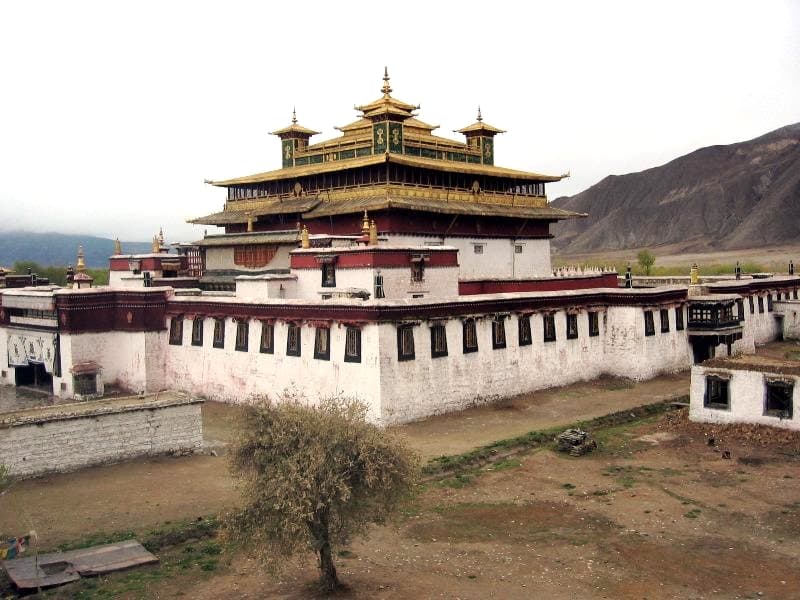
Samye Monastery
Samye Monastery, the first Tibetan Buddhist and Nyingma monastery in Tibet, was constructed during the reign of King Trisong Deutsen. Its design reflects Buddhist cosmology, with a central temple and surrounding stupas. Despite extensive destruction during the Cultural Revolution, it has been rebuilt and remains an active monastery, pilgrimage site, and tourist destination.