
Drepung
Tibetan Buddhism·Tibet·Active (with reduced population in Lhasa, active community in exile)·15th century
Drepung Monastery, meaning "Rice Heap Monastery," is one of the "great three" Gelug monasteries of Tibet and the largest of all Tibetan monasteries. Founded in 1416, it served as the principal seat of the Gelug school and was renowned for its high academic standards, often referred to as the "Nalanda of Tibet." The Ganden Phodrang within Drepung was the residence of the Dalai Lamas until the construction of the Potala Palace.
Key Facts
- ›Founded in 1416 by Jamyang Choge Tashi Palden.
- ›Historically housed up to 10,000 monks.
- ›Known as the "Nalanda of Tibet" for its academic rigor.
- ›The Ganden Phodrang was the early residence of the Dalai Lamas.
- ›Divided into seven great colleges, analogous to medieval European universities.
- ›A significant portion of its older buildings was destroyed after 1951.

Ganden Phodrang, Seven Great Colleges
Rice Heap Monastery, 'Bras Spungs Dgon Pa, DréPung GöNpa
Jamyang Choge Tashi Palden, Tsongkhapa, Gendun Gyatso, Sonam Drakpa, SöNam Gyatso, Tulku Dragpa Gyaltsen, Freddie Spencer Chapman
- Founded In 1416.
- Ganden Phodrang Constructed In 1518.
- Residence of Dalai Lamas Until Potala Palace Construction.
- Destruction of Buildings After 1951.
- Demonstration By Monks On March 10, 2008.
- Sieged By Chinese Forces On March 14, 2008.
- Reopened In 2013 After Being Shut For Five Years.
About Drepung
Drepung Monastery
Drepung Monastery, whose name translates to "Rice Heap Monastery" (Tibetan: འབྲས་སྤུངས་དགོན་པ, Wylie: 'bras spungs dgon pa), is a significant institution within Tibetan Buddhism, belonging to the Gelug school. It is recognized as one of the "great three" Gelug monasteries of Tibet, alongside Ganden and Sera monasteries. Historically, Drepung was the largest of all Tibetan monasteries and was situated on the Gambo Utse mountain, a few kilometers west of Lhasa.
History and Significance
The monastery was founded in 1416 by Jamyang Choge Tashi Palden, a principal disciple of Tsongkhapa, the founder of the Gelug school. Drepung quickly rose to prominence, becoming the principal seat of the Gelug school and retaining a premier position among its four major monasteries. Its academic standards were exceptionally high, earning it the moniker "Nalanda of Tibet," a comparison to the ancient Indian monastic university. The Ganden Phodrang within Drepung served as the early residence of the Dalai Lamas until the construction of the Potala Palace by the Great Fifth Dalai Lama. Historical records indicate Drepung was divided into centers of power, including the "lower chamber" associated with future Dalai Lamas and the "upper chamber" linked to descendants of the illustrious teacher Sonam Drakpa.
Colleges and Structure
In the late 1930s, Drepung was organized into four colleges, each drawing monks from distinct geographical regions. Today, the monastery is divided into seven major colleges: Gomang, Loseling, Deyang, Shagkor, Tosamling, Dulwa, and Ngagpa. This structure has been likened to medieval European universities like Oxford or the Sorbonne, with each college potentially having different emphases, teaching lineages, or traditional affiliations.
Modern Era and Exile
Following the Chinese arrival in Lhasa in 1951, nearly half of Drepung's older monastic buildings were destroyed. Despite this, the main structures, including the colleges and the Dalai Lamas' former residence, were preserved. In recent times, Drepung has faced challenges, including protests in 2008 and subsequent closures. Currently, the monastic population in Lhasa is reportedly around 300 monks due to enforced population caps. However, the traditions of Drepung continue in exile, with substantial campuses established in South India, housing over 5,000 monks across Drepung Loseling and Drepung Gomang institutions.
Source: Wikipedia ↗
Frequently Asked Questions
When was Drepung Monastery founded?
Drepung Monastery was founded in the year 1416. Its establishment was by Jamyang Choge Tashi Palden, who was a prominent disciple of Tsongkhapa, the founder of the Gelug school.
What is the significance of Drepung Monastery in Tibetan Buddhism?
Drepung Monastery holds significant importance as one of the "great three" Gelug monasteries and was historically the largest monastic institution in Tibet. It was a major center for learning and the principal seat of the Gelug school, known for its high academic standards.
How many monks did Drepung Monastery house historically?
Historically, Drepung Monastery was a massive institution, with reports from 1936-1937 indicating it housed 7,700 monks, and sometimes as many as 10,000 monks. It was considered the largest monastery in the world at that time.
What was the Ganden Phodrang at Drepung Monastery?
The Ganden Phodrang at Drepung Monastery was initially constructed in 1518 by Gendun Gyatso, retrospectively known as the 2nd Dalai Lama. It later served as the primary residence for the Dalai Lamas until the 5th Dalai Lama established the Potala Palace.
What is the current situation at Drepung Monastery in Lhasa?
Currently, the population at the monastery in Lhasa is reported to be around 300 monks due to population caps enforced by the Chinese government. The institution continues its traditions in exile with campuses in South India.
Has Drepung Monastery experienced destruction or closure?
Yes, almost half of the older monastic buildings were destroyed after the Chinese arrived in Lhasa in 1951. More recently, Drepung Monastery was reportedly shut for five years and reopened in 2013.
Related Monasteries

Ganden
Ganden Monastery, founded in 1409 by Je Tsongkhapa, is one of the three principal Gelug university monasteries of Tibet. Located northeast of Lhasa, it served as the seat of the Ganden Tripa, the head of the Gelug school, and housed significant religious traditions and educational colleges. Although largely destroyed in 1959 and during the Cultural Revolution, it has been partially rebuilt and a similar monastery was established by Tibetan exiles in India.

Drigung
Drigung Thil Monastery, established in 1179, is a significant monastic seat of the Drikung Kagyu tradition of Tibetan Buddhism. Historically, it held considerable religious and political influence until its destruction by Mongol forces in 1290. Though rebuilt, it primarily functioned as a center for meditative studies and was again severely damaged after 1959, with partial reconstruction commencing in 1983. As of 2015, it housed approximately 250 resident monks and remains a site of pilgrimage.
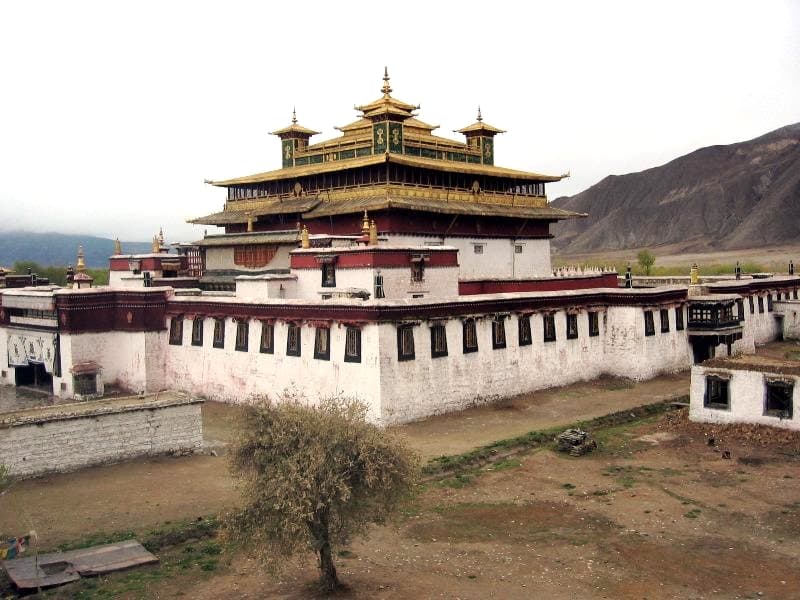
Samye Monastery
Samye Monastery, the first Tibetan Buddhist and Nyingma monastery in Tibet, was constructed during the reign of King Trisong Deutsen. Its design reflects Buddhist cosmology, with a central temple and surrounding stupas. Despite extensive destruction during the Cultural Revolution, it has been rebuilt and remains an active monastery, pilgrimage site, and tourist destination.