
Samye Monastery
Samye Monastery, the first Tibetan Buddhist and Nyingma monastery in Tibet, was constructed during the reign of King Trisong Deutsen. Its design reflects Buddhist cosmology, with a central temple and surrounding stupas. Despite extensive destruction during the Cultural Revolution, it has been rebuilt and remains an active monastery, pilgrimage site, and tourist destination.
Key Facts
- ›Established as the first Tibetan Buddhist and Nyingma monastery in Tibet.
- ›Construction began in 763 CE under Khenpo Shantarakshita and was completed in 767 CE with the help of Guru Padmasambhava.
- ›The first Tibetan monks were ordained at Samye in 779 CE.
- ›Its architectural design is based on a mandala depicting the Buddhist cosmos.
- ›Suffered significant destruction during the Cultural Revolution and was rebuilt after 1988.
- ›It is located in the Chimpu valley, south of Lhasa, in the administrative region of Gra Nang or Drananga Lhokha.
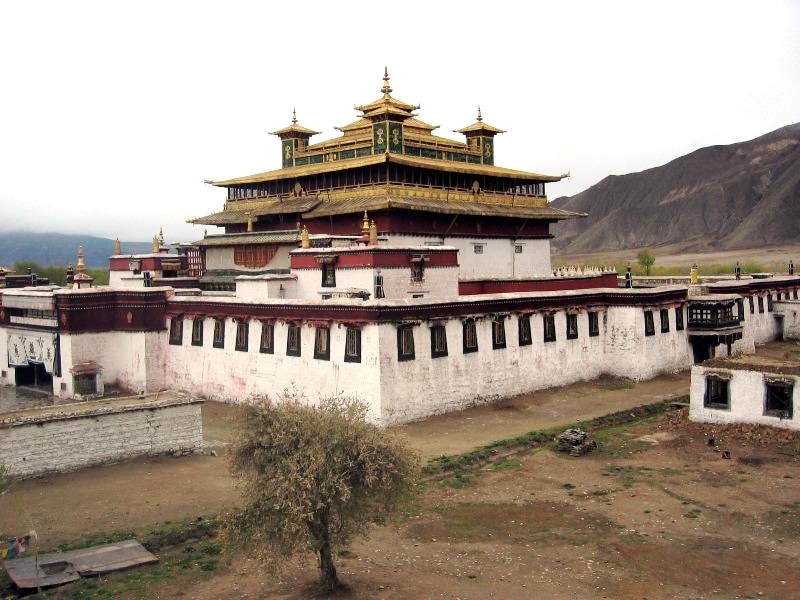
Indian, Chinese, Khotanese
Mandala-Shaped Layout, Four Colored Stupas, Three-Storied Main Temple, 8 Main Temples, Stone Pillar Inscription, Bronze Bell Inscription
Bsam Yas, Sangye Monastery
King Trisong Deutsen, Khenpo Shantarakshita, Guru Padmasambhava, Kamalasila, Hosang Mahayana, Queen Rgyal Mo Brtsan, Pehar Gyalpo
Construction Began In 763 Ce., Completion and Consecration In 767 Ce., First Tibetan Monks Ordained In 779 Ce., the Great Samye Debate In the Early 790s., Destruction During the Cultural Revolution., Rebuilding After 1988.
About Samye Monastery
Samye Monastery, known in Tibetan as བསམ་ཡས་ (bSam yas) and sometimes referred to as Sangye Monastery, holds the distinction of being the first Buddhist monastery and the first Nyingma school monastery constructed in Tibet. Its establishment during the reign of King Trisong Deutsen marked a pivotal moment in the history of Buddhism in the region.
History and Founding
The construction of Samye Monastery began around 763 CE under the guidance of the Indian scholar Khenpo Shantarakshita. However, construction faced significant obstacles, with buildings collapsing. According to tradition, Guru Padmasambhava, a key figure in Tibetan Vajrayana Buddhism, was invited to Tibet and successfully subdued the local spirits and obstructive forces, allowing the monastery to be completed in 767 CE. The ordination of the first Tibetan monks at Samye in 779 CE further solidified its importance as a center for monastic life and Buddhist practice.
Architectural Design and Cosmology
The architectural plan of Samye Monastery is a profound representation of Buddhist cosmology, designed in the form of a three-dimensional mandala. At its center stands the main temple, symbolizing the mythical Mount Meru, the axis of the universe. This central structure is surrounded by four distinct stupas at the cardinal points, representing continents, and the entire complex is enclosed by a circular wall with four gates. The main three-story building itself incorporates architectural styles from India, China, and Khotan (Tibet), reflecting the diverse influences on early Tibetan Buddhism.
Historical Significance and Challenges
Samye Monastery has been the site of significant historical events, including the renowned Great Samye Debate in the early 790s, where Indian and Chinese Buddhist philosophical traditions were debated. The monastery has endured numerous challenges throughout its history, including damage from civil war, fires, earthquakes, and particularly devastating destruction during the Cultural Revolution. Despite these setbacks, Samye has been consistently rebuilt, most notably after 1988, largely due to the efforts of the 10th Panchen Lama. Today, it stands as an active monastery, a vital pilgrimage destination, and an important tourist site, preserving its original 8th-century design principles.
Notable Features and Associations
Key features of Samye include its unique mandala layout, the four colored stupas, and the presence of eight main temples within its complex. The monastery also preserves historical artifacts such as an 8th-century stone pillar recording treaties and events, and a large bronze bell cast by one of King Trisong Detsen's queens. The monastery is also associated with the taming of the local spirit protector Pehar Gyalpo by Padmasambhava, who later became the principal protector of the Dalai Lamas, manifesting through the Nechung Oracle.
Source: Wikipedia ↗
Frequently Asked Questions
When was Samye Monastery founded?
Foundation of Samye Monastery is recorded as being set in the 'hare year,' which could be either 763 or 775 CE. Completion and consecration of the main shrine took place in the 'sheep year,' either 767 or 779 CE. The patron of the monastery was King Trisong Detsen.
What is the architectural significance of Samye Monastery?
The monastery's layout is designed as a giant mandala, symbolizing the Buddhist cosmos with a central temple representing Mount Meru. Other buildings represent continents and cosmological features. The main temple's three stories are designed in Indian, Chinese, and Khotanese styles, respectively.
What happened to Samye Monastery during the Cultural Revolution?
Samye Monastery was largely destroyed during the Cultural Revolution. Historical accounts from the late 1980s describe it as 'totally destroyed,' with only the outer wall still visible, and no temples or stupas surviving.
Who were the key figures involved in the founding of Samye Monastery?
The founding was patronized by King Trisong Deutsen. Khenpo Shantarakshita initiated the construction, and Guru Padmasambhava was instrumental in subduing obstructive spirits and ensuring its completion.
Is Samye Monastery still an active monastery?
Yes, Samye Monastery has been rebuilt and is currently an active monastery. It is also an important pilgrimage and tourist destination.
What was the Great Samye Debate?
The Great Samye Debate was a significant event in Tibetan Buddhist history, occurring in the early 790s. It was a debate between Indian Buddhist theory, represented by Kamalasila, and Chinese Buddhist theory, represented by Hosang Mahayana, hosted by King Trisong Detsen. Kamalasila's victory is said to have determined the fate of Chan Buddhism in Tibet.
Related Monasteries

Ralung
Ralung Monastery, established in 1180, is the historical seat of the Drukpa Lineage of Tibetan Buddhism. Located in the Tsang region of western Tibet, it is profoundly sacred and considered the origin point of the influential Drukpa school. The monastery's founder, Tsangpa Gyare, was a disciple of Lingje Répa, and the site's auspicious natural surroundings are described through symbolic interpretations of surrounding peaks and landforms.
Riwoche
Riwoche Monastery, also known as Riwoche Tsukla Khang Tragyelma, is a significant Taklung Kagyu monastery founded in 1276 by Sangye On. It stands as one of the oldest and largest monasteries in eastern Tibet, renowned for its philosophers, logicians, and distinctive red, black, and white painted tree-trunk columns that support its main temple. Historically, it was the main branch of the Taklung Kagyu in Kham and once housed up to 2,000 monks.

Drepung
Drepung Monastery, meaning "Rice Heap Monastery," is one of the "great three" Gelug monasteries of Tibet and the largest of all Tibetan monasteries. Founded in 1416, it served as the principal seat of the Gelug school and was renowned for its high academic standards, often referred to as the "Nalanda of Tibet." The Ganden Phodrang within Drepung was the residence of the Dalai Lamas until the construction of the Potala Palace.