
Riwoche
Riwoche Monastery, also known as Riwoche Tsukla Khang Tragyelma, is a significant Taklung Kagyu monastery founded in 1276 by Sangye On. It stands as one of the oldest and largest monasteries in eastern Tibet, renowned for its philosophers, logicians, and distinctive red, black, and white painted tree-trunk columns that support its main temple. Historically, it was the main branch of the Taklung Kagyu in Kham and once housed up to 2,000 monks.
Key Facts
- ›Founded in 1276 CE by Sangye on, a student of the Taklung lineage holder Sangye Yarjon.
- ›One of the oldest and largest monasteries in eastern Tibet.
- ›Historically served as the main branch of the Taklung Kagyu in Kham.
- ›Once home to as many as 2,000 monks, holding great repute among Khampa monasteries.
- ›Known for its monks' expertise in philosophy and logic.
- ›Features a distinctive main temple supported by large tree trunks painted in vertical red, black, and white stripes.
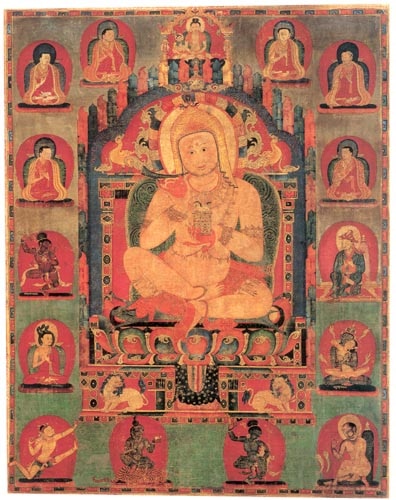
Tibetan
- Red, Black, and White Painted Tree-Trunk Columns Supporting the Main Temple
- Main Temple Undergoing Restoration Since 1985
- 14th-Century Cloth Painting Entitled Jnanatapa
Riwoche Tsukla Khang Tragyelma, Leiwuqi Si
Sangye On, Sangye Yarjon, Onpo, Mangalaguru, Choku Orgyan Gonpo
- Destruction of the Main Temple By Chinese Communists Before Restoration Began In 1985.
About Riwoche
Riwoche Monastery
Riwoche Monastery, formally known as Riwoche Tsukla Khang Tragyelma, is a prominent monastery of the Taklung Kagyu school of Tibetan Buddhism, located in eastern Tibet. Founded in 1276 CE by Sangye On, a disciple of Sangye Yarjon, the monastery holds the distinction of being one of the oldest and largest monastic institutions in the Kham region.
History and Significance
Riwoche quickly rose to prominence, becoming the main branch of the Taklung Kagyu in Kham. Historical accounts suggest that at its peak, it housed as many as 2,000 monks, earning it a great reputation among the monasteries of the Khampa people. The monks of Riwoche were particularly noted for their advanced philosophical and logical studies. The monastery's lineage was historically divided into an "upper" and "lower" branch, with Riwoche representing the "lower" branch.
Description and Features
The main temple of Riwoche Monastery is a striking structure, notable for its three-story design and the massive tree trunks that support it. These columns are distinctively painted in vertical stripes of red, black, and white, a characteristic motif of the Taklung lineage. The monastery suffered destruction during the era of Chinese communist rule, prompting a significant restoration effort that began in 1985. Among its preserved treasures is a 14th-century cloth painting known as Jnanatapa, which depicts the Onpo Lama Rinpoche and the spiritual lineage of Riwoche.
Contemporary Community
Today, Riwoche Monastery continues to be an active religious center, with 305 monks currently in residence. The broader community of practitioners includes individuals from both the Kagyu and Nyingma schools, some of whom are married. The monastery is situated in a fertile valley beside the Dzi River, a tributary of the Mekong, approximately 29 km north of Ratsaka town and 134 km west of Chamdo.
Source: Wikipedia ↗
Frequently Asked Questions
When was Riwoche Monastery founded?
Riwoche Monastery was founded in 1276 CE by Sangye On. This makes it one of the oldest monasteries in eastern Tibet.
Where is Riwoche Monastery located?
The monastery is situated in eastern Tibet, 29 km north of the town of Ratsaka (also known as Riwoche Town). It is 134 km west of Chamdo in the Kham region, at an altitude of about 3,400 meters in a fertile valley.
What is Riwoche Monastery famous for?
Riwoche Monastery is renowned for its philosophers and logicians, and for the unique red, black, and white painted tree-trunk columns that support its main temple. It was also historically known for its large monastic population and its role as the main branch of the Taklung Kagyu in Kham.
What is the current size of the monastic community at Riwoche?
Currently, there are 305 monks residing at Riwoche Monastery. The surrounding community of practitioners also includes married members from both Kagyu and Nyingma schools.
What is the architectural style of the main temple?
The main temple is three-storied and is a distinctive feature of the Taklung lineage. It is supported by huge tree trunks painted in vertical black, red, and white stripes.
Related Monasteries

Ralung
Ralung Monastery, established in 1180, is the historical seat of the Drukpa Lineage of Tibetan Buddhism. Located in the Tsang region of western Tibet, it is profoundly sacred and considered the origin point of the influential Drukpa school. The monastery's founder, Tsangpa Gyare, was a disciple of Lingje Répa, and the site's auspicious natural surroundings are described through symbolic interpretations of surrounding peaks and landforms.
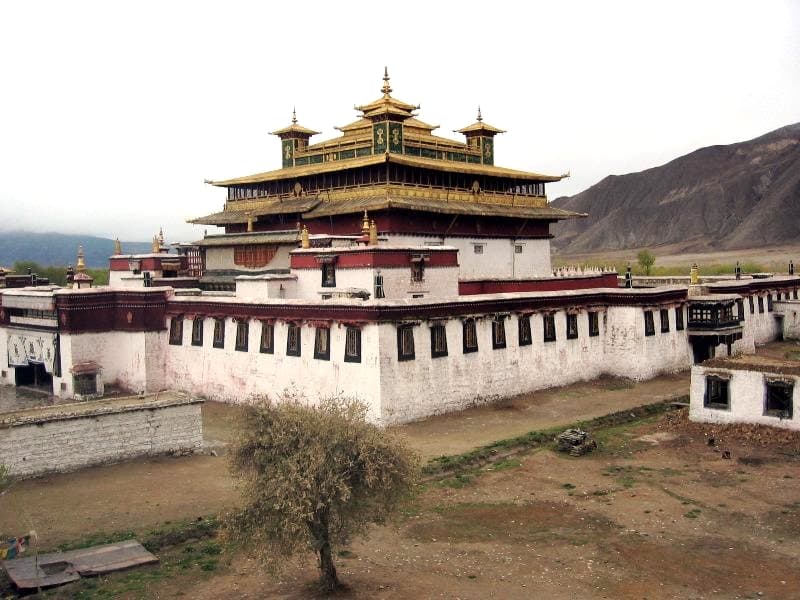
Samye Monastery
Samye Monastery, the first Tibetan Buddhist and Nyingma monastery in Tibet, was constructed during the reign of King Trisong Deutsen. Its design reflects Buddhist cosmology, with a central temple and surrounding stupas. Despite extensive destruction during the Cultural Revolution, it has been rebuilt and remains an active monastery, pilgrimage site, and tourist destination.

Drepung
Drepung Monastery, meaning "Rice Heap Monastery," is one of the "great three" Gelug monasteries of Tibet and the largest of all Tibetan monasteries. Founded in 1416, it served as the principal seat of the Gelug school and was renowned for its high academic standards, often referred to as the "Nalanda of Tibet." The Ganden Phodrang within Drepung was the residence of the Dalai Lamas until the construction of the Potala Palace.