
Drepung Monastery
Drepung Monastery, meaning "Rice Heap Monastery," is one of Tibet's "great three" Gelug monasteries and was historically the largest monastery in the world, once housing up to 10,000 monks. Founded in 1416, it served as the principal seat of the Gelug school and was renowned for its high academic standards, often referred to as the Nalanda of Tibet. The Ganden Phodrang within Drepung was the residence of the Dalai Lamas until the Potala Palace was constructed.
Key Facts
- ›Founded in 1416 by Jamyang Choge Tashi Palden, a disciple of Tsongkhapa.
- ›Historically the largest monastery in the world, with reports of housing up to 10,000 monks.
- ›Served as the principal seat of the Gelug school and was renowned for its academic rigor.
- ›The Ganden Phodrang at Drepung was the residence of the Dalai Lamas before the Potala Palace.
- ›Divided into seven major colleges, analogous to medieval European universities.
- ›A significant portion of its older buildings was destroyed after 1951, but it continues its tradition in exile in India.

Important Relationships
- Tsongkhapa
- Jamyang Choge Tashi Palden
- Dalai Lamas
- Ganden Monastery
- Sera Monastery
Ganden Phodrang, Seven Great Colleges
- Founded In 1416.
- Ganden Phodrang Constructed In 1518 By Gendun Gyatso.
- Destruction of Older Monastic Buildings After 1951.
- Demonstration and Subsequent Siege By Chinese Forces In March 2008.
- Reopened In 2013 After A Five-Year Closure.
About Drepung Monastery
Drepung Monastery, whose name translates to "Rice Heap Monastery" in Tibetan, stands as a historically significant religious institution located at the foot of Mount Gephel, near Lhasa. It is recognized as one of the "great three" Gelug monasteries of Tibet, alongside Ganden and Sera monasteries. Historically, Drepung was the largest monastery in the world, with records indicating it housed as many as 10,000 monks at its peak.
History and Academic Prowess
Founded in 1416 by Jamyang Choge Tashi Palden, a prominent disciple of Tsongkhapa, Drepung quickly rose to prominence. It served as the principal seat of the Gelug school and was celebrated for its rigorous academic standards, earning it the appellation "the Nalanda of Tibet," a reference to the ancient Indian monastic university. The Ganden Phodrang, a complex within Drepung, served as the primary residence of the Dalai Lamas until the construction of the Potala Palace by the Great Fifth Dalai Lama.
The monastery was structured into various colleges, functioning much like a university, with different colleges often affiliated with specific geographic regions or lineages. Notable among these were the Gomang and Loseling colleges. The Ganden Phodrang itself was first constructed in 1518 by Gendun Gyatso, posthumously recognized as the Second Dalai Lama, and became his chief residence.
Modern Era and Exile
Following the Chinese arrival in Lhasa in 1951, a significant portion of Drepung's older monastic buildings were destroyed. Despite this, the main structures, including its colleges and the Dalai Lamas' former residence, were preserved. In recent history, Drepung Monastery was the site of protests during the 2008 Tibetan uprising anniversary, leading to its subsequent closure and eventual reopening in 2013. Due to population caps enforced by the Chinese government, the monastery in Lhasa currently houses around 300 monks. However, Drepung continues its monastic and academic traditions in exile, with substantial campuses established in South India, housing over 5,000 monks.
Source: Wikipedia ↗
Frequently Asked Questions
When was Drepung Monastery founded?
Drepung Monastery was founded in the year 1416. Its founding figure was Jamyang Choge Tashi Palden, who was one of the main disciples of Tsongkhapa.
What does the name 'Drepung Monastery' mean?
The name 'Drepung Monastery' translates from Tibetan as 'Rice Heap Monastery.' This naming is said to be inspired by the sacred abode of Shridhanyakataka in South India.
What was Drepung Monastery's significance in Tibetan Buddhism?
Drepung Monastery was the principal seat of the Gelug school and held the premier place among the four great Gelug monasteries. It was also known for its high academic standards, earning it the moniker 'the Nalanda of Tibet.'
What was the Ganden Phodrang at Drepung Monastery?
The Ganden Phodrang was an important estate within Drepung Monastery. It served as the residence for the Dalai Lamas until the construction of the Potala Palace by the Great Fifth Dalai Lama.
How large was Drepung Monastery historically?
Historically, Drepung Monastery was the largest monastery in the world. Freddie Spencer Chapman reported in the late 1930s that it housed 7,700 monks, with numbers sometimes reaching up to 10,000.
What happened to Drepung Monastery after 1951?
After the Chinese arrived in Lhasa in 1951, almost half of Drepung Monastery's older buildings were destroyed. However, the main buildings, including its four colleges and the Dalai Lamas' residence, were preserved.
Does Drepung Monastery still operate today?
Drepung Monastery continues to operate, although the population of monks in Lhasa is now capped at around 300 due to Chinese government regulations. The institution also maintains its tradition in exile with campuses in South India.
Related Buddhist Temples

Ganden Monastery
Ganden Monastery, founded in 1409 by Je Tsongkhapa, is one of the "great three" Gelug university monasteries in Tibet. It served as the spiritual and administrative center for the Gelug school, with its "throne-holder" being the head of the order. Although largely destroyed in the 1950s and 1960s, the monastery has been partially rebuilt and a new Ganden Monastery was established by Tibetan exiles in India.
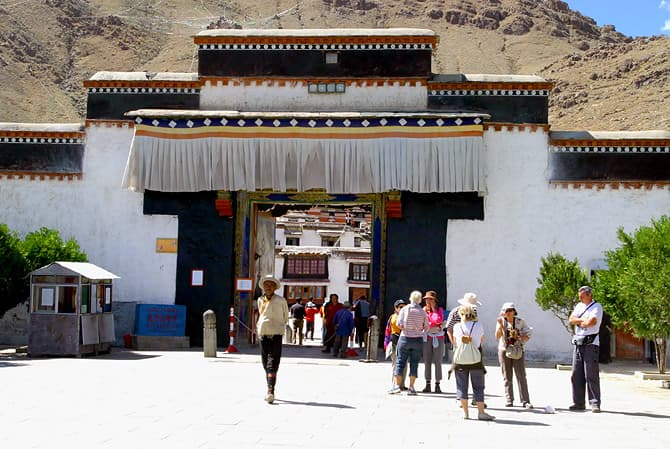
Tashi Lhunpo Monastery
Tashi Lhunpo Monastery, founded in 1447, is a historically and culturally significant Buddhist monastery located in Shigatse, Tibet. It serves as the traditional monastic seat of the Panchen Lama, the second-highest-ranking spiritual leader in the Gelug tradition of Tibetan Buddhism, and has endured significant destruction and reconstruction throughout its history.

Phugtal Monastery
Phugtal Monastery is a remarkable Buddhist monastery situated in a remote cave in the Lungnak Valley of Ladakh, Northern India. Its unique honeycomb-like structure built into a cliffside, combined with its spiritual significance and historical legacy, makes it a notable site for pilgrimage and cultural preservation. The monastery provides education and traditional medical care to the local community, embodying a holistic approach to spiritual and social well-being.