
Je Tsongkhapa
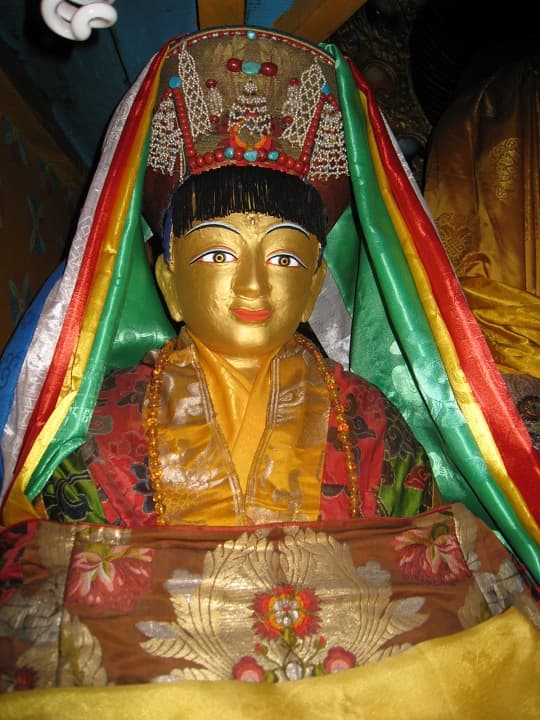
Je Tsongkhapa was a highly influential Tibetan Buddhist monk, philosopher, and tantric yogi who founded the Gelug school of Tibetan Buddhism. His philosophical system synthesized various Indian Buddhist traditions, emphasizing a rigorous understanding of emptiness and the importance of reasoned inquiry in the path to liberation. He is revered as one of the most important figures in Tibetan Buddhism.
Key Facts
- ›Founded the Gelug school of Tibetan Buddhism.
- ›Synthesized Indian Madhyamaka philosophy with Dharmakirti's epistemology.
- ›Emphasized a radical view of emptiness, seeing phenomena as dependently originated and devoid of intrinsic nature.
- ›Authored major works including the "Great Exposition of the Stages of the Path" (Lam rim chen mo).
- ›Founded Ganden monastery, one of the three main Gelug monasteries.
- ›Active in the late 14th and early 15th centuries.

Important Relationships
- Choje Dondrub Rinchen (teacher)
- Chenga Chokyi Gyalpo (teacher)
- Bodong Chakleh Namgyal (teacher)
- Khyungpo Hlehpa (teacher)
- Chokyi Pelpa (teacher)
- Rendawa Zhönnu Lodrö (teacher)
- Drupchen Lekyi Dorje (teacher)
- Umapa Pawo Dorje (mystic)
- Mañjuśrī (visions)
- Khedrup Gelek Pelzang (student, 1st Panchen Lama)
- Gyaltsap Darma Rinchen (student)
- Dülzin Drakpa Gyaltsen (student)
- Tokden Jampel Gyatso (student)
- Jamyang Chöjé (student, founder of Drepung)
- Jamchen Chöjé (student, founder of Sera)
- Gendün Drup (student, 1st Dalai Lama)
Great Exposition of the Stages of the Path, Great Exposition of Tantra, Essence of Eloquence, Ocean of Reasoning, Elucidation of the Intent
Tsongkha, Central Tibet, Sangphu Monastery, Drikung Thil Monastery, WöLkha Valley, Jokhang Temple, Ganden Monastery, Drepung Monastery, Sera Monastery
Nagarjuna, Chandrakirti, DignāGa, DharmakīRti, Buddhapalita, Aryadeva, śāNtarakṣIta, AtiśA, Mabja Changchub TsöNdrü
Tibetan, Sanskrit
Novice Monk
Influential, Revered Teacher
About Je Tsongkhapa
Je Tsongkhapa (c. 1357–1419) was a preeminent Tibetan Buddhist monk, philosopher, and tantric yogi whose profound teachings and organizational efforts led to the formation of the Gelug school of Tibetan Buddhism. Born in Tsongkha, Amdo, he received extensive education from an early age, studying under numerous masters from various Tibetan Buddhist traditions.
Philosophical Contributions
Tsongkhapa's philosophy is characterized by a comprehensive synthesis of Indian Buddhist thought. He integrated the Madhyamaka philosophy of masters like Nagarjuna and Chandrakirti with the epistemological frameworks of Dignaga and Dharmakirti, and the Cittamatra philosophy of mind. Central to his teachings is a nuanced understanding of emptiness (shunyata), which he expounded as the lack of intrinsic existence in all phenomena due to their dependent origination. He stressed that this understanding of emptiness is not nihilistic but affirms the conventional reality of phenomena. Tsongkhapa also emphasized the critical role of philosophical reasoning, arguing that it must be paired with meditation to achieve profound insight and cognitive breakthroughs.
Life and Teachings
His early life involved extensive study and travel throughout Tibet. From 1390 to 1398, he undertook significant meditation retreats, during which he reported having numerous visions of the bodhisattva Mañjuśrī, from whom he received teachings. Tsongkhapa meticulously composed his major works in his mature period, including the "Great Exposition of the Stages of the Path" (Lam rim chen mo) and the "Great Exposition of Tantra" (Sngags rim chen mo). These texts systematically outline the Mahayana path and elaborate on his philosophical views.
Founding the Gelug School and Legacy
In 1409, Tsongkhapa founded Ganden monastery near Lhasa, which became the seat of the Gelug school. His disciples, including Khedrup Gelek Pelzang and Gyaltsap Darma Rinchen, went on to establish other major Gelug monasteries such as Drepung and Sera, which became renowned centers of learning. Tsongkhapa's teachings and the Gelug tradition he founded became highly influential across the Tibetan Plateau and beyond, shaping the course of Tibetan Buddhism for centuries. His works continue to be studied and revered, and his philosophical exegesis remains central to Gelug scholasticism.
Source: Wikipedia ↗
Frequently Asked Questions
Who was Je Tsongkhapa?
Je Tsongkhapa (c. 1357–1419) was a pivotal Tibetan Buddhist monk, philosopher, and tantric yogi. His teachings and activities were instrumental in the establishment of the Gelug school of Tibetan Buddhism, which became one of the most prominent traditions in Tibet.
What is Je Tsongkhapa's main philosophical contribution?
Tsongkhapa's philosophy is known for its synthesis of Indian Madhyamaka thought, particularly the works of Nagarjuna and Chandrakirti, with the epistemological traditions of Dignaga and Dharmakirti. He developed a sophisticated understanding of emptiness (shunyata), emphasizing that all phenomena are devoid of intrinsic existence due to their dependent origination.
What is the significance of the Gelug school founded by Tsongkhapa?
The Gelug school, also known as the Ganden tradition, became a dominant force in Tibetan Buddhism. It is characterized by its emphasis on rigorous scholastic study, monastic discipline, and the integration of sutra and tantra teachings, largely based on Tsongkhapa's philosophical framework.
What are some of Je Tsongkhapa's most important works?
His most famous work is the "Great Exposition of the Stages of the Path" (Lam rim chen mo), which outlines the Mahayana path to enlightenment. Other significant writings include "Great Exposition of Tantra" (Sngags rim chen mo), "Essence of Eloquence" (Legs bshad snying po), and "Ocean of Reasoning" (Rigs pa'i rgya mtsho).
How did Tsongkhapa's teachings influence Tibetan Buddhism?
Tsongkhapa's teachings provided a comprehensive philosophical system that revitalized Buddhist study and practice in Tibet. His emphasis on reasoning and his detailed exegesis of emptiness became central to Gelug scholasticism and profoundly influenced subsequent generations of Tibetan Buddhist thinkers.
Related Buddhists

14th Dalai Lama
The 14th Dalai Lama, born Lhamo Thondup, is the current spiritual leader of Tibetan Buddhism and the former temporal leader of Tibet. He is widely regarded as an emanation of Avalokiteśvara, the Bodhisattva of Compassion, and has led the Tibetan government in exile since 1959. Known for his advocacy for peace and interfaith dialogue, he was awarded the Nobel Peace Prize in 1989.

Dolpopa Sherab Gyaltsen
Dolpopa Sherab Gyaltsen (1292–1361) was a prominent Tibetan Buddhist master from the Dölpo region of modern Nepal. He is best known as the principal exponent of the shentong teachings and an influential figure in the Jonang tradition. Dolpopa systematized Buddha-nature and Yogacara-Madhyamaka teachings, interpreting emptiness in a distinctive way that distinguished between "emptiness of self-nature" and "emptiness of other."
Milarepa
Milarepa was a renowned Tibetan siddha, yogi, and spiritual poet, celebrated for his profound teachings within various schools of Tibetan Buddhism. Initially known for sorcery and murder in his youth, he later dedicated himself to spiritual practice under his teacher Marpa the Translator, ultimately achieving realization and becoming an exemplar of religious dedication and mastery. His life story and collection of spiritual songs are foundational to the Kagyu lineage and Tibetan culture.