
Niladevi
Niladevi, also known as Nappinnai, is a Hindu goddess primarily revered in South India as one of Vishnu's consorts. Within the Sri Vaishnava tradition, she is considered an aspect of Lakshmi, alongside Sridevi and Bhudevi. She is particularly significant in Tamil culture as a favorite gopi of Krishna, whom Krishna won in marriage by subduing fierce bulls.
Key Facts
- ›Niladevi is a Hindu goddess primarily worshipped in South India, especially in Tamil culture.
- ›She is considered one of the consorts of Vishnu, and an aspect of Lakshmi in Sri Vaishnava tradition.
- ›As Nappinnai, she is depicted as the daughter of Kumbagan and a favorite gopi of Krishna.
- ›Krishna reportedly won her hand in marriage after overcoming seven ferocious bulls.
- ›Niladevi is sometimes associated with Vishnu's 'ahlāda-śakti' (energy of bliss) and the three gunas.
- ›She is mentioned in important Tamil texts like the Divya Prabandham and Cilappatikaram.
Nappinnai, Nagnajiti
- Depicted Seated On the Serpent Shesha With Vishnu, Often On His Left Side.
- May Be Depicted Standing Behind Vishnu With His Other Consorts.
- In Some Depictions, Her Foot Supports Vishnu.
Divya Prabandham, Cilappatikaram, Krishnagatha, Vaikhanasa Agama Texts, Sita Upanishad, Tiruppavai
Consort of Vishnu, Daughter of Kumbagan, Niece of Yashoda
Thirunarayur Nambi Temple
Gopi
About Niladevi
Niladevi, also known by the name Nappinnai, is a significant Hindu goddess primarily revered in the southern regions of India, particularly within Tamil culture. She is predominantly recognized as one of the consorts of Lord Vishnu. Within the framework of Sri Vaishnava tradition, Niladevi, alongside Sridevi and Bhudevi, is understood as an embodiment or aspect of the goddess Lakshmi.
Role in Krishna's Life
When Vishnu incarnated as Krishna, Niladevi is identified in various traditions. In some accounts, she is regarded as Nagnajiti, a wife of Krishna in the city of Dvārakā. In other narratives, particularly those prevalent in North Indian traditions, she is seen as a southern counterpart to Radha, the well-known gopi consort of Krishna. As Nappinnai, she is described as the daughter of Kumbagan, who was the brother of Yashoda. A key legend recounts how Krishna successfully won Nappinnai's hand in marriage after demonstrating his strength by subduing her father's seven formidable bulls.
Significance in Tamil Tradition and Literature
Niladevi's aspect as Nappinnai holds particular importance in the region of Tamilakam. Her name appears in significant devotional works such as the Divya Prabandham, composed by the Alvars, and in the epic Cilappatikaram. The Alvar saint Andal, in her famous composition Tiruppavai, is depicted as waking up Nappinnai before rousing Krishna, highlighting Nappinnai's proximity to the deity. Sri Vaishnavism posits that complete spiritual surrender to the divine is often achieved through the goddess, and in Krishna's case, this pathway is specifically associated with Nappinnai. Some within the Sri Vaishnava community even consider Andal herself to be an aspect of Niladevi. Scholarly interpretations, such as that by S. M. Srinivasa Chari, identify Nappinnai in the Tiruppavai with Radha.
Theological and Iconographic Aspects
Theologically, Niladevi is associated with Vishnu's divine energies. According to the Vaikhanasa Agama texts, Vishnu's 'iccha shakti' (will energy) manifests in three forms: Sridevi, Bhudevi, and Niladevi, each representing one of the three gunas or qualities. The Sita Upanishad further connects these three forms to the goddess Sita, associating Niladevi with tamas, and also with celestial bodies like the sun and moon, as well as fire. Niladevi is also described as Vishnu's 'ahlāda-śakti,' his energy of bliss. Iconographically, Vishnu is sometimes depicted in his supreme aspect seated on the serpent Shesha, with Sridevi on his right and both Bhudevi and Niladevi on his left. In other depictions, Niladevi might be shown standing behind Vishnu alongside his other co-wives, or in some representations, her foot might be shown supported by Niladevi, as seen in an image of Vishnu as Vaikunthanatha in the British Museum.
Source: Wikipedia ↗
Frequently Asked Questions
Who is Niladevi?
Niladevi is a Hindu goddess primarily revered in South India, particularly in Tamil culture. She is considered one of the consorts of Vishnu and an aspect of the goddess Lakshmi within the Sri Vaishnava tradition.
What is Niladevi known for?
In her aspect as Nappinnai, she is known as a favorite gopi of Krishna. Legend states that Krishna won her hand in marriage after subduing her father's seven ferocious bulls.
What is Niladevi's relationship to Vishnu and Lakshmi?
Niladevi is considered one of Vishnu's consorts. In Sri Vaishnava tradition, she, along with Sridevi and Bhudevi, are regarded as different aspects of the goddess Lakshmi.
Where is Niladevi primarily worshipped?
Niladevi is primarily revered in South India, with a particular prominence in Tamil culture. Her aspect as Nappinnai is mainly limited to the region of Tamilakam.
What role does Niladevi play in Sri Vaishnava tradition?
In Sri Vaishnava tradition, Niladevi is seen as an aspect of Lakshmi. Complete surrender to God is performed through his consort, and specifically for Krishna, this surrender is often enacted through Nappinnai.
What scriptures mention Niladevi or her aspect Nappinnai?
Niladevi's aspect as Nappinnai is found in the Divya Prabandham of the Alvars and in the Cilappatikaram. The Vaikhanasa Agama texts also describe her in relation to Vishnu's shakti.
Related Hindu deities

Indrani
Indrani, also known as Shachi and Paulomi, is the queen of the devas and the consort of Indra, the king of the gods in Hinduism. Revered for her beauty and sensuality, she is also recognized as one of the Sapta Matrikas, or divine mothers. While rarely worshipped independently, she is an important goddess in Shaktism and is often venerated alongside Indra.
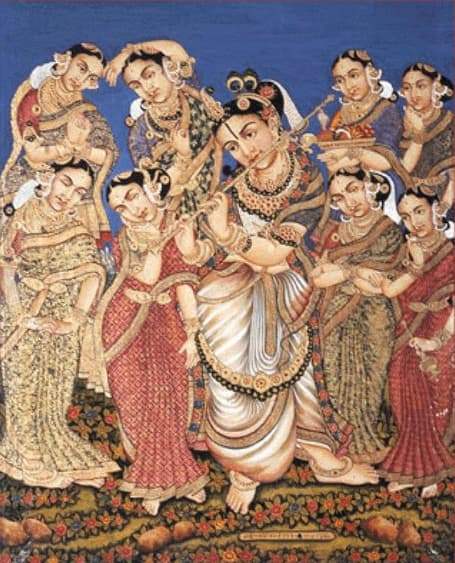
Ashtabharya
The Ashtabharya are the eight principal queen-consorts of the Hindu deity Krishna, who was the king of Dvaraka. These queens, often princesses, are revered as avatars of the goddess Lakshmi and play significant roles in various Hindu scriptures. They symbolize different aspects of Krishna's sovereignty and are central figures in narratives of his life and divine play.
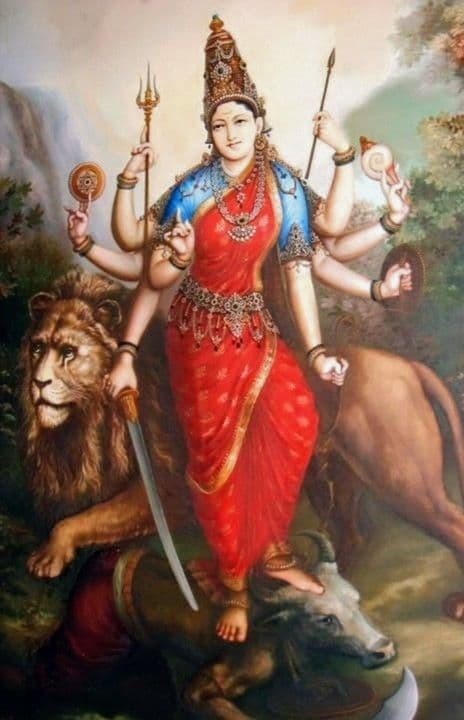
Durga
Durga is a prominent Hindu deity, widely worshipped in Shaktism as the principal aspect of Mahadevi, the Ultimate Reality. She is revered for her protective, motherly, and warrior attributes, symbolizing the triumph of good over evil. Legends often depict her battling demonic forces that threaten cosmic order, and she is a central figure in festivals like Durga Puja and Navaratri.