
Indrani
Indrani, also known as Shachi and Paulomi, is the queen of the devas and the consort of Indra, the king of the gods in Hinduism. Revered for her beauty and sensuality, she is also recognized as one of the Sapta Matrikas, or divine mothers. While rarely worshipped independently, she is an important goddess in Shaktism and is often venerated alongside Indra.
Key Facts
- ›Indrani is the queen of the devas and the wife of Indra.
- ›She is also known by the names Shachi and Paulomi.
- ›Indrani is considered one of the Sapta Matrikas, the seven divine mothers.
- ›She is an important goddess within the Shaktism tradition.
- ›Indrani is often worshipped alongside her husband, Indra.
- ›She is also acknowledged in Jainism and Buddhism with minor roles.

Shachi, Paulomi, Aindri, Devarani, Poulomuja, Shakrani, Mahendrani
Golden Complexion, Blue Garments, Two Arms, Embracing Indra, Holding A Santana-Manjari, Holding An Utpala Flower, Three Eyes, Four Arms, Holding A Vajra, Holding A Spear, Wearing A Kirita, One Thousand Eyes, Six Arms, Holding A Sutra, Holding A Pot, Holding A Vessel, Abhaya Mudra, Varada Mudra, Holding An Ankusha, Carrying A Lotus
Rigveda, Shatapatha Brahmana, Taittiriya Brahmana, Aitareya Brahmana, Ramayana, Mahabharata, Bhagavata Purana, Vishnu Purana, Devi Mahatmyam, Varaha Purana, Kanda Purana, Pali Canon
- Daughter of Puloman
- Wife of Indra
- Mother of Jayanta, Rishabha, Midhusha, Jayanti, Devasena
- Sister-In-Law of Shukra
Puja During Ashada Navratri
Amaravati
Jayanta, Rishabha, Midhusha, Jayanti, Devasena
Vajra
Lion, Vrishakapi
Queen, Goddess, Divine Mother
About Indrani
Indrani (Shachi)
Indrani, also widely known as Shachi and Paulomi, holds the esteemed position of queen of the devas (gods) in Hinduism. She is the divine consort of Indra, the king of the celestial realm. Renowned for her exquisite beauty, proud demeanor, and kind heart, Indrani is the daughter of the asura Puloman. Her significance extends to her role as one of the Sapta Matrikas, the seven divine mothers, and she is an important figure within Shaktism, a prominent sect of Hinduism.
Origins and Early Depictions
Indrani's name itself, Indrani, directly translates to 'wife of Indra,' highlighting her primary relationship. While some scholars suggest she may have originated solely as Indra's consort without a distinct natural myth, Vedic texts like the Rigveda present her as the "deification" of Indra's power. The term 'Shachi,' a prominent alternative name, can mean 'speech,' 'power of speech,' or 'eloquence,' and is associated with strength, hinting at the later concept of Shakti, the divine feminine power. Despite being mentioned more frequently than other Vedic goddess-consorts, she often remained overshadowed by her powerful husband in these early texts.
Epic and Puranic Narratives
In later Hindu literature, including the epics and Puranas, Indrani is more commonly referred to as Shachi. These texts detail her lineage as the daughter of the asura Puloman and her marriage to Indra. Her role is often highlighted in narratives that underscore her intelligence and virtue, particularly in stories where she outwits adversaries attempting to usurp her position or harm her family. A notable myth recounts how she cleverly orchestrated the downfall of the mortal king Nahusha, who attempted to seduce her during Indra's penance, ultimately restoring Indra to his throne.
Iconography and Worship
Sculptures of Indrani are frequently found alongside Indra in Hindu temples, often depicted seated on the white elephant Airavata. Iconographic descriptions vary, but she is typically portrayed as beautiful, sometimes with a golden complexion, adorned with ornaments, and holding symbols such as a flower or a goad. As one of the Matrikas, her iconography may include multiple arms and eyes, wielding weapons like the vajra. Indrani is seldom worshipped as an independent deity; her veneration is most often coupled with that of Indra, and they are sometimes considered the family deities of royal lineages. She is also acknowledged in Jainism and Buddhism, where she plays a minor but symbolic role.
Source: Wikipedia ↗
Frequently Asked Questions
Who is Indrani in Hinduism?
Indrani is the queen of the devas (gods) and the consort of Indra, the king of the gods. She is depicted as beautiful, proud, and kind. Her name, Indrani, means 'wife of Indra', and she is also widely known as Shachi.
What are Indrani's other names and epithets?
Besides Shachi and Paulomi, Indrani is also known as Aindri, Poulomuja, Devarani (queen of devas), Charudhara (beautiful), Shakrani (wife of Shakra), and Mahendrani (wife of Mahendra). These names often refer to her lineage or her relationship with Indra.
What is Indrani's significance in Shaktism?
In Shaktism, Indrani is recognized as one of the Sapta Matrikas, the seven divine mothers. She is sometimes identified with the energy or Shakti of Indra.
What are some notable stories involving Indrani?
A significant story involves Indrani cleverly deposing the mortal king Nahusha, who attempted to seduce her while Indra was in penance. Another tale describes her role in the abduction attempt by Anuhlada and her subsequent rescue by Indra.
How is Indrani depicted in iconography?
Iconographic descriptions vary, but she is often shown as beautiful, sometimes with golden complexion and blue garments. She may embrace Indra, hold a jewel-like flower or a goad, and her vehicle can be an elephant. As a Matrika, she might be depicted with three eyes and four arms, holding a vajra and a spear.
Is Indrani worshipped independently?
Indrani is rarely worshipped as an independent deity. She is most commonly venerated alongside her husband, Indra, and together they are considered family deities for some royal lineages.
Related Hindu deities

Kali
Kali is a prominent Hindu goddess associated with time, death, and destruction, but also with transcendental knowledge. She is considered the Divine Mother, the Mother of the Universe, and the Divine feminine energy, offering liberation to her devotees. Kali is a central figure in Tantric traditions and goddess-centric sects, and her terrifying iconography symbolizes her embrace of life's grim realities.
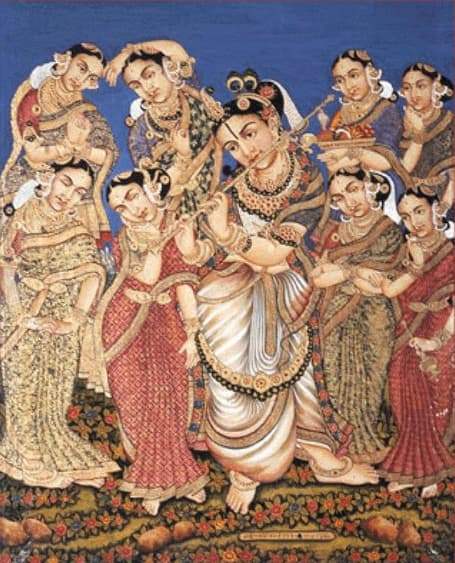
Ashtabharya
The Ashtabharya are the eight principal queen-consorts of the Hindu deity Krishna, who was the king of Dvaraka. These queens, often princesses, are revered as avatars of the goddess Lakshmi and play significant roles in various Hindu scriptures. They symbolize different aspects of Krishna's sovereignty and are central figures in narratives of his life and divine play.
Niladevi
Niladevi, also known as Nappinnai, is a Hindu goddess primarily revered in South India as one of Vishnu's consorts. Within the Sri Vaishnava tradition, she is considered an aspect of Lakshmi, alongside Sridevi and Bhudevi. She is particularly significant in Tamil culture as a favorite gopi of Krishna, whom Krishna won in marriage by subduing fierce bulls.