
Thriprayar Temple
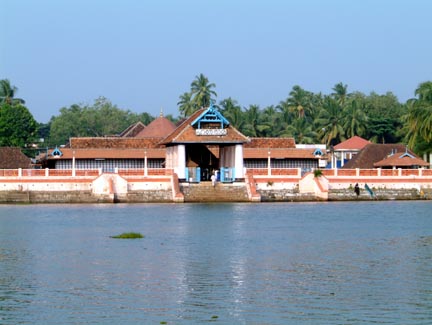
The Thriprayar Temple, also known as the Shree Ramaswami Temple, is a significant Hindu temple located in Triprayar, Thrissur district, Kerala, India. It is dedicated to Lord Rama, the seventh incarnation of Vishnu, who is depicted with four arms holding a conch, discus, bow, and garland. The temple's origin story involves the idol being worshipped by Krishna in Dwarka, later immersed in the sea, and eventually found by fishermen.
Key Facts
- ›The primary deity is Lord Rama, an avatar of Vishnu.
- ›The idol is believed to have been worshipped by Lord Krishna in Dwarka.
- ›The temple is situated on the banks of the 'Thirupurayar' river.
- ›It is one of the four Nalambalam temples dedicated to Rama and his brothers.
- ›Triprayar Ekadasi is a major festival celebrated in the month of Vrischikam.
- ›Offerings include Chathan Bhandaram, Kadhina Vedi, and Meenoottu.
Rama
Pilgrimage Site, Associated With Nalambalam Pilgrimage
Triprayar Ekadasi
Thirupurayar River
About Thriprayar Temple
The Thriprayar Temple, officially known as the Shree Ramaswami Temple, is a prominent Hindu temple situated in Triprayar, within the Thrissur district of Kerala, India. The temple's principal deity is Lord Rama, revered as the seventh incarnation of Vishnu. The idol depicts Rama with four arms, each holding a conch, a discus, a bow, and a garland.
Origin Story
Tradition holds that the Rama idol enshrined in the Thriprayar Temple was once worshipped by Lord Krishna in Dwarka. Following Krishna's ascension to heaven, the idol was immersed in the sea. Centuries later, it was discovered by fishermen while they were engaged in their livelihood.
Religious Significance and Festivals
The Thriprayar Temple is a key destination for devotees and holds significant religious importance, particularly in relation to the Nalambalam pilgrimage. This pilgrimage involves visiting four temples dedicated to Lord Rama and his three brothers: Thriprayar Temple (Rama), Koodalmanikyam Temple (Bharata), Thirumoozhikkulam Lakshmana Perumal Temple (Lakshmana), and Payammal Shatrughna Temple (Shatrughna). Completing this circuit on the first day of the Malayalam month of Karkadakam is considered highly auspicious.
A famous festival celebrated at the temple is the Triprayar Ekadasi. This event occurs on the 'Ekadasi' (the eleventh day after the full moon) in the Malayalam month of 'Vrischikam' (mid-November to mid-December). The festival is known for its grand processions with caparisoned elephants and orchestrations of traditional drums called 'Melam'. The festival's preference for the 'Karutha Paksha Ekadasi' (the dark fortnight's Ekadasi) is traditionally linked to the presence of spirits and Chathan alongside the deity.
Other Deities and Offerings
While Lord Rama is the presiding deity, the temple complex also accommodates shrines for other deities, including Lord Shiva as Dakshinamoorthy, Ganesha, Shastha, and Krishna. Devotees also venerate Hanuman, Karthikeya, Chathan, and serpent gods within the temple premises.
Prominent offerings at the Thriprayar Temple include 'Chathan Bhandaram,' intended to remove evil influences; 'Kadhina Vedi,' offered to commemorate Hanuman's successful search for Sita; and 'Meenoottu,' the act of feeding fish in the river, which is believed to have therapeutic benefits for asthma patients. Other popular offerings consist of milk payasam and Chandhanam Charthal.
Source: Wikipedia ↗
Frequently Asked Questions
What is the story behind the origin of the Thriprayar Temple idol?
According to tradition, the idol of Rama at Thriprayar was worshipped by Lord Krishna himself in Dwarka. After Krishna's ascension, the idol was immersed in the sea and later discovered by fishermen.
When is the Triprayar Ekadasi festival celebrated?
Triprayar Ekadasi is a significant festival in central Kerala, observed on the 'Ekadasi' (the 11th day after the full moon) during the Malayalam month of 'Vrischikam' (which falls between November 15 and December 15).
What are the main offerings at Thriprayar Temple?
Key offerings at the temple include 'Chathan Bhandaram' to ward off evil influences, 'Kadhina Vedi' to commemorate Hanuman's search for Sita, and 'Meenoottu' (feeding of fishes), which is believed to benefit asthma patients. Other offerings include milk payasam and Chandhanam Charthal.
What is the significance of the Nalambalam pilgrimage?
The Nalambalam refers to four Hindu temples dedicated to Lord Rama and his brothers. Undertaking a pilgrimage to these four temples on the first day of the Malayalam month of Karkadakam is considered auspicious.
Which other deities are worshipped at Thriprayar Temple?
Besides the presiding deity, Lord Rama, the temple complex also features shrines dedicated to Lord Shiva as Dakshinamoorthy, Ganesha, Shastha, and Krishna. Worship is also offered to Hanuman, Karthikeya, Chathan, and Serpent gods.
Related Temples (Hindu)

Taraknath Temple
The Taraknath Temple, located in Tarakeswar, West Bengal, India, is a significant Hindu pilgrimage site dedicated to Lord Shiva, worshiped here as Tarakanatha. Constructed in 1729, it features a distinct Bengal architectural style with an 'atchala' structure and an adjacent 'natmandir'. The temple is renowned for its belief that a dip in the nearby Dudhpukur tank fulfills prayers and is considered one of the 64 Jyotirlingas.

Tanot Mata Temple
The Tanot Mata Temple is a significant Hindu shrine located in the Jaisalmer district of Rajasthan, India, near the Pakistan border. Revered as a form of Goddess Hinglaj Mata, the temple is famously associated with the Indian victories in the Indo-Pakistani Wars of 1965 and 1971, with local folklore attributing the successful outcomes to divine intervention. The Border Security Force of India now manages the temple complex, which also includes a victory tower and a war museum.

Thanjai Mamani Koil
Thanjai Mamani Koil is a complex of three adjacent Hindu temples dedicated to Vishnu, located in Thanjavur, Tamil Nadu, India. Revered by the Alvars as one of the 108 Divya Desams, these temples are unique as they are collectively referenced in sacred hymns. The temples showcase architectural contributions from various dynasties, including the Medieval Cholas, Vijayanagara Empire, and Madurai Nayaks.