
Madan Mohan Temple
The Shri Radha Madan Mohan Ji Temple is a Hindu temple located in Karauli, Rajasthan, India, situated on the banks of the Bhadravati River. It is dedicated to Madan Mohan, a form of Lord Krishna, who is depicted alongside his consort Radha and Lalita.
Key Facts
- ›The temple is dedicated to Madan Mohan, a form of Lord Krishna.
- ›It is located in Karauli, Rajasthan, on the banks of the Bhadravati River.
- ›The temple houses icons of Krishna, Radha, and Lalita.
- ›It is considered one of the Char Dham of Karauli District.
- ›The temple is a mandatory visit for completing the Govardhan Yatra, alongside the Govind Dev Ji Temple.
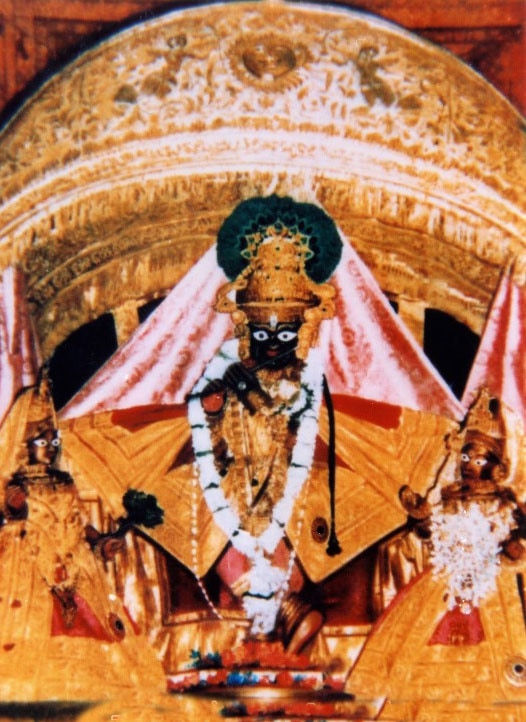
Madan Mohan, Radha, Lalita
Religious Pilgrimage, Safeguarding of Idols From Historical Threats
Krishna Janmashtami, Radhashtami, Gopashtami, Holi
King Gopal Singh
Bhadravati River
About Madan Mohan Temple
The Shri Radha Madan Mohan Ji Temple is a significant Hindu place of worship located in Karauli, within the Indian state of Rajasthan. The temple is strategically situated on the banks of the Bhadravati River, a tributary of the Banas River, nestled in the hills of the Aravali range. It falls within the broader Braj region, an area deeply associated with the life and legends of Lord Krishna.
Deity and Iconography
The temple is primarily dedicated to Madan Mohan, a revered form of Lord Krishna. The central altar of the temple prominently features the icon of Krishna, with the figures of his divine consort Radha and her companion Lalita standing on either side, representing a common devotional arrangement in Vaishnavism.
Historical Context and Construction
Historical accounts suggest that the temple's origin is linked to the preservation of deities during times of religious persecution. It is believed that King Gopal Singh of Karauli received divine instruction in a dream to relocate the Madan Mohan idol from Vrindavan to Rajasthan. This move was undertaken overnight to protect the idol from the anticipated attacks by Mughal emperor Aurangzeb on temples in Vrindavan. Following this, the king commissioned the construction of this temple in Karauli.
Further traditions mention that to safeguard Krishna idols from the Mughals, two idols were brought from Vrindavan, with one being placed in Karauli and the other in Jaipur. This historical narrative underscores the temple's role as a sanctuary for religious artifacts.
Pilgrimage Significance
The Madan Mohan Temple holds considerable importance within the local pilgrimage circuit. It is recognized as one of the four sacred sites comprising the Char Dham of Karauli District, alongside the Kaila Devi Temple, Mehandipur Balaji Temple, and Shri Mahavirji Temple. Moreover, it is considered a mandatory destination for devotees undertaking the Govardhan Yatra, with a visit to the Govind Dev Ji Temple also being essential to complete this pilgrimage.
Festivals and Observances
The temple attracts a large influx of devotees, particularly from across Rajasthan, during major Hindu festivals. Celebrations such as Krishna Janmashtami (Lord Krishna's birth anniversary), Radhashtami (Radha's birth anniversary), Gopashtami, and Holi are observed with great fervor. During these festivals, the temple premises are adorned with an abundance of flowers, enhancing the devotional atmosphere.
Unique Devotional Practice
A notable practice at the temple involves the offering of 'Jugal Prasad', a specific form of 'Bhog' (offering) that includes Laddu and Kachauri. This offering is made by a single devotee each day, and the demand for this opportunity is so high that the waiting list is reported to be approximately two years long, indicating the deep reverence and devotion associated with the deity.
Source: Wikipedia ↗
Frequently Asked Questions
Who is the primary deity worshipped at the Madan Mohan Temple?
The primary deity worshipped at the Madan Mohan Temple is Madan Mohan, a form of Lord Krishna. The central altar features Krishna flanked by the icons of his consort Radha and Lalita.
What is the historical significance of the Madan Mohan Temple?
The temple's history is tied to the protection of Krishna idols from Mughal emperor Aurangzeb. King Gopal Singh of Karauli was instructed in a dream to move the Madan Mohan idol from Vrindavan to Karauli to safeguard it, leading to the temple's construction.
Why is visiting the Madan Mohan Temple considered important for the Govardhan Yatra?
It is believed that to complete the Govardhan Yatra, a visit to both the Madan Mohan Temple in Karauli and the Govind Dev Ji Temple is mandatory. This highlights the temple's significance within regional pilgrimage circuits.
What are the major festivals celebrated at the Madan Mohan Temple?
The temple witnesses large numbers of devotees during festivals such as Krishna Janmashtami, Radhashtami, Gopashtami, and Holi. The premises are elaborately decorated with flowers for these important occasions.
What unique offering practice is observed at the temple?
Devotees offer 'Jugal Prasad', a type of Bhog consisting of Laddu and Kachauri. This offering is made once a day by a single person, and the queue for this privilege is reportedly around two years long.
Related Temples (Hindu)

Taraknath Temple
The Taraknath Temple, located in Tarakeswar, West Bengal, India, is a significant Hindu pilgrimage site dedicated to Lord Shiva, worshiped here as Tarakanatha. Constructed in 1729, it features a distinct Bengal architectural style with an 'atchala' structure and an adjacent 'natmandir'. The temple is renowned for its belief that a dip in the nearby Dudhpukur tank fulfills prayers and is considered one of the 64 Jyotirlingas.

Tanot Mata Temple
The Tanot Mata Temple is a significant Hindu shrine located in the Jaisalmer district of Rajasthan, India, near the Pakistan border. Revered as a form of Goddess Hinglaj Mata, the temple is famously associated with the Indian victories in the Indo-Pakistani Wars of 1965 and 1971, with local folklore attributing the successful outcomes to divine intervention. The Border Security Force of India now manages the temple complex, which also includes a victory tower and a war museum.
Thriprayar Temple
The Thriprayar Temple, also known as the Shree Ramaswami Temple, is a significant Hindu temple located in Triprayar, Thrissur district, Kerala, India. It is dedicated to Lord Rama, the seventh incarnation of Vishnu, who is depicted with four arms holding a conch, discus, bow, and garland. The temple's origin story involves the idol being worshipped by Krishna in Dwarka, later immersed in the sea, and eventually found by fishermen.