
Govind Dev Ji Temple
The Govind Dev Ji Temple in Jaipur, Rajasthan, India, is a significant Hindu temple dedicated to Radha and Krishna. Established in the 18th century by Maharaja Jai Singh II, it houses idols traditionally believed to be created by Krishna's great-grandson, Bajranabh. The temple is renowned for its historical importance, including being the site where Baladeva Vidyabhushana composed a key commentary on the Brahma Sutras, and for its modern architectural achievement in its pillarless Satsang Hall, which holds a Guinness World Record.
Key Facts
- ›Dedicated to Radha and Krishna, with idols traditionally attributed to Krishna's great-grandson, Bajranabh.
- ›Established in the 18th century by Maharaja Jai Singh II of Jaipur.
- ›Houses the idol of Govind Dev Ji, one of three images of Krishna created by Bajranabh.
- ›The Satsang Hall holds the Guinness World Record for the world's widest concrete building.
- ›Baladeva Vidyabhushana composed the Govinda Bhashya, a commentary on the Brahma Sutras, at this temple.
- ›The temple celebrates major Hindu festivals like Janmashtami, Radhashtami, and Holi.
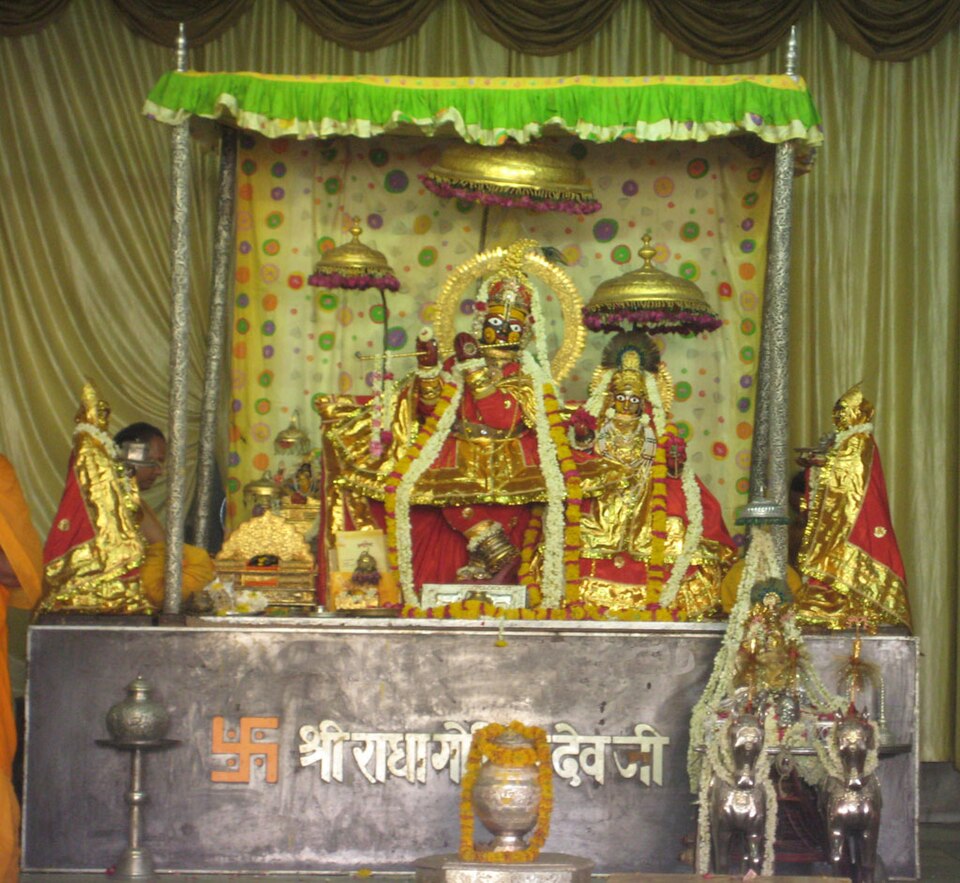
Radha, Krishna
Religious Pilgrimage Site, Site of Philosophical Composition, Architectural Marvel
Kachwaha Dynasty
Janmashtami, Radhashtami, Gopashtami, Holi
Red Sandstone
Maharaja Jai Singh Ii
About Govind Dev Ji Temple
The Govind Dev Ji Temple, located within the City Palace complex in Jaipur, Rajasthan, India, is a prominent Hindu temple dedicated to the deities Radha and Krishna. Established in the 18th century by Maharaja Jai Singh II, the visionary founder of Jaipur, the temple's idols were brought from Vrindavan. The primary deity worshipped is Govind Dev Ji, an image traditionally believed to have been created by Bajranabh, the great-grandson of Lord Krishna. This deity is complemented by the worship of Radha, forming the central devotional focus of the temple.
Historical and Spiritual Significance
The temple holds considerable historical and spiritual importance. It is renowned as the site where Baladeva Vidyabhushana, a significant philosopher of the Gaudiya Vaishnavism tradition, composed the Govinda Bhashya. This influential commentary on the Brahma Sutras was reportedly inspired by a divine dream in which the deity Govind Dev Ji himself provided guidance. The original idols were once housed in a grand 7-storeyed temple in Vrindavan, built by Mansingh I of Amber and consecrated in 1570 with red sandstone donated by Mughal Emperor Akbar. However, following the sacking of Vrindavan on Aurangzeb's orders in 1670, the icons were relocated to their present sanctuary in Jaipur.
Architectural Achievements
Beyond its spiritual heritage, the Govind Dev Ji Temple is also recognized for its modern architectural innovation. The temple's Satsang Hall is the holder of a Guinness World Record for being the world's widest concrete building. This impressive pillarless hall, designed by N M Roof Designers (NMRD) Ltd, features a reinforced concrete cement (RCC) flat roof with a single span of 119 feet. Its expansive 15,800 square feet area can accommodate up to 5,000 devotees and utilizes a grid or waffle slab design to support the vast roof structure. This architectural feat was officially recognized by Guinness World Records in 2009.
Worship and Festivals
The temple actively engages in daily worship, observing seven aartis (ritualistic prayers) and offering bhog (food offerings) to the deities throughout the day. Devotees visit regularly for darshan, the auspicious sight of the deities. The Govind Dev Ji Temple is a focal point for the celebration of major Hindu festivals, including Janmashtami (commemorating Krishna's birth), Radhashtami (celebrating Radha's birth), Gopashtami, and Holi. These occasions draw large numbers of devotees for special prayers and ceremonies.
Source: Wikipedia ↗
Frequently Asked Questions
What is the legend behind the idols at Govind Dev Ji Temple?
According to legend, the idol of Govind Dev Ji was created by Bajranabh, the great-grandson of Krishna. Bajranabh is said to have created three images of Krishna representing his feet, chest, and face, which are known as Lord Madan Mohan Ji, Gopinath Ji, and Govind Dev Ji respectively. These icons were later rediscovered by Rupa Goswami.
What is the historical significance of the Govind Dev Ji Temple?
The temple is historically significant as the location where Baladeva Vidyabhushana, a philosopher of Gaudiya Vaishnavism, composed the Govinda Bhashya, a commentary on the Brahma Sutras. This composition was done after receiving guidance in a dream from the deity Govind Dev Ji.
What is the architectural distinction of the temple's Satsang Hall?
The temple's Satsang Hall holds the Guinness World Record for being the world's widest concrete building. It features a reinforced concrete cement (RCC) flat roof with a single span of 119 feet, creating a large, pillarless space designed with a grid or waffle slab.
What are the daily rituals observed at Govind Dev Ji Temple?
The temple conducts daily rituals that include seven aartis (ritualistic prayers) and bhog offerings to the deities. Devotees regularly visit to receive darshan (sight of the deity) at specific times throughout the day.
When were the idols originally housed before being moved to Jaipur?
The idols were originally enshrined at a large, 7-storeyed temple in Vrindavan, which was constructed by Mansingh I of Amber. This temple was consecrated in 1570, with red sandstone donated by Mughal Emperor Akbar.
Why were the idols moved from Vrindavan to Jaipur?
The idols were removed from Vrindavan to their current location in Jaipur in 1670. This relocation occurred when Vrindavan was sacked on the orders of Aurangzeb, necessitating the transfer of the sacred icons to a safer place.
Related Temples (Hindu)

Taraknath Temple
The Taraknath Temple, located in Tarakeswar, West Bengal, India, is a significant Hindu pilgrimage site dedicated to Lord Shiva, worshiped here as Tarakanatha. Constructed in 1729, it features a distinct Bengal architectural style with an 'atchala' structure and an adjacent 'natmandir'. The temple is renowned for its belief that a dip in the nearby Dudhpukur tank fulfills prayers and is considered one of the 64 Jyotirlingas.

Ugratara Devalaya
Ugratara Devalaya is a significant Shakti shrine located in Guwahati, Assam, India, dedicated to the goddess Ugratara. Legend connects the temple to the navel of Sati, and it is noted for its unique representation of the deity as a water-filled pit rather than an idol.

Tara Devi Temple
Tara Devi Temple is a prominent Hindu religious site located at an altitude of 7200 feet above sea level near Shimla, India. The temple is dedicated to Goddess Tara Devi and is believed to grant blessings and fulfill the wishes of devotees who visit with unwavering faith. It is a popular destination, drawing thousands of visitors, especially on weekends.