
Sakya Monastery
Tibetan Buddhism·China·Active (with renovations)·11th century
Sakya Monastery, also known as Pel Sakya, is a significant Buddhist monastery and the historical seat of the Sakya school of Tibetan Buddhism. Founded in 1073, it played a crucial role in governing Tibet during the 13th and 14th centuries. While the original northern monastery was largely destroyed during the Cultural Revolution, and the southern monastery suffered destruction in the 16th century, it has undergone renovations and rebuilding, preserving its rich collection of art and scriptures.
Key Facts
- ›Founded in 1073 by Khön Könchok Gyalpo.
- ›Served as the seat of the Sakya school of Tibetan Buddhism.
- ›Its powerful abbots governed Tibet in the 13th and 14th centuries.
- ›Houses a vast library with up to 84,000 books, including ancient scriptures.
- ›Features over 3,000 murals depicting religious and historical themes.
- ›A branch of the monastery was reestablished in India in 1959.

Tibetan
Vast Library of 84,000 Books, Collection of Over 3,000 Murals, Ancient Porcelain Pieces, Preservation of Important Buddhist Scriptures, A Conch Shell Presented By Kublai Khan
Pel Sakya, White Earth Monastery
KhöN KöNchok Gyalpo, DrogöN ChöGyal Phagpa, Sakya Sangpo, Kublai Khan, Ngawang Kunga, Kyabgon Sakya Gongma Trichen Rinpoche, Ratna Vajra Rinpoche
- Founding of the Monastery
- Construction of the Southern Monastery Under DrogöN ChöGyal Phagpa
- Eclipsed By Kagyu and Gelug Schools
- Destruction of Most of the Southern Monastery
- 1959 Lhasa Uprising and Departure of Monks
- Destruction of the Northern Monastery During the Cultural Revolution
- Renovation and Rebuilding of the Monastery
- Digitization of the Library
About Sakya Monastery
Sakya Monastery, also known by its Tibetan name Pel Sakya, meaning "White Earth" or "Pale Earth," is a historically and religiously significant Buddhist monastery located in Sa'gya Town, within the Tibet Autonomous Region of China. Established in 1073 by Khön Könchok Gyalpo, it became the primary seat of the Sakya school, a prominent lineage within Tibetan Buddhism. The monastery's powerful abbots played a crucial role in the governance of Tibet during the 13th and 14th centuries, particularly under the patronage of Yuan China.
History and Architecture
The original structures of Sakya Monastery were founded in 1073. A "southern monastery" was later established in 1268 under the direction of Drogön Chögyal Phagpa, requiring a substantial workforce for its construction. While the powerful abbots of Sakya governed Tibet for a period, their influence waned with the rise of other Buddhist schools. The monastery has endured significant destruction throughout its history; most of the southern complex was lost to fire in the 16th century and only fully restored in 1948. The northern monastery was destroyed during the Cultural Revolution, though the southern half was spared. The monastery underwent renovation and rebuilding in 2002.
The architecture of Sakya Monastery is distinct from that found in Lhasa and the Yarlung Valley. The Lhakang Chempo, also known as Sibgon Trulpa, is the sole surviving ancient building, originally a cave that was expanded and restored. This structure houses some of Tibet's most magnificent surviving artwork that appears to have been preserved from recent damage.
Library and Art Collections
Sakya Monastery is renowned for its vast library, said to contain as many as 84,000 books. These works cover a wide range of subjects, including Buddhist scriptures, literature, history, philosophy, astronomy, and art. Notably, the library houses some of the heaviest books in the world, with one scripture weighing over 500 kilograms. The collection also includes many well-preserved palm-leaf manuscripts, benefiting from the region's arid climate.
Beyond its literary treasures, the monastery boasts an impressive collection of over 3,000 murals. These artworks depict religious narratives, historical events, and cultural themes, offering valuable visual records of scenes such as Phagpa's meeting with Kublai Khan. The main library hall features a 66-meter-long mural illustrating the life of Gautama Buddha. The hall also contains over 1,100 pieces of porcelain dating from the Yuan dynasty to the early 14th century.
Modern Era and Indian Branch
Following the 1959 Lhasa uprising and the subsequent Chinese invasion of Tibet, the majority of monks were compelled to leave Sakya Monastery, with only a small number of aged monks remaining by the end of 1959. The 41st Sakya Trizin, Ngawang Kunga, went into exile in India, where he reestablished Sakya Monastery in Dehra Dun. This Indian branch continues to preserve Sakya traditions, supported by senior monks and scholars who escaped Tibet. The monastery in India has established various institutions, including a monastic college and a nunnery, and continues its religious and educational programs under the guidance of successive Sakya Trizins.
Source: Wikipedia ↗
Frequently Asked Questions
When was Sakya Monastery founded?
Sakya Monastery was founded in 1073 by Khön Könchok Gyalpo.
What is the significance of Sakya Monastery?
It is considered the seat of the Sakya school of Tibetan Buddhism and its abbots governed Tibet for a period. The monastery is also renowned for its extensive library and ancient artwork.
What happened to Sakya Monastery during the Cultural Revolution?
The northern monastery was destroyed during the Cultural Revolution, although the southern half largely escaped destruction. Many monks were also forced to leave.
What kind of art is found at Sakya Monastery?
The monastery contains over 3,000 murals depicting religious, historical, and cultural themes, including scenes of meetings between historical figures and the monastery's founding. There are also valuable porcelain pieces.
Does Sakya Monastery have a large library?
Yes, Sakya Monastery houses a huge library with as many as 84,000 books, including Buddhist scriptures, literature, history, and philosophy. One scripture is noted as the heaviest in the world.
Is there a Sakya Monastery in India?
Yes, following the Chinese invasion of Tibet, the 41st Sakya Trizin went into exile in India and reestablished Sakya Monastery in Dehra Dun, where it continues to maintain Sakya traditions.
Related Monasteries

Gonchen Monastery
Gonchen Monastery, also known as Derge Monastery, is a significant Sakya Tibetan Buddhist monastery situated in the town of Derge, within the Kham region of Sichuan, China. Founded by the renowned polymath Thang Tong Gyalpo, it is recognized for its unique architectural design and its association with the historic Derge Parkhang printing house, which continues to produce Buddhist scriptures using traditional methods. Though largely destroyed during the Cultural Revolution, the monastery was restored in the 1980s and remains a vital center for Tibetan Buddhism.
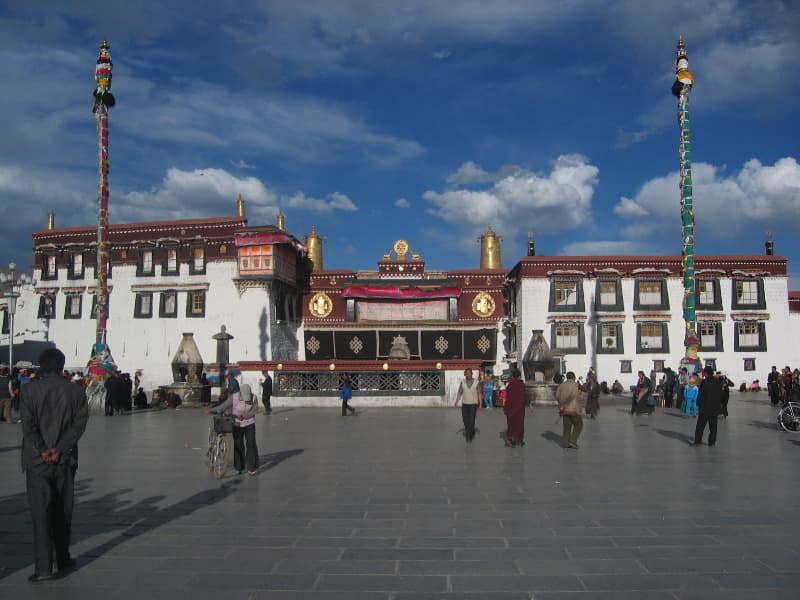
Jokhang Temple
The Jokhang Temple, also known as Rasa Trulnang or Zuglagkang, is a Tibetan Buddhist temple complex and monastery in Lhasa, considered the spiritual heart of the city. Constructed around 640 CE by King Songsten Gampo, it was built to house the Jowo Mikyo Dorje statue. Over centuries, it has undergone expansions and renovations, most notably by the Fifth Dalai Lama in 1610, and was designated a UNESCO World Heritage Site in 2000 as an extension of the Potala Palace.
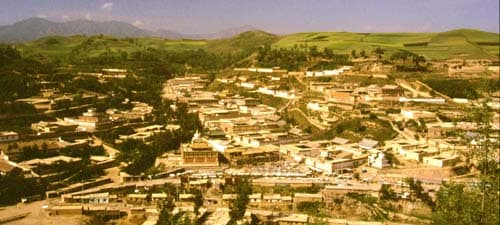
Kumbum Monastery
Kumbum Monastery, also known as Ta'er Temple, is a significant Tibetan Buddhist monastery founded in 1583 in Lusar, Qinghai, China. It holds a prominent place in Tibetan Buddhism, second only to Lhasa's Drepung Monastery. The monastery is renowned for its origins tied to Je Tsongkhapa, the founder of the Gelug school, and the miraculous "Tree of Great Merit" that grew from his birthplace.