
Panfield Priory
Panfield Priory was a small Augustinian priory located in Panfield, Essex, England. Founded in the late 11th century by Waleran Fitz Ranulph, it operated as an "alien house" dependent on St. Etienne Abbey in Caen. The priory was dissolved in the early 15th century, with its property eventually granted to Sir Giles Caple following the Dissolution of the Monasteries.
Key Facts
- ›Founded between 1069 and 1070 by Waleran Fitz Ranulph.
- ›Belonged to the Augustinian Canons Regular.
- ›Was an "alien house" subordinate to St. Etienne Abbey in Caen.
- ›Dissolved in 1413.
- ›Traces of its foundations have been found north of Great Priory Farm.
- ›The property was granted to Sir Giles Caple in 1538-39.

- Foundations Located North of Great Priory Farm
Waleran Fitz Ranulph
Foundation of the Priory, Dissolution of the Priory, Grant To Christchurch, Canterbury, Grant To Sir Giles Caple
About Panfield Priory
Panfield Priory was a religious institution situated in Panfield, Essex, England, belonging to the Augustinian Canons Regular. Its establishment dates to the late 11th century, specifically between 1069 and 1070, with Waleran Fitz Ranulph credited as its founder. The priory operated as a small "alien house," meaning it was dependent on a larger abbey located abroad, in this case, St. Etienne Abbey in Caen, France.
Historical Context
The priory maintained a modest community, consisting of only a few monks. Its existence as an alien house meant its resources and governance were tied to its continental parent institution. This status often made such priories vulnerable during periods of conflict between England and France.
Dissolution and Later History
Panfield Priory was dissolved in 1413. Following its dissolution, the property underwent several transfers. In 1472, it was granted to Christchurch, Canterbury. Much later, as part of the broader Dissolution of the Monasteries, the property was granted to Sir Giles Caple in 1538–39.
Archaeological Traces
Today, no structures from Panfield Priory remain visible above ground. Archaeological investigations have located traces of its foundations in a field situated north of Great Priory Farm, marking the site of this former monastic establishment.
Source: Wikipedia ↗
Frequently Asked Questions
When was Panfield Priory founded?
Panfield Priory was founded between 1069 and 1070. The exact year is noted with a slight range in historical records.
What religious order did Panfield Priory belong to?
Panfield Priory was a priory of Augustinian Canons Regular. This order followed the Rule of Saint Augustine.
What happened to Panfield Priory after its dissolution?
After its dissolution in 1413, Panfield Priory's property was granted to Christchurch, Canterbury in 1472. Later, in 1538-39, it was granted to Sir Giles Caple.
Can you still see Panfield Priory today?
No, nothing of Panfield Priory can be seen above ground today. Traces of its foundations were located in a field north of Great Priory Farm.
Related Monasteries
Binham Priory
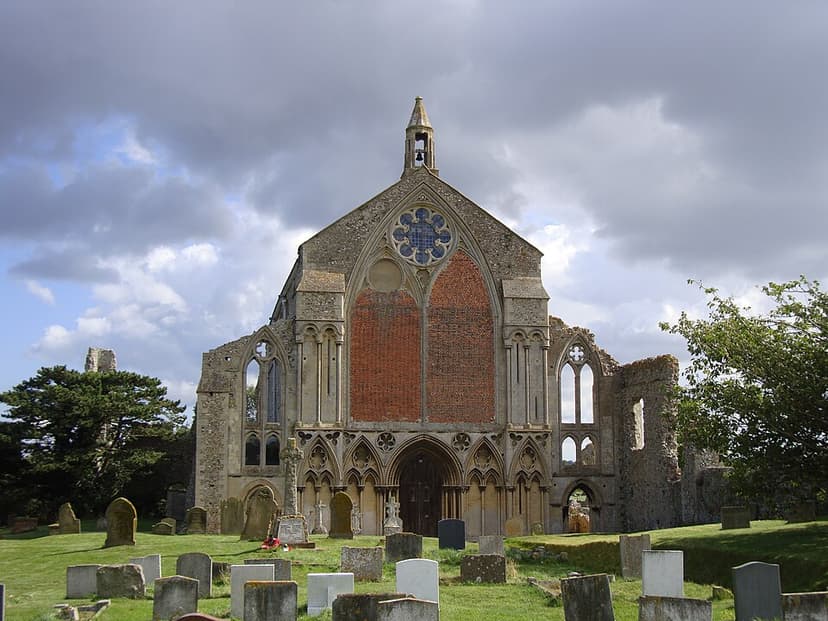
Binham Priory, officially St Mary's Priory, Binham, was a ruined Benedictine priory in Norfolk, England, founded in 1091. Its history is marked by scandal and unscrupulous priors, culminating in its dissolution and partial destruction in 1539. The surviving nave of its priory church continues to serve as the parish church of St. Mary and the Holy Cross.

Chatteris Abbey
Chatteris Abbey was a Benedictine monastery for nuns founded in 1016 by Eadnoth, Bishop of Dorchester. Despite surviving an early fire and the initial wave of monastic dissolutions, it was ultimately surrendered to the King's commissioners in 1538 and demolished. While a portion of its cloister buildings was incorporated into a later mansion, the abbey site has largely vanished, with only a few wall fragments remaining.

Derby Priory (Cluniac)
St. James Priory, also known as Derby Cluniac Priory, was a Benedictine monastery established between 1072 and 1076. Situated in Derby City Centre, it developed from a Saxon-era chapel and was later associated with the Cluniac order. The priory served as a hospital for the poor and unwell in the 13th century and experienced periods of financial difficulty and rebuilding after a fire in 1335. It ceased to exist during the Dissolution of the Monasteries.