
France
France, officially the French Republic, is a country in Western Europe with a rich and complex history spanning millennia, from its Iron Age Celtic settlement to its role as a global power. It has been shaped by Roman influence, the Frankish kingdoms, feudalism, and periods of significant revolution and empire. France is renowned for its cultural contributions, scientific advancements, and its prominent position in international affairs.
Key Facts
- ›France's name originates from the Latin 'Francia,' meaning 'realm of the Franks.'
- ›The country was a significant part of the Roman Empire, developing a distinct Gallo-Roman culture.
- ›The Franks established the Kingdom of Francia, which evolved into modern France.
- ›France was a major participant in the Crusades, with Arabs referring to crusaders as 'Franj.'
- ›The French Revolution of 1789 was a pivotal event that overthrew the Ancien Régime and introduced principles of liberal democracy.
- ›France is a developed country with a high per capita income and ranks among the world's largest economies.

Unesco World Heritage Sites, French Colonial Empire, Palace of Versailles
French Republic, Francia
Clovis I, Charles Martel, Pepin the Short, Charlemagne, Hugh Capet, Joan of Arc, Henri Iv, Cardinal Richelieu, Louis Xiv, Louis Xv, Louis Xvi, Napoleon Bonaparte, Charles De Gaulle
Roman Annexation of Gaul, Battle of the Allia, Julius Caesar's Conquest of Gaul, Baptism of Clovis I, Battle of Tours, Treaty of Verdun, Viking Raids, Coronation of Hugh Capet, Albigensian Crusade, Battle of Bouvines, Hundred Years' War, Black Death, French Renaissance, French Wars of Religion, Edict of Nantes, Thirty Years' War, the Fronde, Revocation of the Edict of Nantes, Seven Years' War, French Revolution, Napoleonic Wars, Battle of Waterloo, July Revolution, French Revolution of 1848, Franco-Prussian War, World War I, World War Ii, Algerian War
About France
France, officially the French Republic, is a nation located primarily in Western Europe with a history stretching back to the Iron Age when it was settled by Celtic tribes known as Gauls.
Early History and Roman Influence
Following Roman annexation in 51 BC, Gaul developed a distinct Gallo-Roman culture. In the early Middle Ages, the Franks formed the Kingdom of Francia, which became the heartland of the Carolingian Empire. The Treaty of Verdun in 843 AD partitioned this empire, with West Francia eventually evolving into the Kingdom of France. Throughout the 9th and 10th centuries, Viking raids contributed to the fragmentation of West Francia into a decentralized feudal society.
Medieval and Early Modern Eras
The Capetian dynasty, beginning in 987 AD, worked to unify the country, with rulers eventually being referred to as 'kings of France.' French knights played a significant role in the Crusades, to the extent that Arabs called crusaders 'Franj.' By the 15th century, royal authority had become more assertive. The French Renaissance saw cultural flourishing and the standardization of the French language. France became a rival to the House of Habsburg, leading to numerous conflicts and the expansion of its colonial empire. The period was also marked by internal religious strife, including the French Wars of Religion.
Revolutions and Empires
The French Revolution of 1789 was a transformative period that overthrew the Ancien Régime and introduced principles of liberal democracy. France reached its political and military zenith under Napoleon Bonaparte in the early 19th century, establishing the First French Empire and subjugating much of continental Europe. Following Napoleon's eventual defeat, France experienced periods of restoration, republic, and empire, including the French Second Republic and the Second French Empire. The Franco-Prussian War in 1870 led to the establishment of the French Third Republic.
Modern France
France was a major participant in both World War I and World War II. Following liberation in 1944, the Fourth Republic was established, which was later dissolved over the course of the Algerian War. The current Fifth Republic was formed in 1958. France retains its status as a global centre of art, science, cuisine, and philosophy, and is a developed country with a significant global economic and political influence, holding a permanent seat on the United Nations Security Council.
Source: Wikipedia ↗
Frequently Asked Questions
What is the origin of the name 'France'?
The name 'France' comes from the Latin word 'Francia,' which means 'realm of the Franks.' This name refers to the Germanic tribe that settled in the region after the decline of the Roman Empire.
When did France become a unified country?
While the area that is now France was unified under various rulers throughout history, the Kingdom of France evolved from West Francia after the partition of the Carolingian Empire in 843 AD. The Capetian dynasty, starting in 987 AD, further unified the country through wars and inheritance.
What were the major periods of conflict in French history?
Key conflicts include the Gallic Wars against Rome, the Hundred Years' War with England, the French Wars of Religion between Catholics and Huguenots, the Napoleonic Wars, and the World Wars. The French Revolution also involved significant internal conflict and external wars.
What is France known for culturally?
France has long been a global centre for art, science, cuisine, and philosophy. Its cultural influence is evident in its literature, fashion, cinema, and architecture, and it hosts a significant number of UNESCO World Heritage Sites.
What is the current political system of France?
The current political system is the Fifth Republic, established in 1958 by Charles de Gaulle. It is characterized as a semi-presidential system.
Related Monasteries

Avignon
Avignon, also known as 'La Cité des Papes' (The City of the Popes), is a historic city in southern France renowned for its papal history and well-preserved medieval architecture. Between 1309 and 1377, it served as the residence for seven successive popes, significantly shaping its urban development and cultural landscape. The city's historic center, including the Palais des Papes and its ramparts, is a UNESCO World Heritage Site, drawing millions of visitors annually for its architectural grandeur and vibrant arts scene, particularly the annual Festival d'Avignon.
Bourges
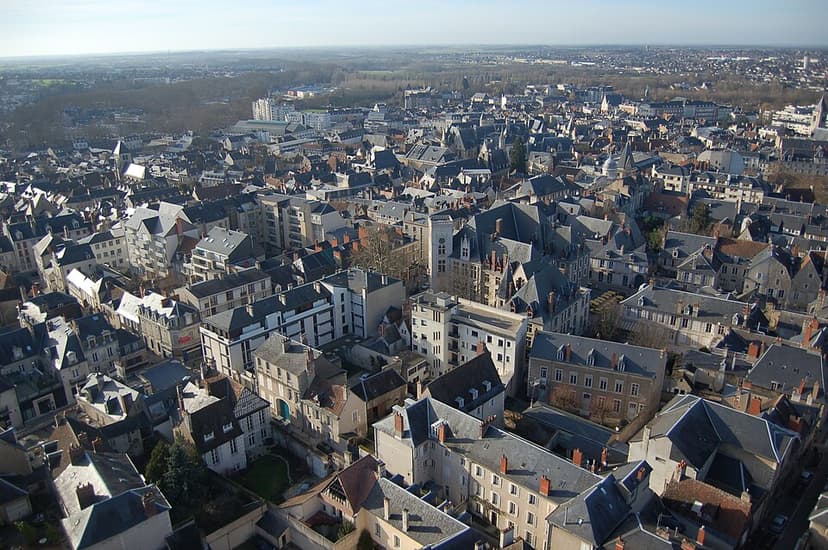
Bourges is a historic commune in central France, serving as the capital of the Cher department and the former province of Berry. Its origins trace back to the Gallic confederacy, enduring sieges and reconstructions by Romans and Franks. Throughout the Middle Ages and Renaissance, it served as a significant administrative and cultural center, notably as a refuge for Charles VII and a hub for alchemy. Today, Bourges is recognized for its stunning Gothic cathedral, a UNESCO World Heritage site, and its rich architectural heritage.

Châlons-sur-Marne
Châlons-en-Champagne, formerly known as Châlons-sur-Marne, is a city in the Grand Est region of France with a rich historical background, dating back to Gallic and Gallo-Roman settlements. It is historically significant as a conjectured site for major battles, including those involving Roman emperors and Attila the Hun. The city boasts notable architectural landmarks, including cathedrals and churches, with some parts recognized as UNESCO World Heritage.