
L'Étanche Abbey
L'Étanche Abbey was a Premonstratensian monastery founded in the 12th century near Deuxnouds-aux-Bois, France. Despite destruction during the Thirty Years' War and subsequent rebuilding, its ruins and chapel, classified as Monuments historiques, are undergoing repair efforts. The abbey was known for notable abbots who contributed to fields like chemistry, heraldry, and literature, and possessed a prestigious library.
Key Facts
- ›Founded around 1144 near Deuxnouds-aux-Bois, Meuse, France.
- ›Originally a Premonstratensian monastery.
- ›The abbey church was consecrated in 1147.
- ›Structures were destroyed by Swedes in 1632 and rebuilt starting in 1743.
- ›The chapel was completed in 1770.
- ›Ruins and chapel classified as Monuments historiques since 1984.

Ruins of Abbey Church, Ruins of Monastic Buildings, Chapel, Prestigious Library
Notre-Dame De L'éTanche
Philippe, AlbéRon De Chiny, Bertrand Le Loup, Albert, Dom Dominique Callot, Dom Edmont Maclot, Dom Jean FrançOis Joseph Boucart
- Destruction By Swedes During the Thirty Years' War
About L'Étanche Abbey
L'Étanche Abbey, also known as Notre-Dame de l'Étanche, was a former Premonstratensian monastery established in the 12th century. Situated in a secluded valley then called Faverolles, near the modern village of Deuxnouds-aux-Bois in the Meuse department of France, its foundation is attributed to Philippe, abbot of Belval, around 1144. The initial patrons included Albéron de Chiny, bishop of Verdun, and local seigneurs Bertrand le Loup and his nephew Albert, on whose lands the community was settled. The abbey church received consecration in 1147, and the earliest surviving charter dates from 1157.
History and Reconstruction
The abbey's early history included a nearby Premonstratensian convent that was eventually dissolved. L'Étanche Abbey also maintained a priory at Benoîte-Vaux, a significant pilgrimage site in Lorraine. A devastating event occurred in 1632 when Swedish forces utterly destroyed the abbey structures during the Thirty Years' War. Reconstruction efforts began much later, in 1743, resulting in new monastic cells and a chapel that was completed in 1770.
Notable Abbots and Legacy
Several abbots of L'Étanche left their mark. Dom Dominique Callot was noted for his studies in chemistry and heraldry. Dom Edmont Maclot was an author of devotional works. Perhaps most significantly, Dom Jean François Joseph Boucart assembled a collection of medals and a prestigious library, though this collection has since been dispersed. The chapel and monastic buildings, now in ruins, were classified as Monuments historiques in 1984, and in 2017, the Fondation du Patrimoine launched a subscription campaign to fund emergency repairs for the site.
Source: Wikipedia ↗
Frequently Asked Questions
When was L'Étanche Abbey founded?
L'Étanche Abbey was founded in about 1144. Its abbey church was consecrated a few years later, in 1147.
What religious order was L'Étanche Abbey a part of?
L'Étanche Abbey was a Premonstratensian monastery. It also possessed a priory at Benoîte-Vaux, which was a noted place of pilgrimage.
What is the current status of L'Étanche Abbey?
The abbey church and monastic buildings are now in ruins. They have been classified as Monuments historiques since 1984, and efforts are underway to fund emergency repairs.
Were there any notable figures associated with L'Étanche Abbey?
Yes, three abbots of L'Étanche Abbey were noted for their contributions. Dom Dominique Callot studied chemistry and heraldry, Dom Edmont Maclot authored pious works, and Dom Jean François Joseph Boucart amassed a significant collection of medals and a prestigious library.
Has L'Étanche Abbey suffered destruction?
Yes, the structures of L'Étanche Abbey were utterly destroyed by the Swedes in 1632 during the Thirty Years' War. They were not rebuilt until 1743.
Related Monasteries

Valsery Abbey
Valsery Abbey was a former Premonstratensian abbey founded in 1124 near the Forest of Retz in Aisne, France. Though suppressed during the Revolution, its remaining structures were further ruined during World War I. Today, the site is undergoing restoration by an association and is open to visitors, with the chapter house being a focal point.
Dryburgh Abbey
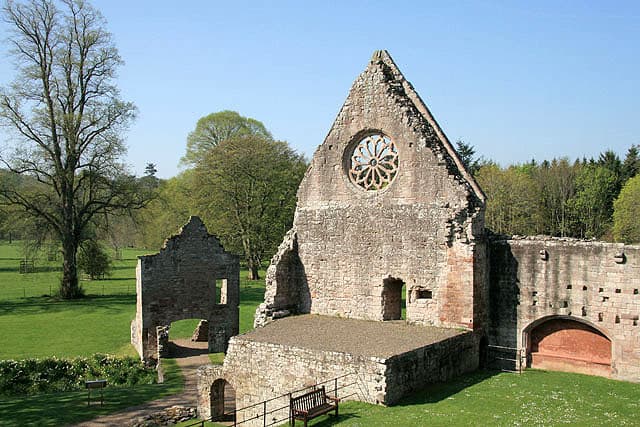
Dryburgh Abbey, situated near the River Tweed in the Scottish Borders, was founded in 1150 by Premonstratensian canons. Despite significant destruction from English raids in the 14th and 16th centuries, the abbey experienced periods of restoration and flourished in the 15th century. Today, it stands as a designated scheduled monument, with its grounds serving as the final resting place for notable figures like Sir Walter Scott and Douglas Haig.
Egglestone Abbey
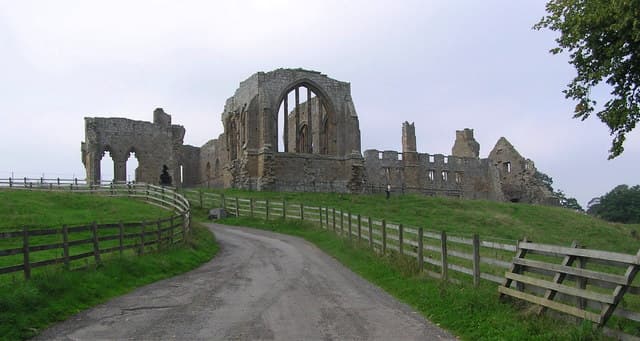
Egglestone Abbey is a ruined Premonstratensian abbey located in County Durham, England, southeast of Barnard Castle on the south bank of the River Tees. Founded between 1168 and 1198 by the Premonstratensians, known as the White Canons, the abbey was noted for its austerity and pastoral work in the region. Despite facing difficulties, including damage from Scottish invaders and the English army, it was dissolved in 1540 and has since fallen into ruin, with parts of its stonework repurposed.