
Le Thoronet Abbey
Le Thoronet Abbey is a former Cistercian monastery constructed in the late 12th and early 13th centuries, renowned as one of the best examples of the Cistercian order's architectural spirit. Located in the Var Department of Provence, France, it is one of the "Three Sisters of Provence" along with Sénanque and Silvacane abbeys. Restored as a museum, its austere design emphasizes volume, light, and fine masonry, with the church's acoustics even dictating the pace of monastic chant.
Key Facts
- ›Founded by Cistercian monks relocating from Notre-dame-des-Floriéges around 1157.
- ›Construction of the monastery likely began around 1176 and was completed in the early 13th century.
- ›Known for its architectural unity, with the entire monastery built at once.
- ›The church's acoustics, due to long echoes from stone walls, required monks to sing slowly and in unison.
- ›Deconsecrated and declared bankrupt in 1785, later purchased and restored by the French government.
- ›Classified as a French Monument historique in 1840, one of the first buildings to receive this designation.

Romanesque, Gothic
Austerity and Simplicity of Design, Ingenious Water System, Church Acoustics Influencing Monastic Chant, Latin Cross-Shaped Church With Barrel Vaults, Chapter House With Gothic Ribbed Vaults, Cloister With Hexagonal Lavabo
L'Abbaye Du Thoronet
Robert De Molesme, Bernard of Clairvaux, Folquet De Marseille, Prosper MéRiméE, Le Corbusier, John Pawson, Fernand Pouillon
- Move From FloriéGes To Le Thoronet
- Confirmation of Abbey Property By Alphonse I, Count of Provence
- Folquet De Marseille Elected Abbot
- Bankruptcy and Secularization
- Classification As A Monument Historique
- Restoration Begins
- Purchase By French Government
About Le Thoronet Abbey
Le Thoronet Abbey (L'abbaye du Thoronet) is a former Cistercian monastery located in the Var Department of Provence, southeastern France, between the towns of Draguignan and Brignoles. Established by Cistercian monks who relocated from Notre-dame-des-Floriéges around 1157, its construction took place in the late twelfth and early thirteenth centuries. It is recognized as one of the "Three Sisters of Provence," alongside Sénanque Abbey and Silvacane Abbey, and stands as a remarkable testament to the architectural principles and spiritual ethos of the Cistercian order.
Architectural Significance and Design
The abbey's design epitomizes the Cistercian ideal of austerity, sobriety, and functional beauty. Constructed from locally quarried, uniformly colored stones, the buildings exhibit an exceptional architectural unity, largely due to the entire complex being built at once. The church, placed on the highest point of the site, is a masterpiece of Romanesque architecture with Gothic influences in its chapter house. Its austere exterior and plain interior, devoid of ornamentation, emphasize volume, light, and the purity of form. The careful placement of windows, particularly the three in the apse, allows natural light to play a crucial role, marking the passage of time and enhancing the spiritual atmosphere. The church's acoustics are notable, with the stone walls creating a long echo that necessitated slow, unified chanting by the monks, thus imposing a form of discipline.
History and Restoration
The Cistercian order, founded in 1098 as a reform movement reacting against the perceived luxury of Benedictine monasteries, emphasized a stricter observance of the Rule of St. Benedict and a sober aesthetic. Le Thoronet Abbey flourished for a time, with its monks engaging in agriculture, raising livestock, and operating salt ponds and fisheries. However, by the 14th century, the monastery entered a period of decline, exacerbated by famine and the Black Plague. The practice of appointing abbots in commendam from the 14th century onwards, often for political or financial reasons, further contributed to its dilapidation. By 1785, the abbey was declared bankrupt and deconsecrated, with its remaining monks dispersed. Although parts of the property were sold, state officials recognized the church and other elements as "treasures of art and architecture." The dilapidated buildings gained attention in the mid-19th century, leading to their classification as a Monument historique in 1840 and subsequent restoration efforts by the French government, which eventually acquired the entire complex by 1938. Today, Le Thoronet Abbey is preserved as a museum, open to the public, and continues to inspire architects and visitors with its enduring architectural integrity and spiritual resonance.
Source: Wikipedia ↗
Frequently Asked Questions
When was Le Thoronet Abbey founded?
The Cistercian monks who would eventually found Le Thoronet Abbey established a community called Notre-dame-des-Floriéges in the Var region in 1136. They moved to the Le Thoronet site around 1157, and construction of the monastery likely began in 1176.
What is the architectural style of Le Thoronet Abbey?
Le Thoronet Abbey is a prime example of Cistercian Romanesque architecture, characterized by its austerity, simplicity, and emphasis on volume and light. The construction features finely cut, monochrome stones and a sober aesthetic that reflects the Cistercian order's ideals.
Is Le Thoronet Abbey still an active monastery?
No, Le Thoronet Abbey is no longer an active monastery in the traditional sense. It was deconsecrated in 1785 and later restored as a museum. However, since 1978, members of the Sisters of Bethlehem have been celebrating Sunday Mass in the abbey.
Why is Le Thoronet Abbey considered important?
Le Thoronet Abbey is highly significant as one of the best-preserved and most representative examples of Cistercian architecture, embodying the order's spirit of simplicity and functional design. Its architectural unity and the innovative use of natural light and acoustics have made it an influential site for architects and art historians.
What are the 'Three Sisters of Provence'?
The 'Three Sisters of Provence' refers to three Cistercian abbeys in Provence, France: Le Thoronet Abbey, Sénanque Abbey, and Silvacane Abbey. These abbeys share similar architectural styles and historical context, making them a notable group for understanding Cistercian monasticism in the region.
Related Monasteries

Priory of Saint-Michel de Grandmont
The Priory of Saint-Michel de Grandmont is a well-preserved former monastery of the Order of Grandmont, established in 1128 in Hérault, France. Situated in a remote oak forest, it was once part of a network of over 160 Grandmontine monasteries. The priory is known for its austere monastic life and has survived significant historical periods, now maintained by a local association and open to the public.

Chaalis Abbey
Chaalis Abbey was a Cistercian monastery founded in 1136 north of Paris. Although largely ruined due to mismanagement, it retains a chapel with significant frescos by Primaticcio. The abbey was later sold and demolished during the French Revolution, but its former site now houses the Musée Jacquemart-André, showcasing a rich art collection bequeathed by Nélie Jacquemart-André.
Loc-Dieu Abbey
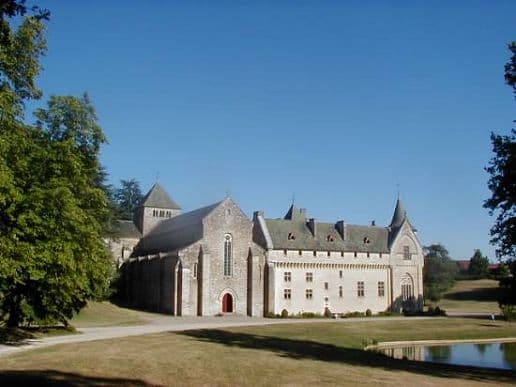
Loc-Dieu Abbey is a Cistercian monastery established in 1123 near Martiel, Aveyron, France. Originally named "devil's place" due to local dolmens, it was renamed "place of God" by its founding monks. The abbey has a history of destruction and rebuilding, notably being burnt by the English in 1409 and fortified in 1470. Despite being suppressed during the French Revolution, its buildings were restored, and it famously served as a hiding place for artworks from the Louvre during World War II.