
Baltinglass Abbey
Baltinglass Abbey, a ruined medieval Cistercian monastery in County Wicklow, Ireland, was founded in 1148 by Diarmait Mac Murchada. It served as a daughter house of Mellifont Abbey and later became the mother house of Jerpoint Abbey. The abbey was suppressed in 1536 during the Dissolution of the Monasteries and is now a National Monument.
Key Facts
- ›Founded in 1148 by Diarmait Mac Murchada, King of Leinster.
- ›Established as a daughter house of Mellifont Abbey.
- ›Was the mother house of Jerpoint Abbey by approximately 1160.
- ›At its peak in 1228, it housed 36 monks and 50 lay brothers.
- ›Suppressed in 1536 during the Dissolution of the Monasteries.
- ›Features a unique glazed tile potentially depicting Saint George and the Dragon.

Romanesque, Cistercian
- Carved Humans and Animals In Stonework
- Glazed Tile Depicting Saint George and the Dragon
- Surviving 12th-Century Church Elements
- Parts of the Original Cloister
Mainistir Bhealach Conglais, Vallis Salutis
Diarmait Mac Murchada
- Suppression During the Dissolution of the Monasteries
About Baltinglass Abbey
Baltinglass Abbey (Irish: Mainistir Bhealach Conglais) is a significant ruined medieval monastic site located in Baltinglass, County Wicklow, Ireland. Founded in 1148 by Diarmait Mac Murchada, the King of Leinster, it was established as a daughter house of the influential Mellifont Abbey and later became the mother house of Jerpoint Abbey. The abbey's original Latin name was Vallis Salutis, meaning "Valley of Salvation," bestowed by its founder.
History and Significance
The abbey's history spans nearly four centuries before its suppression in 1536 as part of the Dissolution of the Monasteries. At its height in 1228, Baltinglass Abbey was home to a substantial community of 36 monks and 50 lay brothers. The monks played a role in the local economy, operating a corn-mill in the area that is now the village of Grangecon, which was originally an out-farm of the abbey. Following its suppression, the site was granted to Edmond Butler, 3rd/13th Baron Dunboyne. A Church of Ireland church was later constructed within the abbey ruins in 1815, though it ceased functioning in 1883.
Architecture and Discoveries
The surviving stonework at Baltinglass Abbey showcases a distinct Cistercian Romanesque architectural style, featuring carved representations of humans and animals. The decoration on the capitals bears similarities to that found at its daughter house, Jerpoint Abbey. The surviving church, measuring 56 meters in length, and parts of the cloister largely date from the 12th century. These include the nave with aisles, the chancel, and a square presbytery with a three-light window and projecting chapels. While the church retains 12th-century elements, it also incorporates additions from the 13th and 15th centuries, with 19th-century additions to the east windows and tower. A notable discovery was made in 1941: a glazed tile potentially depicting Saint George and the Dragon, which was at the time the only known tile with a human figure painted on it found in Ireland.
Current Status
Today, Baltinglass Abbey stands as a National Monument, preserving its historical and architectural importance for visitors and researchers. While the operational monastic community is long gone, the ruins offer a glimpse into Ireland's medieval monastic past and its Cistercian heritage.
Source: Wikipedia ↗
Frequently Asked Questions
When was Baltinglass Abbey founded?
Baltinglass Abbey was founded in 1148. It was established by Diarmait Mac Murchada, the King of Leinster.
What religious order was Baltinglass Abbey a part of?
Baltinglass Abbey was a Cistercian abbey. It was founded as a daughter house of Mellifont Abbey, which was also Cistercian.
What happened to Baltinglass Abbey?
The abbey was suppressed in 1536 as part of the Dissolution of the Monasteries. Its lands were granted to Edmond Butler. It is now a National Monument.
What architectural styles are present at Baltinglass Abbey?
The stonework at Baltinglass Abbey exhibits a particular Cistercian form of Romanesque architecture, with carved humans and animals. The surviving church and parts of the cloister date from the 12th century, with additional 13th and 15th-century elements. The east windows and tower were built in the nineteenth century.
What is notable about the glazed tile found at the abbey?
A glazed tile, potentially depicting Saint George and the Dragon, was unearthed at Baltinglass Abbey in 1941. At that time, it was the only tile ever discovered in Ireland with a human figure painted on it.
Related Monasteries
Bective Abbey
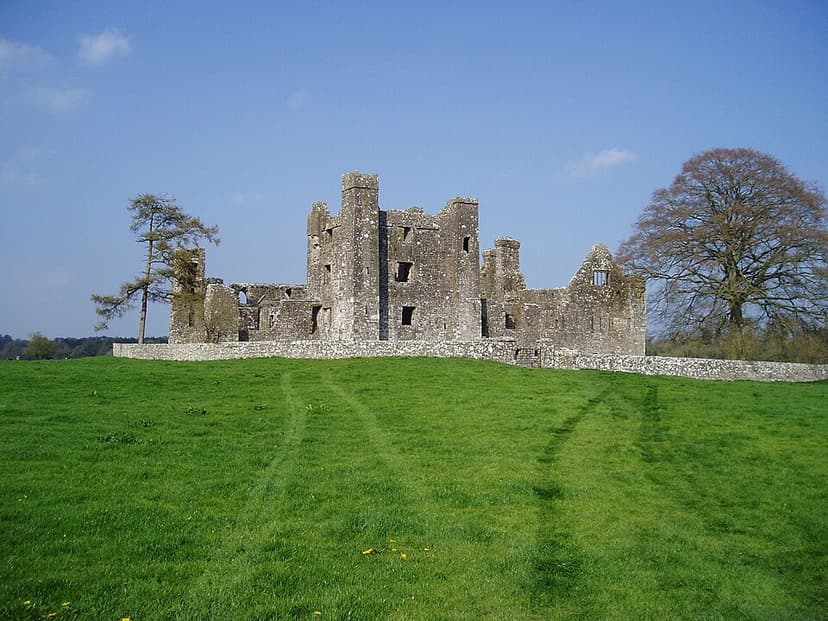
Bective Abbey is a well-preserved Cistercian abbey located on the River Boyne in County Meath, Ireland. Founded in 1147 as a daughter house of Mellifont Abbey, its remaining structures and ruins primarily date from the 15th century, though it also features an early 13th-century church and a 16th-century tower. The abbey's lands were confiscated during the Dissolution of the Monasteries and its buildings were later partially converted into a manor house.

Boyle Abbey
Boyle Abbey is a ruined Cistercian friary in County Roscommon, Ireland, founded by Saint Malachy in 1161. Despite interruptions from invasions and fires, its construction was completed and consecrated in 1218. The abbey became a significant Cistercian foundation in Ireland, known for its impressive architecture featuring influences from Burgundy and the West of England, and its squat square tower added in the thirteenth century.

Corcomroe Abbey
Corcomroe Abbey is an early 13th-century Cistercian monastery situated in the Burren region of County Clare, Ireland. Renowned for its exceptionally fine Gothic stone carvings, it was once known as "St. Mary of the Fertile Rock." Despite its historical significance and architectural merit, documentary evidence regarding its founding and early history is scarce, with its operational decline attributed to factors such as monastic reforms, family control of lands, and the English Reformation.