
Jerpoint Abbey
Jerpoint Abbey is a ruined Cistercian monastery located in County Kilkenny, Ireland, founded in the latter half of the 12th century. It was dedicated to the Blessed Virgin and became known for its intricate stone carvings, including tomb effigies. The abbey flourished for centuries until its dissolution by King Henry VIII, after which it became a significant burial site for local noble families. Today, it is a national monument maintained by the Office of Public Works, featuring extensive ruins and a visitor center.
Key Facts
- ›Founded in the second half of the 12th century, possibly in the 1160s, and formally affiliated with the Cistercian order in 1180.
- ›Located near Thomastown in County Kilkenny, Ireland.
- ›Notable for its extensive stone carvings, including effigies of bishops and noble families.
- ›Flourished until the dissolution of the monasteries by Henry VIII.
- ›Declared a national monument and in the care of the Office of Public Works since 1880.
- ›The ruins display a MIX of later Norman and early English architectural styles.

Norman, Early English, Romanesque
Stone Carvings, Tomb Sculptures, Cloister Arcade With Figure Carvings, Square, Embattled Tower, Visitor Centre With Exhibition
Mainistir SheireapúIn
Domnall Mac Gilla PáTraic, Felix Ua Duib SláIn, Donogh O'Donoghoe Mac Gilla Patraic, Oliver Grace, James Butler, 9th Earl of Ormond, William, Bishop of Cork, Thomas, Edmund Walsh, Johanna Le Boteller, Nicholas Baron, Rory O'Tunney
- Dissolution of the Monasteries By Henry Viii
- Surrender To King Henry Viii By Oliver Grace
- Leased To James Butler, 9th Earl of Ormond In 1541
About Jerpoint Abbey
Jerpoint Abbey, known in Irish as Mainistir Sheireapúin, is a significant ruined Cistercian monastery situated in County Kilkenny, Ireland. Founded in the latter half of the 12th century, it was formally affiliated with the Cistercian order in 1180 and dedicated to the Blessed Virgin. The abbey grew to be a substantial monastic community, owning considerable lands until its dissolution in the 16th century.
History and Significance
The abbey's origins are attributed by scholars to Domnall Mac Gilla Pátraic, with evidence suggesting it may have been in existence since the 1160s. It was later moved to its present site in 1180 by Donogh O'Donoghoe Mac Gilla Patraic, King of Ossory, possibly on the location of an earlier Benedictine foundation. Jerpoint Abbey flourished for centuries, becoming a centre of religious life and a favored place of sepulture for prominent local families.
Its historical importance continued even after the Dissolution of the Monasteries by King Henry VIII. The abbey was surrendered by its last abbot, Oliver Grace, and subsequently leased to James Butler, the 9th Earl of Ormond. The extensive ruins bear testament to its former grandeur and its role in the medieval and early modern history of the region.
Architecture and Notable Features
The surviving ruins of Jerpoint Abbey are extensive and showcase a blend of architectural styles, transitioning from later Norman elements to the early English style. Among its most notable features are its intricate stone carvings. These include effigies of significant figures such as Felix Ua Duib Sláin, Bishop of Ossory and the abbey's first abbot, and William, Bishop of Cork, also known as William of Jerpoint. The cloister arcade, with its unique figure carvings between the columns, is another highlight. The church exhibits Romanesque details, while a well-proportioned, square, embattled tower and cloister date from the 15th century.
Legacy
Jerpoint Abbey has been declared a national monument and has been under the care of the Office of Public Works since 1880. The site includes a visitor center with an exhibition, allowing the public to explore the rich history and architectural heritage of this once-thriving monastic community. Local legends and folklore also add layers to its historical narrative, including stories of Cromwellian soldiers and otherworldly priests.
Source: Wikipedia ↗
Frequently Asked Questions
When was Jerpoint Abbey founded?
Jerpoint Abbey is believed to have been founded in the second half of the 12th century. While it may have existed since the 1160s, it was formally affiliated with the Cistercian order in 1180.
What is Jerpoint Abbey known for?
Jerpoint Abbey is particularly renowned for its impressive stone carvings. These include effigies of notable figures like Bishop Felix Ua Duib Sláin and members of prominent local families, as well as sculptured cloister arcades.
What happened to Jerpoint Abbey after its dissolution?
Following the dissolution of the monasteries by Henry VIII, Jerpoint Abbey was surrendered to the king and later leased to James Butler, the 9th Earl of Ormond. It subsequently became a favored burial place for the great families of the surrounding region.
What is the architectural style of Jerpoint Abbey?
The extensive ruins of Jerpoint Abbey exhibit a blend of architectural styles, transitioning from later Norman influences to the early English style. Specific elements include a 12th-century church with Romanesque details and 15th-century additions like a tower and cloister.
Is Jerpoint Abbey open to visitors?
Yes, Jerpoint Abbey is a national monument and is open to the public. There is a visitor center on-site that features an exhibition about the abbey's history and significance.
Related Monasteries

Dunbrody Abbey
Dunbrody Abbey is a former Cistercian monastery located in County Wexford, Ireland, founded in 1182. Its cross-shaped church, built in the 13th century and featuring a 15th-century tower, was one of the longest in Ireland. Though dissolved under Henry VIII in 1536, the abbey's ruins remain a significant historical site, now featuring a visitor center with one of Ireland's two full-sized hedge mazes.
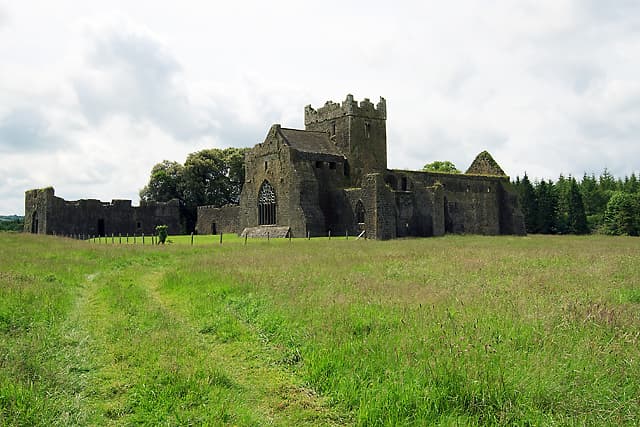
Kilcooly Abbey
Kilcooly Abbey is a historic Cistercian monastery located in County Tipperary, Ireland, founded in 1182 by Donal Mor O’Brien. Dedicated to the Virgin Mary and St. Benedict, it is known for its Cistercian architecture, sharing similarities with Jerpoint Abbey and Holy Cross Abbey. The abbey, which passed through various hands after the Reformation, is now open to the public and offers a glimpse into monastic life with its preserved structures and intricate carvings.

Monasteranenagh
Monasteranenagh Abbey is a medieval friary and national monument in County Limerick, Ireland, founded in 1148 by Toirdelbhach mac Diarmaida Ua Briain for Cistercians from Mellifont. The name signifies "Monastery of the Fair." Despite its dissolution in 1540, the site endured significant destruction during the Second Desmond Rebellion in 1580 when English soldiers massacred the monastic community. Today, its ruins primarily consist of the church and an early Gothic chapter house.