
Monasteranenagh
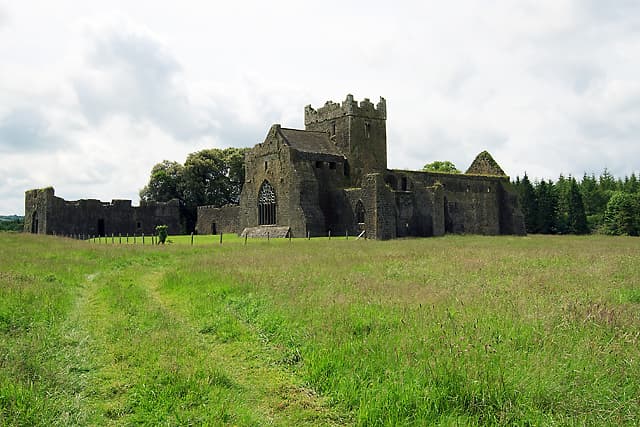
Monasteranenagh Abbey is a medieval friary and national monument in County Limerick, Ireland, founded in 1148 by Toirdelbhach mac Diarmaida Ua Briain for Cistercians from Mellifont. The name signifies "Monastery of the Fair." Despite its dissolution in 1540, the site endured significant destruction during the Second Desmond Rebellion in 1580 when English soldiers massacred the monastic community. Today, its ruins primarily consist of the church and an early Gothic chapter house.
Key Facts
- ›Founded in 1148 by Toirdelbhach mac Diarmaida Ua Briain.
- ›Originally established for Cistercian monks from Mellifont Abbey.
- ›The name translates to "Monastery of the Fair."
- ›Suffered a massacre of its community during the Second Desmond Rebellion in 1580.
- ›Ruins include the church (1170–1220) and an early Gothic chapter house.
- ›Designated as a national monument in Ireland.

Gothic, Romanesque
- Church Ruins
- Early Gothic Chapter House
- Remains of West Doorway With Round-Headed Windows
- Lancet Windows In the East Wall
Toirdelbhach Mac Diarmaida Ua Briain, Domnall MóR Ua Briain, Stephen of Lexington, Sir Osborne Echingham, Sir Nicholas Malby, Sir John of Desmond
- Founded In 1148.
- Subject To Margam Abbey After the Conspiracy of Mellifont In 1127 .
- Monks Fortified the Abbey In 1228 To Prevent Visitation.
- Dissolved In 1540.
- Granted To Sir Osborne Echingham In 1543.
- Taken By English Soldiers and Community Massacred On 3 April 1580 During the Second Desmond Rebellion.
- Tower Fell In 1806–7.
- Presbytery Vault Collapsed In 1874.
- Interior Used As A Burial Ground Until the 1970s.
About Monasteranenagh
Monasteranenagh Abbey
Monasteranenagh Abbey, situated in County Limerick, Ireland, is a significant medieval friary and a designated national monument. Its founding in 1148 by Toirdelbhach mac Diarmaida Ua Briain was for the Cistercian order, bringing monks from Mellifont Abbey. The name itself, translating to "Monastery of the Fair," hints at its historical importance.
History and Significance
The construction of the abbey's buildings was likely completed by Domnall Mór Ua Briain in the late 12th century. Over the centuries, Monasteranenagh faced periods of upheaval. It was made subject to Margam Abbey and, in 1228, its monks fortified the abbey to resist a visitation by Stephen of Lexington. A pivotal and tragic event occurred in 1580 during the Second Desmond Rebellion when English soldiers, led by Sir Nicholas Malby, not only routed Irish forces but also turned their cannons on the Abbey. This assault resulted in the destruction of the cloister and refectory and the massacre of the entire surviving monastic community.
The abbey was officially dissolved in 1540 and subsequently granted to Sir Osborne Echingham in 1543, though some monks continued to reside there. The physical structure also suffered over time; the tower collapsed between 1806 and 1807, and the presbytery's barrel vault fell in 1874. The interior of the abbey was utilized as a burial ground until the 1970s.
Architectural Remains
Today, the ruins of Monasteranenagh Abbey primarily comprise its church, with architectural elements dating between 1170 and 1220, and an early Gothic chapter house. Notable surviving features include the walls, gables, and the main window frame of the church. Above the remnants of the west doorway, two round-headed windows are visible, while the east wall features three lancet windows, offering a glimpse into the abbey's past architectural grandeur.
Source: Wikipedia ↗
Frequently Asked Questions
When was Monasteranenagh Abbey founded?
Monasteranenagh Abbey was founded in 1148. It was established by Toirdelbhach mac Diarmaida Ua Briain.
Who were the original monastic order at Monasteranenagh?
The monastery was founded for Cistercian monks. They came from Mellifont Abbey.
What is the meaning of the name Monasteranenagh?
The name Monasteranenagh means "Monastery of the Fair." This reflects its historical significance.
What significant historical events affected Monasteranenagh Abbey?
The abbey was dissolved in 1540. It also experienced a massacre of its community by English soldiers in 1580 during the Second Desmond Rebellion.
What remains of Monasteranenagh Abbey today?
The ruins primarily consist of the church, dating from 1170–1220, and an early Gothic chapter house. The walls, gables, and main window frame of the church are still visible.
Related Monasteries

Dunbrody Abbey
Dunbrody Abbey is a former Cistercian monastery located in County Wexford, Ireland, founded in 1182. Its cross-shaped church, built in the 13th century and featuring a 15th-century tower, was one of the longest in Ireland. Though dissolved under Henry VIII in 1536, the abbey's ruins remain a significant historical site, now featuring a visitor center with one of Ireland's two full-sized hedge mazes.

Jerpoint Abbey
Jerpoint Abbey is a ruined Cistercian monastery located in County Kilkenny, Ireland, founded in the latter half of the 12th century. It was dedicated to the Blessed Virgin and became known for its intricate stone carvings, including tomb effigies. The abbey flourished for centuries until its dissolution by King Henry VIII, after which it became a significant burial site for local noble families. Today, it is a national monument maintained by the Office of Public Works, featuring extensive ruins and a visitor center.
Kilcooly Abbey
Kilcooly Abbey is a historic Cistercian monastery located in County Tipperary, Ireland, founded in 1182 by Donal Mor O’Brien. Dedicated to the Virgin Mary and St. Benedict, it is known for its Cistercian architecture, sharing similarities with Jerpoint Abbey and Holy Cross Abbey. The abbey, which passed through various hands after the Reformation, is now open to the public and offers a glimpse into monastic life with its preserved structures and intricate carvings.