
Dunbrody Abbey
Dunbrody Abbey is a former Cistercian monastery located in County Wexford, Ireland, founded in 1182. Its cross-shaped church, built in the 13th century and featuring a 15th-century tower, was one of the longest in Ireland. Though dissolved under Henry VIII in 1536, the abbey's ruins remain a significant historical site, now featuring a visitor center with one of Ireland's two full-sized hedge mazes.
Key Facts
- ›Founded in 1182 by monks from St. Mary's Cistercian Abbey in Dublin.
- ›The church, constructed in the 13th century, measured 59 meters in length and was cross-shaped.
- ›A tower was added to the structure in the 15th century.
- ›The abbey was dissolved in 1536 during the reign of Henry VIII.
- ›The ruins include significant architectural elements from the early Gothic period.
- ›The site currently features a visitor centre and one of Ireland's two full-sized hedge mazes.

Early Gothic
Cross-Shaped Church, 15th-Century Tower, Visitor Centre, Full-Sized Hedge Maze
Mainistir DhúN BróIthe, Port of St. Mary's
Dermot Macmurrough, Henry Ii, Richard De Clare, Herve De Montmorency, Alexander Devereux, Osborne Ichyngham
Norman Invasion of Ireland, Foundation of the Abbey, Dissolution of the Monasteries
About Dunbrody Abbey
Dunbrody Abbey, known in Irish as Mainistir Dhún Bróithe, is a significant former Cistercian monastery situated in County Wexford, Ireland. Its establishment in 1182 marked a key moment in the Norman influence on the region, with monks from St. Mary's Cistercian Abbey in Dublin settling on land donated for a new foundation.
History and Significance
The abbey's primary church, constructed in the 13th century, is notable for its cross-shaped plan and impressive length of 59 meters, making it one of the longest monastic churches in Ireland. The prosperity experienced by the Anglo-Norman colony in the mid-13th century is reflected in the scale and quality of these early Gothic buildings. However, the abbey's monastic life came to an end in 1536 when it was dissolved under King Henry VIII as part of the Dissolution of the Monasteries. The last Abbot, Alexander Devereux, went on to become Bishop of Ferns.
Architectural Features and Present Day
Architecturally, Dunbrody Abbey showcases typical Cistercian design with a nave, aisles, transepts, and choir. A distinctive 15th-century tower was later added, a construction notable for its innovative use of new piers to support its weight rather than relying on existing arches. Following its dissolution, the abbey was plundered and later converted into a residence. A severe collapse on Christmas Eve 1852 destroyed the south wall of the church and parts of the monastery, leaving it in its current ruined state. Today, the site operates with a visitor centre, managed by the current Marquess of Donegall, and famously features one of Ireland's two full-sized hedge mazes, drawing visitors to explore its historical remains and unique attractions.
Source: Wikipedia ↗
Frequently Asked Questions
When was Dunbrody Abbey founded?
Dunbrody Abbey was founded in 1182. Monks from St. Mary's Cistercian Abbey in Dublin established the community on land donated by Herve de Montmorency.
What is the architectural style of Dunbrody Abbey?
The primary architectural style of Dunbrody Abbey is early Gothic, particularly evident in the 13th-century church. The structure also features a 15th-century tower.
What happened to Dunbrody Abbey?
Dunbrody Abbey was dissolved in 1536 under Henry VIII. The abbey was plundered, and the land was later converted into a residence. A significant collapse occurred on Christmas Eve 1852, leaving the abbey in ruins.
Is Dunbrody Abbey still an active monastery?
No, Dunbrody Abbey is a former monastery and currently exists in ruins. It is no longer an active monastic community.
What can visitors see at Dunbrody Abbey today?
Visitors can explore the extensive ruins of the abbey church and monastic buildings. The site also includes a visitor centre and one of the only two full-sized hedge mazes in Ireland.
Related Monasteries

Jerpoint Abbey
Jerpoint Abbey is a ruined Cistercian monastery located in County Kilkenny, Ireland, founded in the latter half of the 12th century. It was dedicated to the Blessed Virgin and became known for its intricate stone carvings, including tomb effigies. The abbey flourished for centuries until its dissolution by King Henry VIII, after which it became a significant burial site for local noble families. Today, it is a national monument maintained by the Office of Public Works, featuring extensive ruins and a visitor center.
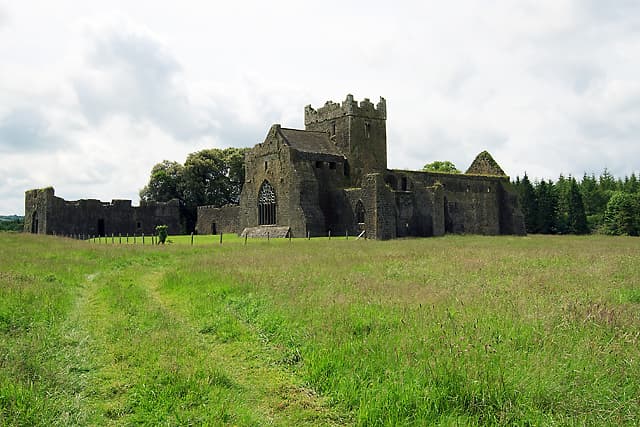
Kilcooly Abbey
Kilcooly Abbey is a historic Cistercian monastery located in County Tipperary, Ireland, founded in 1182 by Donal Mor O’Brien. Dedicated to the Virgin Mary and St. Benedict, it is known for its Cistercian architecture, sharing similarities with Jerpoint Abbey and Holy Cross Abbey. The abbey, which passed through various hands after the Reformation, is now open to the public and offers a glimpse into monastic life with its preserved structures and intricate carvings.

Monasteranenagh
Monasteranenagh Abbey is a medieval friary and national monument in County Limerick, Ireland, founded in 1148 by Toirdelbhach mac Diarmaida Ua Briain for Cistercians from Mellifont. The name signifies "Monastery of the Fair." Despite its dissolution in 1540, the site endured significant destruction during the Second Desmond Rebellion in 1580 when English soldiers massacred the monastic community. Today, its ruins primarily consist of the church and an early Gothic chapter house.