
Gayatri
Gayatri is the personified form of the Gayatri Mantra, a significant hymn from Vedic texts, and is also known as Savitri and Vedamata ('mother of the Vedas'). She is considered a manifestation of Saraswati and is often associated with the solar deity Savitṛi, with whom she is sometimes depicted as the consort of the creator god Brahma in Puranic traditions. Gayatri is revered as the Supreme pure consciousness and a powerful goddess.
Key Facts
- ›Gayatri is the personification of the Gayatri Mantra, a central hymn in Vedic tradition.
- ›She is also known by the names Savitri and Vedamata ('mother of the Vedas').
- ›Gayatri is considered a manifestation of the goddess Saraswati.
- ›In Puranic texts, she is often depicted as the consort of the creator god Brahma.
- ›Her iconography can vary, sometimes featuring multiple heads and hands holding various divine weapons.
- ›She is associated with purity, knowledge, and the power to overcome demons.
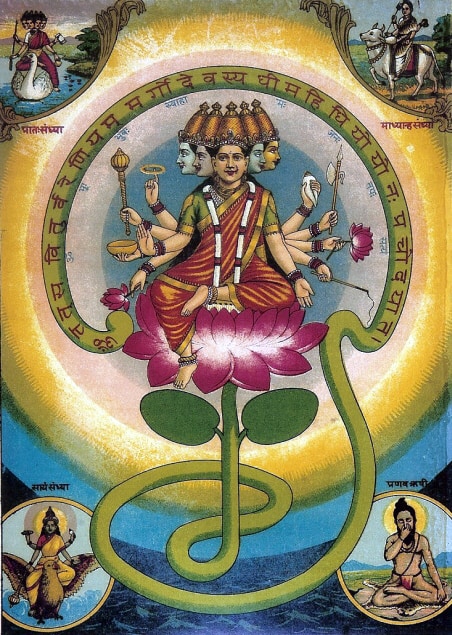
Savitri, Vedamata, Supreme pure consciousness
- Five Faces
- Ten Hands
- Holding A Sword, Lotus, Trident, Disc, Skull, Goad, Noose, Manuscript, Jar of Ambrosia
- Third Eye
- Crescent Moon
- Four-Armed Depictions
- Mounted On A Lotus
- Three-Faced Depictions
Rig Veda, Jaiminiya Upanishad Brahmana, Gopatha Brahmana, Savitri Upanishad, Mahanarayana Upanishad, Mahabharata, Matsya Purana, Kurma Purana, Skanda Purana, Padma Purana, Varaha Purana, Gayatri Tantra, MantramahāRṇAva, Taittiriya Sandhya Bhashyam, Yoga YāJñAvalkya
Manifestation of Saraswati, Consort of Brahma, Associated With SavitṛI
Trishula, Sudarshana Chakra, Vedas, Lotus, Noose, Scimitar, Bow-Arrow, Goad
Swan
Deity, Personification
About Gayatri
Gayatri is a revered Hindu goddess, most famously known as the personified form of the Gayatri Mantra, a highly significant and widely recited hymn originating from Vedic texts. She is also identified by the epithets Savitri and Vedamata, meaning 'mother of the Vedas.' Her significance lies in her embodiment of purity, knowledge, and divine consciousness.
Origin and Development
Initially, 'Gayatri' referred to a specific meter in the Rig Veda composed of 24 syllables, which became the basis for the Gayatri Mantra. Scholars suggest that the goddess Gayatri is the feminine form of Gayatra, a name for the Vedic solar deity, and is closely linked to Savitri and Savitṛi. Her deification is traced to post-Vedic periods, with early texts like the Jaiminiya Upanishad Brahmana and Gopatha Brahmana laying the groundwork for her recognition as a goddess and mother of the Vedas. The Mahanarayana Upanishad explicitly links her to the Gayatri Mantra and identifies her with Saraswati, marking an unambiguous evocation of her divine status.
Over time, the prominence of the Gayatri Mantra led to an escalation of the goddess's importance. The Mahabharata even states that the Vedas originated from her mouth. While a Vedic goddess named Sūryā, daughter of Savitr, shares some attributes, she was later conflated with Gayatri, particularly through the story of Savitri and Satyavan. This fusion, alongside the growing reverence for the Gayatri Mantra and Saraswati, solidified Gayatri's identity as a powerful, radiant, and wise deity.
Iconography and Symbolism
Gayatri's iconography is rich and varied, often reflecting influences from different traditions. Early bronze images from Himachal Pradesh depict her with five faces and ten hands, holding various divine weapons and symbols attributed to the Trimurti (Brahma, Vishnu, and Shiva), such as a trident, discus, and lotus. She is sometimes depicted with a third eye and a crescent moon, reminiscent of Shiva. Modern depictions frequently feature her mounted on a white swan, symbolizing knowledge and purity, and holding a book.
Her attributes carry profound symbolic meaning. The three feet of Gayatri are said to represent the first three Vedas, while her six bellies can symbolize the six directions. Her five heads are often interpreted as representing the five Vedangas. The 24 letters of the Gayatri Mantra are also deeply significant, representing various cosmic elements, deities, sages, and meters, highlighting the mantra's all-encompassing power.
Mythology and Associations
In Puranic literature, Gayatri is often identified as Saraswati and the consort of the creator god Brahma. The Matsya Purana describes her emerging as a female from Brahma's left half, symbolizing purity in thought, word, and deed. She is also credited with slaying the demon Vetrasura, demonstrating her fierce aspect as a protector. In Shaivism, she is sometimes seen as the consort of Parashiva and identified with Manonmani, the mantra form of Shakti.
Gayatri is considered a major deity, especially within the Smarta tradition, and is deeply integrated into Vedic practices. Her association with the Gayatri Mantra makes her a central figure for meditation, prayer, and spiritual enlightenment across Hinduism.
Source: Wikipedia ↗
Frequently Asked Questions
Who is Gayatri?
Gayatri is the personified form of the Gayatri Mantra, a prominent Vedic hymn. She is also known as Savitri and Vedamata, meaning 'mother of the Vedas'. She is often seen as a manifestation of Saraswati and is associated with the solar deity Savitṛi.
What is Gayatri known for?
Gayatri is known for being the embodiment of the Gayatri Mantra, which is considered highly sacred. She is also revered as the mother of the Vedas and represents purity in thought, word, and deed. In some traditions, she is known for her power to slay demons.
Who is Gayatri's consort?
In Puranic traditions, Gayatri is often depicted as the consort of the creator god Brahma. However, in Shaivism, she is sometimes seen as the consort of Parashiva.
What are the symbolic meanings of Gayatri's attributes?
Gayatri's attributes hold deep symbolic meaning. Her five heads are said to represent the five Vedangas (auxiliary disciplines of Vedic study), and her ten arms often hold weapons symbolizing the Trimurti (Brahma, Vishnu, and Shiva), representing her all-encompassing power and knowledge.
How is Gayatri depicted in iconography?
Gayatri's iconography is diverse. She is often depicted with five heads and ten hands, holding various divine weapons and symbols. Some depictions include a third eye and a crescent moon, similar to Shiva. She is also sometimes shown seated on a white swan, symbolizing knowledge.
What is the significance of the 24 letters of the Gayatri Mantra?
The 24 letters of the Gayatri Mantra are significant as they are believed to represent 24 Vedic rishis, 24 Vedic meters (chandas), 24 Vedic devatas, 24 shaktis, and 24 tattvas (elements of existence). This underscores the mantra's comprehensive nature and its connection to the fundamental principles of the cosmos.
Related Hindu deities
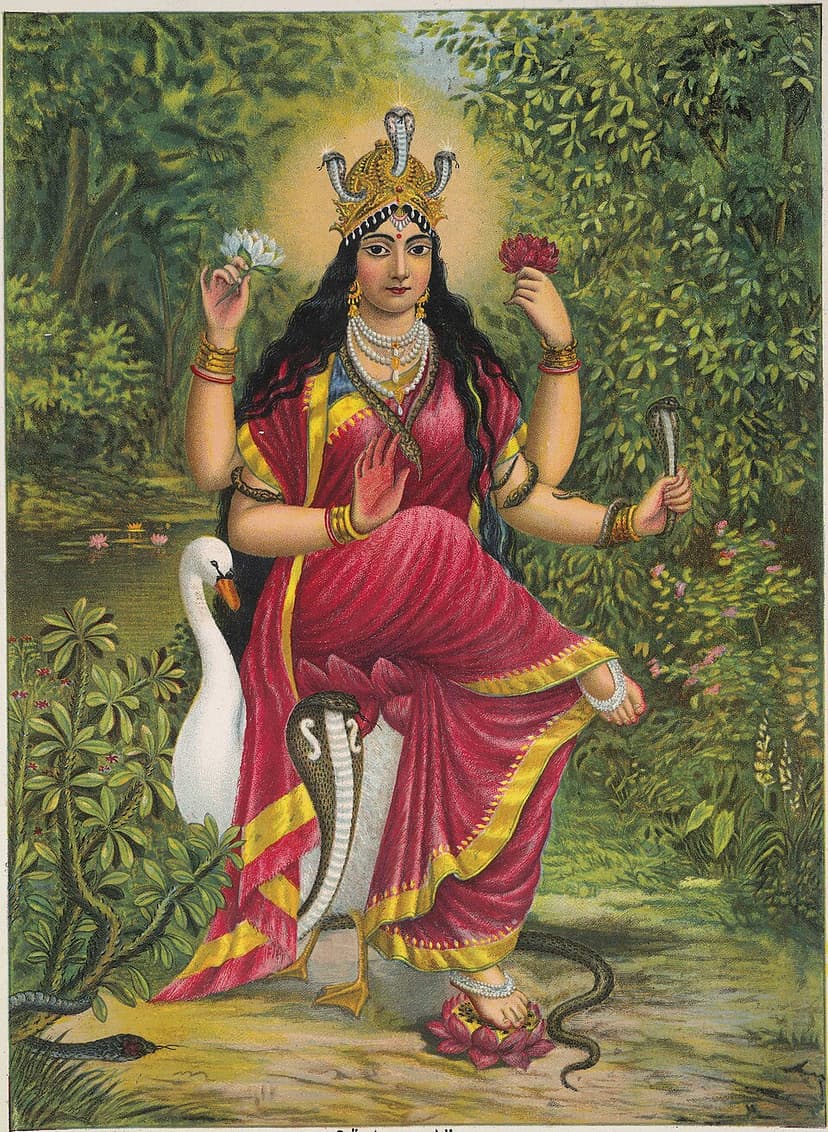
Manasa
Manasa is a Hindu goddess of snakes, primarily worshipped for protection against snakebite, as well as for fertility and prosperity. Though denied full godhood due to her mixed parentage, she is known for her kindness to devotees and her determination to establish her authority. Her worship is particularly prevalent in eastern India.

Ganga
Ganga is the personification of the sacred river Ganges and is worshipped by Hindus as the goddess of purification and forgiveness. Revered as Ganga Mata (Mother Ganges), she is a central figure in Hindu mythology, known for her descent to Earth to purify the souls of ancestors. Her significance extends to being a mother figure to humanity, with her waters believed to aid in achieving moksha.
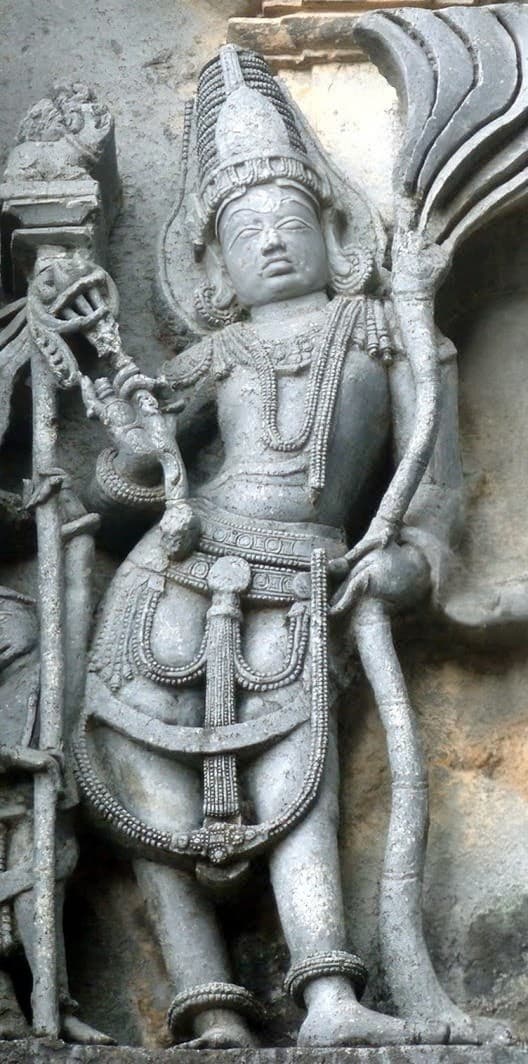
Kamadeva
Kamadeva is the Hindu god of love, attraction, pleasure, and beauty, as well as the personification of kāma (desire). He is depicted as a handsome youth armed with a bow of sugarcane and flower arrows, often accompanied by his consort Rati. Kamadeva's mythology is prominent in the Puranas, where he is known for being incinerated by Shiva's third eye and subsequently reborn as Pradyumna.