
Akilandeshwari
Akilandeshwari is a significant form of the Hindu Goddess Adi Parashakti, revered as an embodiment of Parvati and the divine mother who rules the entire universe. Her primary abode is the Jambukeswarar Temple in Thiruvanaikaval, where she is worshipped alongside her consort, Jambukeswarar, an avatar of Shiva. She is also recognized as part of the Trishakti triad, representing the most powerful goddesses in Shaktism.
Key Facts
- ›Akilandeshwari is considered a main form of the Hindu Goddess Adi Parashakti and an embodiment of Parvati.
- ›Her name translates to 'the divine mother who rules the entire universe'.
- ›She is the presiding deity of the Jambukeswarar Temple in Thiruvanaikaval.
- ›She is venerated as part of the Trishakti triad along with Meenakshi and Kamakshi.
- ›A legend states she performed penance in the Jambu forest, creating a lingam from Kaveri river water.
- ›In her temple, she is worshipped opposite her consort Jambukeswarar, signifying a student-teacher dynamic.
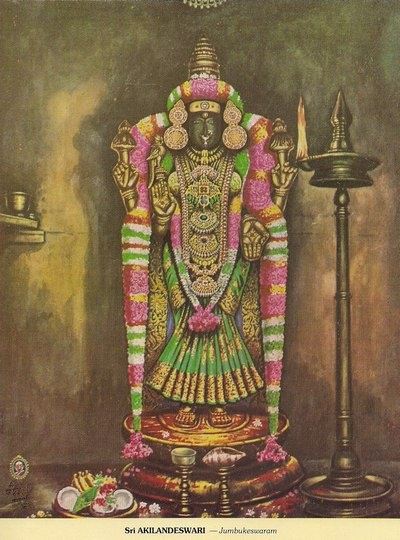
Akhilandeshwari
- Wears Sri Chakra Thaatankas To Reduce Her Anger.
- Idol's Sanctum Sanctorum Is In the Shape of the Pranava Mantra 'Om'.
Embodiment of Parvati, Consort of Jambukeswarar
Pancha-Prakara Vizha
Jambukeswarar Temple, Thiruvanaikaval
About Akilandeshwari
Akilandeshwari is a prominent form of the Hindu Goddess Adi Parashakti, revered as an embodiment of Parvati and the divine mother who governs the entire universe. Her name, derived from Sanskrit, translates to 'the divine mother who rules the entire universe'. Her principal seat of worship is the Jambukeswarar Temple in Thiruvanaikaval, where she presides alongside her consort, Jambukeswarar, who is considered an avatar of Lord Shiva.
Legend and Worship
Akilandeshwari is central to several legends. One notable story recounts her penance in the Jambu forest, where she fashioned a lingam from the waters of the Kaveri River and worshipped it. Shiva, impressed by her devotion, appeared and imparted divine knowledge. In her temple, a unique aspect of worship is that her idol is placed opposite her consort, symbolizing a teacher-student dynamic, and therefore, traditional marriage ceremonies are not conducted between them.
Forms and Significance
She is also recognized as a key figure within Shaktism, forming the Trishakti triad along with goddesses Meenakshi and Kamakshi, representing the most powerful divine feminine forces. Devotees believe Akilandeshwari transforms into various forms throughout the day, including Lakshmi, Durga, Saraswati, and Varahi, each embodying different aspects of divine power. The Sri Chakra earrings she wears are significant; tradition holds they were installed by Adi Sankara to pacify her fierce nature, absorbing her intense energy.
Cultural Impact
Her influence extends to devotional music, with the 18th-century composer Muthuswamy Dikshitar creating songs in her honor. More recently, she has been featured in devotional albums, celebrating her divine presence and the history of her temple.
Source: Wikipedia ↗
Frequently Asked Questions
What does the name Akilandeshwari mean?
The name Akilandeshwari is derived from Sanskrit and breaks down into 'Akhila' meaning the universe, 'Anda' meaning ruling, and 'Ishwari' meaning the divine mother. Thus, it signifies the divine mother who rules the entire universe.
Where is the famous abode of Akilandeshwari?
The most famous abode of Akilandeshwari is the Jambukeswarar Temple located in Thiruvanaikaval. She is the presiding deity in this temple.
Who is Akilandeshwari worshipped with?
Akilandeshwari is revered collectively with the goddesses Meenakshi and Kamakshi, forming the Trishakti triad. She is also worshipped alongside her consort, Jambukeswarar, who is an avatar of Shiva.
What is a significant legend associated with Akilandeshwari?
One legend tells of Parvati, in the form of Akilandeshwari, performing penance in the Jambu forest. She created a lingam from Kaveri river water and worshipped it. Shiva later appeared and imparted divine knowledge to her.
How is Akilandeshwari worshipped in her temple?
In the Jambukeswarar Temple, Akilandeshwari's idol is installed opposite her consort Jambukeswarar, reflecting a guru-shishya (teacher-student) relationship. Due to this, traditional marriage ceremonies (Thirukalyanam) are not performed for them in this temple.
What are the different forms Akilandeshwari is believed to take throughout the day?
It is believed that Akilandeshwari transforms into different forms during the day: Lakshmi in the morning, Durga at noon, Saraswati in the evening, and Varahi after the night puja. She is said to be particularly fierce as Varahi.
Related Hindu deities
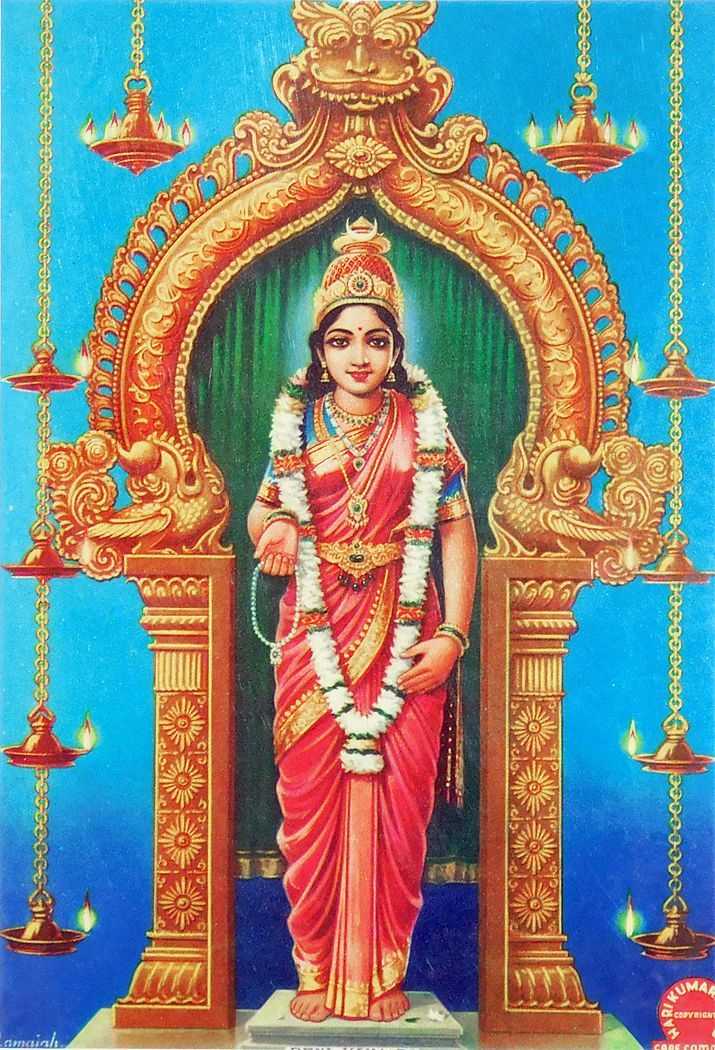
Devi Kanya Kumari
Devi Kanya Kumari is a prominent Hindu goddess, a manifestation of Mahadevi in the form of an adolescent girl. She is revered as a form of Parvati or Lakshmi, and is particularly known for her role in slaying the demon Banasura. Her worship is deeply tied to the town of Kanyakumari at the southernmost tip of India.

Chandraghanta
Chandraghanta is a powerful form of the Hindu goddess Mahadevi, revered as the destroyer of demons and the protector of her devotees. She is the third of the Navadurga and is prominently worshipped on the third day of Navaratri. Her name, meaning 'adorned with the moon as her bell,' refers to the crescent moon on her forehead, and she is depicted with ten arms holding various weapons and a bell.
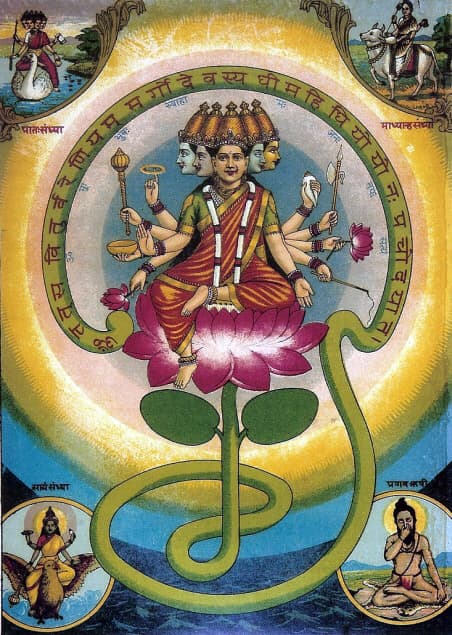
Gayatri
Gayatri is the personified form of the Gayatri Mantra, a significant hymn from Vedic texts, and is also known as Savitri and Vedamata ('mother of the Vedas'). She is considered a manifestation of Saraswati and is often associated with the solar deity Savitṛi, with whom she is sometimes depicted as the consort of the creator god Brahma in Puranic traditions. Gayatri is revered as the Supreme pure consciousness and a powerful goddess.