
Shifang Temple
Shifang Temple, also known as Guangren Temple, is a significant Buddhist temple located on Mount Wutai in China's Shanxi province. Established during the Qing dynasty, it is recognized as a National Key Buddhist Temple and maintains traditional architectural styles.
Key Facts
- ›The temple was first established during the Daoguang period (1821–1850) of the Qing dynasty.
- ›It was designated a National Key Buddhist Temple in the Han Chinese Area in 1983.
- ›Shifang Temple covers an area of 3,645 square meters and comprises 54 rooms and halls.
- ›The architecture follows Qing dynasty building principles and traditional styles.
- ›Key halls include the Hall of four Heavenly Kings, the Hall of Maitreya, and the Hall of Je Tsongkhapa.
- ›A set of the Kangyur, printed between 1821 and 1850, is preserved in the Hall of Maitreya.

Important Relationships
Hall of Four Heavenly Kings, Hall of Maitreya, Hall of Je Tsongkhapa, Set of Kangyur, Copper Statue of Je Tsongkhapa, One Thousand Miniature Buddha Statues
Qing Dynasty Architecture, Traditional Chinese Architecture
About Shifang Temple
Shifang Temple, also known by the name Guangren Temple, is a significant Buddhist temple situated on Mount Wutai in Taihuai Town, Wutai County, Shanxi province, China. Its establishment dates back to the Daoguang period (1821–1850) of the Qing dynasty. The temple holds national importance, having been designated as a National Key Buddhist Temple in the Han Chinese Area by the State Council of China in 1983.
History and Significance
The temple's founding in the early to mid-19th century places it within a period of continued Buddhist development under the Qing dynasty. Its designation as a National Key Buddhist Temple underscores its role in preserving Buddhist heritage and practice within China. Mount Wutai itself is one of the Four Sacred Mountains of Buddhism in China, making any temple located there a site of considerable religious significance.
Architecture
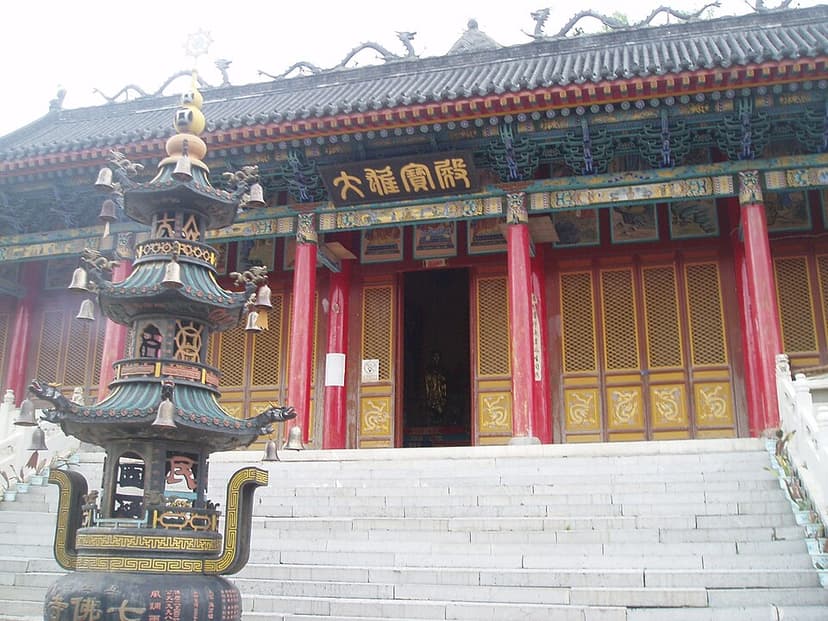
Shifang Temple spans an area of 3,645 square meters and contains 54 rooms and halls. The existing structures are built in accordance with Qing dynasty architectural principles, maintaining a traditional style. The temple complex is organized into three courtyards, each featuring a prominent hall: the Hall of Four Heavenly Kings, the Hall of Maitreya, and the Hall of Je Tsongkhapa.
Key Halls and Contents
The Hall of Maitreya is dedicated to Maitreya Buddha, revered as the future Buddha and the successor to Sakyamuni. This hall is notable for housing a complete set of the Kangyur, a collection of Buddhist scriptures, which was printed between 1821 and 1850. The Hall of Je Tsongkhapa honors Je Tsongkhapa, a pivotal figure in Tibetan Buddhism whose teachings were instrumental in the formation of the Gelug school. This hall contains a striking copper statue of Je Tsongkhapa, and its interior walls are adorned with one thousand miniature Buddha statues inlaid into alcoves.
Source: Wikipedia ↗
Frequently Asked Questions
When was Shifang Temple founded?
Shifang Temple was first established during the Daoguang period of the Qing dynasty, which spanned from 1821 to 1850.
What is the architectural style of Shifang Temple?
The temple's extant structure is based on Qing dynasty building principles and retains a traditional architectural style. It is divided into three courtyards with three main halls.
What notable items are housed in the Hall of Maitreya?
The Hall of Maitreya enshrines Maitreya Buddha and preserves a set of the Kangyur, which was printed between 1821 and 1850.
Who is venerated in the Hall of Je Tsongkhapa?
The Hall of Je Tsongkhapa houses a copper statue of Je Tsongkhapa, a significant teacher in Tibetan Buddhism whose teachings led to the formation of the Gelug school. The hall also features one thousand miniature Buddha statues inlaid in alcoves on its interior walls.
What is the significance of Shifang Temple's designation?
In 1983, Shifang Temple was designated as a National Key Buddhist Temple in the Han Chinese Area by the State Council of China, highlighting its importance.
Related Buddhist Temples

Pusading
Pusading, also known as the Bodhisattva Summit Temple, is a significant Buddhist temple located in Taihuai Town, Shanxi, China. It is considered the finest temple among all those situated on Mount Wutai and holds historical importance, having been established during the Northern Wei dynasty and later converted to Tibetan Buddhism in the Qing dynasty.
Qifo Temple
Qifo Temple is a significant Buddhist temple located in Taihuai Town, Shanxi, China. Originally constructed during the Northern Song dynasty, it has undergone several reconstructions and conversions, most notably to Tibetan Buddhism in 1734. Despite being destroyed during the Cultural Revolution, it was rebuilt starting in 1991 and features several halls and a notable white marble pagoda.

Xihuang Temple
Xihuang Temple is a significant Buddhist temple located in Beijing, China, historically serving as a residence for important Tibetan Buddhist leaders. It holds importance for its role in Tibetan Buddhism in Beijing and its connection to various Panchen Lamas and Dalai Lamas, making it a site of both religious and historical interest.