
Pusading
Pusading, also known as the Bodhisattva Summit Temple, is a significant Buddhist temple located in Taihuai Town, Shanxi, China. It is considered the finest temple among all those situated on Mount Wutai and holds historical importance, having been established during the Northern Wei dynasty and later converted to Tibetan Buddhism in the Qing dynasty.
Key Facts
- ›Originally established during the Northern Wei dynasty (386–534) and initially named 'Great Temple of Wenshu'.
- ›Renamed 'Zhenrong Temple' in 631 during the Tang dynasty by monk Fayun.
- ›Received a plaque from Emperor Zhenzong of the Northern Song dynasty during the Jingde period (1004–1007).
- ›The name was changed to 'Great Temple of Wenshu' during the Ming dynasty and the temple was government-renovated in 1581.
- ›Converted to Tibetan Buddhism in 1656 and the roof was tiled with yellow glazed tiles with Emperor Kangxi's permission in 1683.
- ›Classified as a 'National Key Buddhist Temple in Han Chinese Area' in 1983.

Important Relationships
- Emperor Xiaowen of Northern Wei
- Fayun
- Emperor Zhenzong of Song
- Yongle Emperor
- Emperor Kangxi
- William Woodville Rockhill
- 13th Dalai Lama
- Chen Yi
108 Stone Steps, Paifangs With Inscriptions By Emperor Kangxi
- Conversion To Tibetan Buddhism In 1656
- Meeting Between William Woodville Rockhill and the 13th Dalai Lama In 1908
About Pusading
Pusading, whose name translates to 'Bodhisattva Summit Temple,' is a significant Buddhist temple located in Taihuai Town, Wutai County, Shanxi Province, China. It is widely regarded as the finest temple among all those situated on the sacred Mount Wutai. The temple's designation as a 'National Key Buddhist Temple in Han Chinese Area' in 1983 underscores its national importance.
History and Development
The origins of Pusading are traced back to the Northern Wei dynasty, with its establishment occurring during the reign of Emperor Xiaowen (467–499 CE). Initially, it was known as the 'Great Temple of Wenshu.' Over the centuries, the temple underwent several transformations and name changes. In 631 CE, during the Tang dynasty, Buddhist monk Fayun rebuilt the structure and renamed it 'Zhenrong Temple.' During the Northern Song dynasty, Emperor Zhenzong bestowed a plaque reading 'Fengzhen Pavilion' in the Jingde period (1004–1007).
The Ming dynasty saw further changes, with the Yongle Emperor renaming it the 'Great Temple of Wenshu' in the early 15th century. The temple was also renovated by the government in 1581. A pivotal shift occurred in the Qing dynasty when, in 1656, the temple converted to Tibetan Buddhism. By 1683, with the approval of Emperor Kangxi, its roof was adorned with yellow glazed tiles, a symbol of imperial favor and unique architectural distinction.
Architectural Significance and Features
Pusading is renowned for its distinct architectural elements that blend spiritual symbolism with historical grandeur. A striking feature is the walkway of 108 stone steps leading to the summit, interpreted as a symbolic ascent representing the overcoming of 108 human worries on the path to enlightenment. The temple also boasts paifangs (traditional Chinese archways) bearing significant inscriptions. One paifang under the shanmen (temple gate) displays the characters '灵峰胜境' (beautiful site of Lingjiu Peak), attributed to Emperor Kangxi. Another paifang in front of the Wenshu Hall features '五台圣境' (beautiful site of Mount Wutai), also bearing the Kangxi Emperor's calligraphy.
Historical Encounters
Beyond its religious and architectural importance, Pusading has been a site of notable historical encounters. In June 1908, the United States Ambassador to China, William Woodville Rockhill, engaged in discussions with the 13th Dalai Lama at the temple regarding issues pertaining to British India and Tibet. Later, in the spring of 1948, Chen Yi visited Mount Wutai, passing through the area and composing a poem in appreciation of its scenic beauty.
The temple's name, 'Bodhisattva Summit,' is derived from the legend that the bodhisattva Wenshu (Manjushri) chose this peak to reveal himself and preach. This association, along with its geographical position resembling the spiritual Lingjiu Peak described by Shakyamuni Buddha, imbues Pusading with profound spiritual meaning for Buddhists.
Source: Wikipedia ↗
Frequently Asked Questions
What is the origin of the name Pusading?
The name Pusading, meaning 'Bodhisattva Summit', originates from the legend that the bodhisattva Wenshu (Manjushri) revealed himself and preached at the summit of Mount Wutai. It is also referred to as 'Spiritual Black Eagle Peak' due to its geographical resemblance to Lingjiu Peak.
When was Pusading first established?
Pusading was first established during the reign of Emperor Xiaowen of the Northern Wei dynasty, between 467 and 499 CE. It was initially known as the 'Great Temple of Wenshu'.
What significant architectural features does Pusading have?
A notable feature is a walkway of 108 stone steps leading to the summit, symbolizing the overcoming of human worries. The temple also features paifangs with inscriptions by the Kangxi Emperor, including '灵峰胜境' (beautiful site of Lingjiu Peak) and '五台圣境' (beautiful site of Mount Wutai).
What is the religious affiliation of Pusading?
While originally established as a Han Chinese Buddhist temple, Pusading converted to Tibetan Buddhism in 1656 during the Qing dynasty.
Has Pusading hosted any notable historical figures or events?
In June 1908, United States Ambassador William Woodville Rockhill met with the 13th Dalai Lama at Pusading to discuss cooperation regarding British India and Tibet. In the spring of 1948, Chen Yi visited and wrote a poem praising the scenery.
Related Buddhist Temples

Baotong Temple
Baotong Temple is a significant Buddhist temple located on the south hillside of Mount Hong in Wuhan, China, recognized as one of the "Four Buddhist Temples" in the city. Its history spans over 1,500 years, with its origins tracing back to the Liu Song dynasty, and it has undergone numerous restorations and expansions throughout various dynasties, including the Ming and Qing dynasties. The temple is renowned for its Mahavira Hall and the historic Hongshan Pagoda, and it continues to be a vital center for Buddhist practice and education.
Caotang Temple
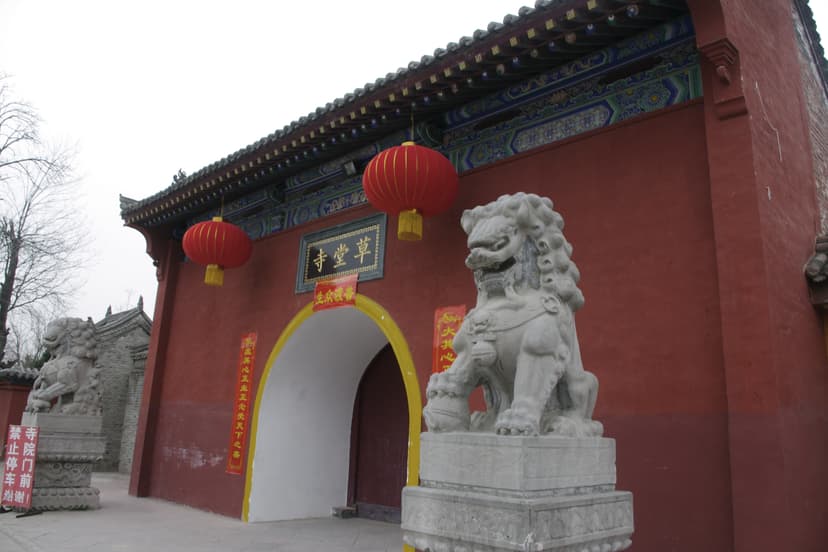
Caotang Temple, located on the northern slope of Mount Guifeng in Xi'an, China, is a historically significant Buddhist temple. It holds immense importance as the site where the monk Kumārajīva resided and translated key Mahayana texts in the 4th century, laying the groundwork for East Asian Mādhyamaka. Consequently, Caotang Temple is revered as the cradle of this influential Buddhist school.

Foguang Temple
Foguang Temple is a significant Buddhist temple located in Shanxi Province, China, renowned for its exceptionally preserved Tang dynasty architecture, particularly the Dongda Hall. It is considered a national treasure of ancient Chinese architecture, housing a unique collection of Tang-era art and inscriptions, making it a vital site for understanding China's architectural and religious history.