
Guangren Temple
Guangren Temple, also known as Guangren Lama Temple, is a significant Buddhist temple located in Xi'an, China. Established by Emperor Kangxi in 1705, it holds the distinction of being the only Tibetan Buddhist temple in Shaanxi province. The temple served as a vital accommodation and religious activity center for Tibetan Buddhist leaders visiting the Qing court and has since been recognized as a National Key Buddhist Temple.
Key Facts
- ›Founded in 1705 by Emperor Kangxi of the Qing dynasty.
- ›The sole Tibetan Buddhist temple in Shaanxi province.
- ›Designated as a National Key Buddhist Temple in Han Chinese Area in 1983.
- ›Features a central axis with various halls including the Main Hall, Thousand Buddha Hall, and Buddhist Texts Library.
- ›Houses a collection of 6,600 volumes of Prajnaparamita sutras awarded by Emperor Kangxi.
- ›Architectural elements include plaques inscribed by Qing emperors and statues of various Buddhist deities and figures.

Important Relationships
- Kangxi Emperor
- Yang Hucheng
- Zhao Puchu
- Kang Youwei
- Qianlong Emperor
- Je Tsongkhapa
- Plaque With "Guangren Temple" Written By Kangxi Emperor
- Statue of "Two Deer Listening To Sutras" On the Roof of Shanmen
- Yingbi Carved With the Eighteen Arhats
- Statue of Thousand Handed and Eyed Guanyin
- Statues of Yamantaka, Mahakala, Yama Dharmaraja, and Palden Lhamo
- Statues of Amitayus, White Tara, Bhaisajyaguru, Ksitigarbha, Ushnisha Vijaya, Four Armed Guanyin, and Akashagarbha
- Plaque With "庄严佛土" Written By Kang Youwei
- Statue of Green Tara
- Statues of Manjushri and Samantabhadra
- Plaque With "慈云西荫" Written By Kangxi Emperor
- Statues of Je Tsongkhapa and His Disciples
- Thousand Miniature Gilded Bronze Statues of Tsongkhapa
- Engraved Pillars With Four Bodhisattvas
- Full-Length Statue of 12-Year-Old Sakyamuni
- 2,500-Year History Lotus Throne
- Plaque With "佛教圣地" Written By Qianlong Emperor
- 6,600 Volumes of Prajnaparamita Sutras
- Established By Kangxi Emperor In 1705.
- Temple Damaged By Bombs In 1931 and Reconstructed By Yang Hucheng.
- Renovated and Redecorated In 1952.
- Designated As A National Key Buddhist Temple In Han Chinese Area In 1983.
Tibetan Buddhist
About Guangren Temple
Guangren Temple, also known as Guangren Lama Temple, is a prominent Buddhist temple situated in the Lianhu District of Xi'an, Shaanxi, China. It holds the unique distinction of being the sole Tibetan Buddhist temple within Shaanxi province. Its establishment in 1705 by Emperor Kangxi of the Qing dynasty was motivated by the need to provide accommodation and facilities for the numerous Tibetan Buddhist leaders who traveled to Beijing to meet with the emperor. This strategic placement in Xi'an facilitated their religious practices and interactions.
Historical Context and Development
The temple's history is marked by periods of both imperial patronage and significant historical shifts. Following the fall of the Qing dynasty in 1911, Guangren Temple was repurposed for use as an office by the local government. A notable event occurred in 1931 when bombing damaged the abbot's room, though it was subsequently rebuilt under the direction of Yang Hucheng. In 1952, the temple underwent a comprehensive renovation and redecoration with state funding. Its historical and religious importance was further solidified in 1983 when the State Council of China designated it as a National Key Buddhist Temple in the Han Chinese Area.
Architectural Significance
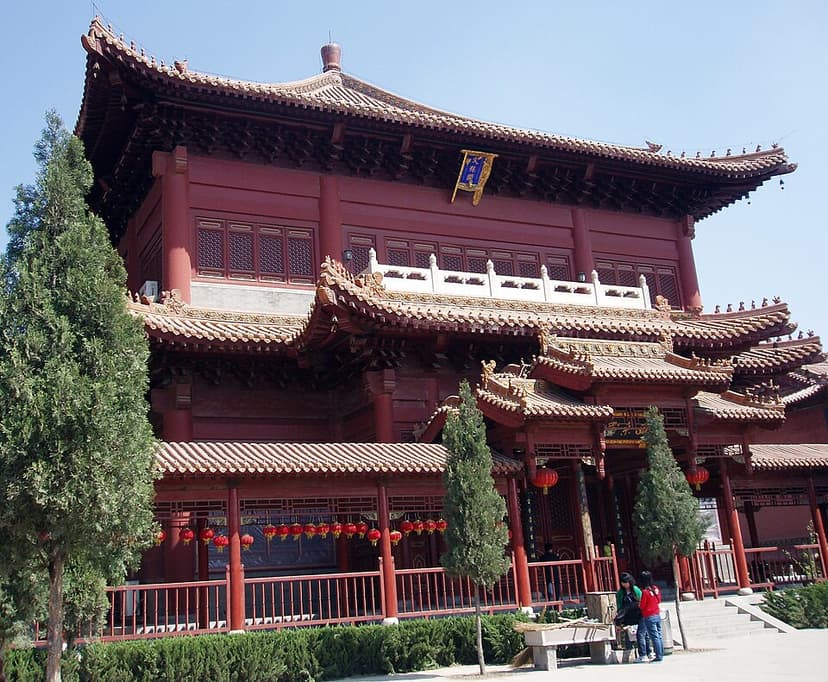
The architectural layout of Guangren Temple is oriented towards the south, with a central axis that connects various important halls and structures. These include the Shanmen (temple gate), the Hall of the Four Heavenly Kings, the Changshou Hall, the Hufa Jingang Hall, the Main Hall, the Reception Room, the Hall of the God of Wealth, the Thousand Buddha Hall, the Buddhist Texts Library, and the Mahavira Hall. The Shanmen features a plaque with the characters "Guangren Temple" inscribed by Emperor Kangxi himself, and its roof is adorned with a statue symbolizing "Two Deer Listening to Sutras," a motif common in Tibetan Buddhist temple construction.
Other notable architectural elements and religious artifacts found within the temple include the Yingbi, a screen wall intricately carved with the Eighteen Arhats. The Guanyin Hall houses a statue of the Thousand Handed and Eyed Guanyin, while the Hufa Jingang Hall contains statues of wrathful deities such as Yamantaka and Mahakala. The Changshou Hall is dedicated to Amitayus and features statues of various Tara and Bhaisajyaguru figures. The Green Tara Hall is adorned with a plaque bearing Emperor Kangxi's calligraphy. The Thousand Buddha Hall is notable for enshrining statues of Je Tsongkhapa and his disciples, with one thousand miniature gilded bronze statues of Tsongkhapa inlaid on its walls. The Buddhist Texts Library, distinguished by its golden roof tiles, houses a vibrant statue of a 12-year-old Sakyamuni and a 2,500-year-old lotus throne from ancient India. A plaque above the library's eaves, bearing the inscription "Buddhist Holy Land," was written by Emperor Qianlong.
Source: Wikipedia ↗
Frequently Asked Questions
When was Guangren Temple founded?
Guangren Temple was first established in 1705 during the Qing dynasty by Emperor Kangxi. This was in the 44th year of the Kangxi period.
What is the significance of Guangren Temple?
It is the only Tibetan Buddhist temple in Shaanxi province and served as a place for Tibetan Buddhist leaders to stay and participate in religious activities when visiting the Qing court. In 1983, it was recognized as a National Key Buddhist Temple in Han Chinese Area.
What are some notable architectural features of Guangren Temple?
The temple's central axis includes structures like the Shanmen, Four Heavenly Kings Hall, and Mahavira Hall. Notable features include plaques inscribed by Emperors Kangxi and Qianlong, and the statue of the Thousand Handed and Eyed Guanyin in the Guanyin Hall.
What valuable artifacts or texts are housed at Guangren Temple?
The Buddhist Texts Library at Guangren Temple stores 6,600 volumes of Prajnaparamita sutras, which were a gift from Emperor Kangxi. The library also houses a 2,500-year-old lotus throne that originated from ancient India.
Has Guangren Temple undergone significant historical events?
Yes, after the fall of the Qing dynasty, the temple was used as a local government office. In 1931, it was damaged by bombs but subsequently reconstructed. It also underwent renovation and redecoration in 1952.
Related Buddhist Temples

Amarbayasgalant Monastery
Amarbayasgalant Monastery is one of Mongolia's three largest Buddhist monastic centers, established in the early 18th century. It was built to house the remains of Zanabazar, the first spiritual head of Tibetan Buddhism for the Khalkha in Outer Mongolia, and reflects a unified Chinese architectural style with Mongol and Tibetan influences.
Bailin Temple (Beijing)
Bailin Temple, meaning 'Monastery of the Cypress Grove,' is a significant 14th-century Tibetan Buddhist temple located in Beijing, China. Originally constructed in 1347 during the Yuan Dynasty, it served as a prominent center for the Sakya school before experiencing periods of disrepair and subsequent renovations under various emperors. The temple holds a complete set of printing blocks for the Tripitaka, carved in the early 18th century, which are considered a valuable cultural and religious relic.

Pusading
Pusading, also known as the Bodhisattva Summit Temple, is a significant Buddhist temple located in Taihuai Town, Shanxi, China. It is considered the finest temple among all those situated on Mount Wutai and holds historical importance, having been established during the Northern Wei dynasty and later converted to Tibetan Buddhism in the Qing dynasty.