
Bailin Temple (Beijing)
Bailin Temple, meaning 'Monastery of the Cypress Grove,' is a significant 14th-century Tibetan Buddhist temple located in Beijing, China. Originally constructed in 1347 during the Yuan Dynasty, it served as a prominent center for the Sakya school before experiencing periods of disrepair and subsequent renovations under various emperors. The temple holds a complete set of printing blocks for the Tripitaka, carved in the early 18th century, which are considered a valuable cultural and religious relic.
Key Facts
- ›Construction began in 1347 during the reign of Yuan Emperor Shun.
- ›It was initially occupied by the Sakya school of Tibetan Buddhism.
- ›The temple underwent significant renovations in the Ming and Qing dynasties, including a major refurbishment in 1713 supervised by Prince Yong (later Emperor Yongzheng).
- ›It houses a complete set of 7,240 printing blocks for the Tripitaka, carved in the early 18th century.
- ›The temple is located in Dongcheng District, Beijing.
- ›Access is generally restricted to those affiliated with institutions housed there, with public access limited to Cultural Heritage Day.
Important Relationships
- Yuan Emperor Shun
- Sakya school of Tibetan Buddhism
- Zhengtong Emperor
- Kangxi Emperor
- Prince Yong (later Yongzheng Emperor)
- Gelug school of Tibetan Buddhism
- Yonghegong Lamasery
- Qianlong Emperor
- Master Taiyuan
- Master Tanxu
- Zhang Zuolin
- Ministry of Culture/Central Academy of Cultural Administration
- Beijing Historical Site Preservation Bureau
- Beijing Cultural Heritage Protection Centre (CHP)
- A Complete Set of Printing Blocks For the Tripitaka
- Statues of the Buddhas of the Three Worlds
- Seven Carved and Gilded Buddha Images Dating From the Ming Dynasty
- Two Large Bronze Bells, 2.6 Meters Tall, Cast In 1707
- Construction Began In 1347.
- Overthrow of the Sakya School In Tibet In 1355 Led To Initial Decline.
- Renovation Ordered By the Zhengtong Emperor In 1447.
- Palace For Prince Yong Built Nearby In 1694.
- Major Renovation In 1713 Under Prince Yong's Supervision.
- Partial Oblivion Due To the Rise of Yonghegong Lamasery.
- Lavish Renovation Ordered By the Qianlong Emperor In 1758.
- Temple Spared During the 1860 and 1900 Invasions.
- Temples Entered Into Decadence After the Qing Dynasty's End.
- Establishment of A Buddhist Academy In 1929.
- Academy Closure In 1932 Due To Financial Difficulties.
- Attacked By Red Guards In August 1966.
- Government-Funded Renovation In 1992.
Tibetan Buddhist
About Bailin Temple (Beijing)
Bailin Temple (柏林寺; Bǎilín Sì), translating to 'Monastery of the Cypress Grove,' is a historic 14th-century Tibetan Buddhist temple situated in Beijing, China. Established in 1347 during the Yuan Dynasty, it was initially a significant center for the Sakya school, which held considerable influence under the Mongol emperors. The temple's history is marked by periods of decline and extensive renovations, particularly under the Ming and Qing dynasties, with notable refurbishment efforts supervised by imperial figures.
History and Development
The temple's construction began in 1347 in the capital city of Dadu. Its early fortunes were tied to the Sakya school, but a shift in power in Tibet and the fall of the Yuan Dynasty in 1368 led to its disrepair. Despite the Ming Dynasty's relocation of the capital to Beijing in 1421, Bailin Temple remained neglected until the Zhengtong Emperor ordered its renovation in 1447. The temple largely survived subsequent conflicts, including the rebel army takeovers of Beijing in 1644. A significant period of revival occurred in the early 18th century when Prince Yong, later Emperor Yongzheng, became a patron. He oversaw a major renovation in 1713, coinciding with his father Emperor Kangxi's 60th birthday. The subsequent rise of the Yonghegong Lamasery, also patronized by royalty, led to a relative decline in Bailin Temple's prominence, though it was maintained.
During the Warlord era, Tibetan Buddhism was viewed with less favor, and temples faced challenges. In 1929, Abbot Taiyuan established a Buddhist academy within the temple, which played a role in advancing Buddhist studies in Beijing, though it closed in 1932 due to financial instability. The modern era saw further difficulties, with the temple being attacked by Red Guards in 1966 and subsequent alterations to its structures. A government-funded renovation in 1992 restored the original buildings, and the Beijing Cultural Heritage Protection Centre (CHP) has since established its headquarters there.
Architecture and Relics
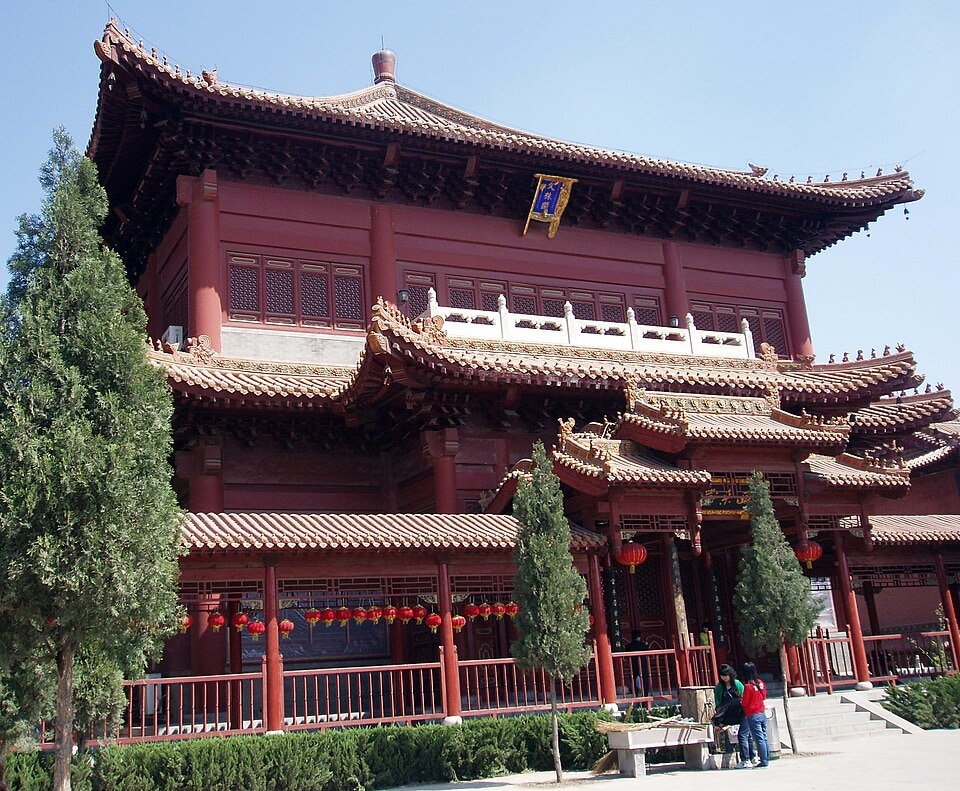
The temple's layout follows a central axis with five main structures: the main gate, the Devaraja Hall, the Hall of Attaining Perfection, the Mahavira Hall, and the Vimalakirti Hall. The Mahavira Hall features a plaque inscribed by Emperor Kangxi and houses statues of the Buddhas of the Three Worlds. Adjacent is the Hall of Vimalakirti, containing Ming Dynasty Buddha images. Notable among the temple's treasures is a complete set of 7,240 printing blocks for the Tripitaka, carved in pear wood during the early 18th century. These blocks, originally stored in the Palace Museum, are now under the care of the Beijing Library and represent a significant contribution to Buddhist textual preservation.
Source: Wikipedia ↗
Frequently Asked Questions
When was Bailin Temple built?
Bailin Temple's construction began in 1347, during the Yuan Dynasty. It was established on an open tract of land in the capital city, Dadu.
What is the significance of the printing blocks at Bailin Temple?
The temple houses a complete set of printing blocks for the Tripitaka, carved in the early 18th century. This collection consists of 7,240 blocks made of high-grade pear wood and remains in fine condition, representing a significant cultural and religious artifact.
What Buddhist school was originally associated with Bailin Temple?
The temple was initially occupied by the Sakya school of Tibetan Buddhism, which held considerable influence under the Mongol emperors of the Yuan Dynasty.
How can visitors access Bailin Temple?
Bailin Temple is typically accessible only to individuals associated with the institutions currently hosted within its grounds. However, the gates are opened to the public on Cultural Heritage Day, which falls on June 8th each year.
What happened to Bailin Temple during the modern era?
After the Communist takeover in 1949, the temple experienced decadence, and in 1966, it was attacked by the Red Guards, leading to the evacuation of lamas and reorganization of buildings. A government-funded renovation occurred in 1992, restoring the original structures.
Related Buddhist Temples
Chenrezig Tibetan Buddhist Center of Philadelphia
The Chenrezig Tibetan Buddhist Center of Philadelphia (CTBC) is a Tibetan Buddhist community established in 1989 by Lama Losang Samten. The center serves as a place for the study and cultivation of loving-kindness and compassion, offering a non-sectarian and inclusive environment for practitioners. It is named and was blessed by His Holiness the Dalai Lama, reflecting its deep connection to Tibetan Buddhism.

Amarbayasgalant Monastery
Amarbayasgalant Monastery is one of Mongolia's three largest Buddhist monastic centers, established in the early 18th century. It was built to house the remains of Zanabazar, the first spiritual head of Tibetan Buddhism for the Khalkha in Outer Mongolia, and reflects a unified Chinese architectural style with Mongol and Tibetan influences.
Cloud Platform at Juyongguan
The Cloud Platform at Juyongguan is a significant mid-14th-century Buddhist structure located at the Juyongguan Pass of the Great Wall of China. Originally serving as the base for three stupas, it is now celebrated for its intricate Buddhist carvings and multilingual inscriptions, making it a key historical and cultural site.