
Amarbayasgalant Monastery
Amarbayasgalant Monastery is one of Mongolia's three largest Buddhist monastic centers, established in the early 18th century. It was built to house the remains of Zanabazar, the first spiritual head of Tibetan Buddhism for the Khalkha in Outer Mongolia, and reflects a unified Chinese architectural style with Mongol and Tibetan influences.
Key Facts
- ›Founded by order of the Yongzheng Emperor of Qing China, with construction between 1727 and 1736.
- ›Established as the final resting place for Zanabazar, the first Jebtsundamba Khutuktu.
- ›The monastery's architecture exhibits a dominant Chinese style, with elements of Mongol and Tibetan influence.
- ›Originally comprised over 40 temples, laid out in a symmetrical north-south axis.
- ›Partially destroyed during Stalinist purges in 1937, with only central buildings surviving.
- ›Restoration efforts began in 1988, supported by UNESCO and private funding.

Important Relationships
- Yongzheng Emperor
- Qianlong Emperor
- Zanabazar
- Kangxi Emperor
- Unified Chinese Architectural Style With Mongol and Tibetan Influences
- Symmetrical Layout With Main Buildings On A North-South Axis
- Remains of Zanabazar
Construction Between 1727 and 1736, Transfer of Zanabazar's Remains In 1779, Destruction During Stalinist Purges In 1937, Restoration Work Began In 1988
Chinese, Mongol, Tibetan
About Amarbayasgalant Monastery
Amarbayasgalant Monastery, also known historically by its Manchu and Chinese names, is one of the three largest Buddhist monastic centers in Mongolia. Its complex is located in the Iven Valley near the Selenge River, nestled at the foot of Mount Büren-Khaan in the Baruunbüren District of Selenge Province in northern Mongolia.
Founding and Purpose
The monastery was established and funded by order of the Yongzheng Emperor of Qing China, with construction taking place between 1727 and 1736. It was intended to serve as a final resting place for Zanabazar (1635–1723), the first Jebtsundamba Khutuktu, who was the spiritual head of Tibetan Buddhism for the Khalkha in Outer Mongolia and a spiritual mentor to the emperors' ancestor, the Kangxi Emperor. Tradition suggests the monastery was named after two boys, Amur and Bayasqulangtu, who were encountered by the exploratory group; however, it is more likely that the site was chosen because it was where Zanabazar's mobile monastery was encamped at the time of his death. Zanabazar's remains were eventually transferred to the monastery in 1779.
Architecture and Layout
Unlike some other monastic complexes, Amarbayasgalant Monastery exhibits a significant stylistic unity. The overriding architectural style is Chinese, complemented by Mongol and Tibetan influences. The design is said to resemble Yongzheng's own palace, Yonghegong, in Beijing, which was later converted into a Buddhist monastery by his son, the Qianlong Emperor. Originally, the monastery consisted of over 40 temples, arranged in a symmetrical pattern with the main buildings positioned along a north-south axis and secondary buildings on parallel sides.
Historical Challenges and Restoration
Amarbayasgalant Monastery was one of the few monastic centers to partially escape destruction during the Stalinist purges of 1937. Following these purges, many monks were executed, and the monastery's valuable artifacts, including thangkas, statues, and manuscripts, were looted, although some were successfully hidden. Today, approximately 28 temples remain. Restoration efforts commenced in 1988, supported by funds from UNESCO and private sources, and some new statuary was commissioned from New Delhi, India.
Significance
Amarbayasgalant Monastery is dedicated to Zanabazar's main tutelary deity, Maitreya. It remains an important Buddhist monastic center and a site of historical and cultural significance in Mongolia. Its partial survival and subsequent restoration underscore its resilience and ongoing importance to the Buddhist faith in the region.
Source: Wikipedia ↗
Frequently Asked Questions
Where is Amarbayasgalant Monastery located?
Amarbayasgalant Monastery is situated in the Iven Valley near the Selenge River, at the foot of Mount Büren-Khaan in Baruunbüren District of Selenge Province in northern Mongolia. The nearest town is Erdenet.
Who was Zanabazar and why is he significant to Amarbayasgalant Monastery?
Zanabazar was the first Jebtsundamba Khutuktu, the spiritual head of Tibetan Buddhism for the Khalkha in Outer Mongolia. The monastery was built to serve as his final resting place and is dedicated to his main tutelary deity, Maitreya.
What is the architectural style of Amarbayasgalant Monastery?
The monastery displays great stylistic unity, primarily in the Chinese style, with some Mongol and Tibetan influences. It is noted to resemble Yongzheng's own palace, Yonghegong, in Beijing.
What happened to Amarbayasgalant Monastery during the Stalinist purges?
During the Stalinist purges of 1937, Amarbayasgalant Monastery was partly destroyed. Many monks were executed, and the monastery's artifacts were looted, though some were hidden. Only the buildings of the central section largely remained.
Is Amarbayasgalant Monastery currently undergoing restoration?
Yes, restoration work began in 1988. Funds for the restoration have been provided by UNESCO and private sources, and new statuary has been commissioned.
Related Buddhist Temples
Deer Park Buddhist Center and Monastery
Deer Park Buddhist Center and Monastery in Oregon, Wisconsin, is a prominent center for Tibetan Buddhism, founded in 1975 by Geshe Lhundub Sopa. It serves as a monastic and teaching institution, upholding the Dalai Lama's tradition and attracting international students. The center is currently undertaking a significant temple expansion project to house Tibetan art and artifacts, expand educational programs, train new monks, and promote Tibetan freedom.
Baldan Bereeven Monastery
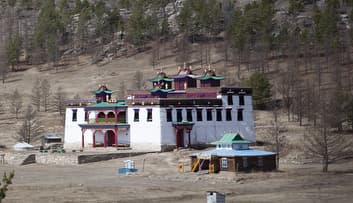
Baldan Bereeven Monastery is a significant Gelugpa Buddhist monastery located in the Khentii Province of Mongolia. Originally founded in 1654 and modeled after Tibetan monasteries, it grew to become one of Mongolia's largest and most important religious centers, reaching its zenith in the mid-19th century with up to 8,000 monks. Although destroyed by the communist regime in 1937, restoration efforts have been underway since 1990, with three temples currently rebuilt.
Chenrezig Tibetan Buddhist Center of Philadelphia
The Chenrezig Tibetan Buddhist Center of Philadelphia (CTBC) is a Tibetan Buddhist community established in 1989 by Lama Losang Samten. The center serves as a place for the study and cultivation of loving-kindness and compassion, offering a non-sectarian and inclusive environment for practitioners. It is named and was blessed by His Holiness the Dalai Lama, reflecting its deep connection to Tibetan Buddhism.