
Baldan Bereeven Monastery
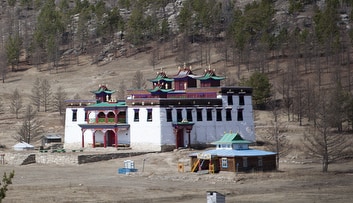
Baldan Bereeven Monastery is a significant Gelugpa Buddhist monastery located in the Khentii Province of Mongolia. Originally founded in 1654 and modeled after Tibetan monasteries, it grew to become one of Mongolia's largest and most important religious centers, reaching its zenith in the mid-19th century with up to 8,000 monks. Although destroyed by the communist regime in 1937, restoration efforts have been underway since 1990, with three temples currently rebuilt.
Key Facts
- ›Founded in 1654 by lama Tsevendorj.
- ›Modeled after the Drepung Monasteries of Tibet.
- ›Reached its peak in the MID-19th century, housing up to 8,000 monks.
- ›Completely destroyed by the communist regime in 1937.
- ›Restoration efforts began in 1999, with three temples rebuilt.
- ›Located in a valley surrounded by sacred mountains resembling animals.
Important Relationships
- Zanabazar
- Remains of Nearly 50 Temples, Stupas, and Religious Edifices
- Cliff Carvings On Munkh Ulziit Mountain
- Stone Carvings of Buddhist Gods
- Inscriptions of Religious Mantras
- Large Soyombo Symbol
- Sacred Mountains Resembling Animals
- Founded In 1654
- Main Temple Completed In 1776
- Tsogchin Dugan Completed In 1813
- Reached Peak In Mid-19th Century
- Epidemic In Circa 1900 Reduced Monastic Population
- Destroyed In 1937 During Stalinist Purges
- Restoration Efforts Began In 1999
- Placed On Unesco Tentative List In 2012
Tibetan
About Baldan Bereeven Monastery
Baldan Bereeven Monastery is a significant Gelugpa Buddhist monastery located in the Baruun Jargalant River valley in the Ömnödelger district of Khentii Province, Mongolia. Its Mongolian name, Baldan Bereeven, is a translation of the Tibetan "Drepung," meaning "pile of rice," and the monastery was initially modeled after the Drepung Monasteries in Tibet and India.
Founding and Growth
The monastery was first established in 1654 by lama Tsevendorj, who had studied with Zanabazar, the First Bogd Gegeen of Mongolia, in Tibet. Tsevendorj aimed to create a pilgrimage site in Mongolia similar to Lumbini, the birthplace of the Buddha, for Mongolian pilgrims unable to travel to India. The main temple, Dash Tsepel Ling, was completed in 1776, followed by the Tsogchin Dugan (great hall) Temple in 1813, which was architecturally reminiscent of Tibet's Kumbum Monastery. By 1850, Baldan Bereeven had reached its zenith as a teaching monastery, boasting four colleges and over twenty temples, with a monastic population of nearly 8,000.
Destruction and Restoration
Following the establishment of Mongolia's communist regime in 1921, the monastery faced severe persecution. Beginning in the 1930s, many monks were expelled, and religious property was confiscated. The monastery complex was completely razed in 1937 during Stalinist purges, with many remaining monks executed or sent to labor camps. The monastery's precious relics were melted down and sent to the Soviet Union. For nearly six decades, the ruins remained off-limits. After the democratic revolution in 1990, restoration efforts commenced, with three temples being rebuilt starting in 1999. In 2012, Baldan Bereeven Monastery and its surrounding area were designated as a tentative site for UNESCO World Heritage nomination.
Location and Features
The monastery is situated within a landscape of scenic and sacred mountains, including Munkh Ulziit, Arvan Gurvan Sansar, Bayan Baraat, and Bayan Khangai, all part of the Khentii mountain range. These mountains are traditionally said to resemble a lion, dragon, tiger, and Garuda. The steep cliff of Munkh Ulziit mountain, which backs the monastery, is adorned with numerous cliff carvings, stone carvings depicting Buddhist deities, inscriptions of religious mantras, and a large Soyombo symbol.
Source: Wikipedia ↗
Frequently Asked Questions
When was Baldan Bereeven Monastery founded?
Baldan Bereeven Monastery was founded in 1654. It was established by lama Tsevendorj with an initial community of about 1500 lamas.
What was the significance of Baldan Bereeven Monastery at its height?
At its peak in the mid-19th century, Baldan Bereeven Monastery was one of the largest and most important monasteries in Mongolia. It housed up to 8,000 monks and contained four colleges and over twenty temples.
What happened to Baldan Bereeven Monastery during the communist era?
The monastery was largely destroyed in 1937 during Stalinist purges under Mongolia’s communist regime. Many monks were killed or sent to labor camps, and the monastery's relics were melted down.
What is the current status of Baldan Bereeven Monastery?
Following the democratic revolution in 1990, restoration efforts began. Today, three temples have been restored, and the grounds include the remains of many original structures. The monastery and its surrounding area have also been placed on the tentative list for UNESCO World Heritage Site nomination.
What are some notable features of the monastery's location?
Baldan Bereeven Monastery is situated in the Baruun Jargalant River valley, surrounded by scenic and sacred mountains: Munkh Ulziit, Arvan Gurvan Sansar, Bayan Baraat, and Bayan Khangai. These mountains are said to resemble a lion, dragon, tiger, and Garuda. The monastery itself is backed by the cliff of Munkh Ulziit, which features cliff carvings, stone carvings of Buddhist deities, religious inscriptions, and a large Soyombo symbol.
Related Buddhist Temples

Amarbayasgalant Monastery
Amarbayasgalant Monastery is one of Mongolia's three largest Buddhist monastic centers, established in the early 18th century. It was built to house the remains of Zanabazar, the first spiritual head of Tibetan Buddhism for the Khalkha in Outer Mongolia, and reflects a unified Chinese architectural style with Mongol and Tibetan influences.

Danzandarjaa Monastery
Danzandarjaa Monastery is a Buddhist monastic complex located in Mörön, Khövsgöl Province, Mongolia. It was built in the 1990s to replace the original Mörön Monastery, which was destroyed in 1937 during the Stalinist repressions. The rebuilt monastery serves as a center for religious practice and houses an impressive collection of thangka.
Brown Palace
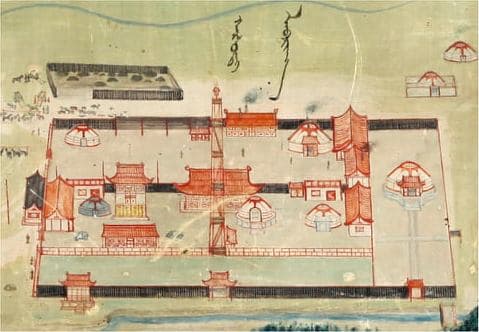
The Brown Palace, also known as Khüren ordon (Imperial Palace) and Haistai Temple (Great Temple of Knowledge), served as the summer residence of the Bogd Khan, the ruler of Mongolia. Constructed at the turn of the 20th century, it was a significant imperial complex that was later transferred to the Mongolian People's Revolutionary Party Academy, leading to the loss of most of its original structures.