
Brown Palace
Palace·Mongolia·20th century
The Brown Palace, also known as Khüren ordon (Imperial Palace) and Haistai Temple (Great Temple of Knowledge), served as the summer residence of the Bogd Khan, the ruler of Mongolia. Constructed at the turn of the 20th century, it was a significant imperial complex that was later transferred to the Mongolian People's Revolutionary Party Academy, leading to the loss of most of its original structures.
Key Facts
- ›Served as the imperial summer residence of the Bogd Khan of Mongolia.
- ›Also known by the Mongolian names Khüren ordon and Haistai Temple.
- ›Construction took place at the Tuul River from the late 19th to early 20th century.
- ›Transferred to the Mongolian People's Revolutionary Party Academy in 1924.
- ›Most structures within the complex were lost after the transfer.
- ›Included a main hall, residential yurts, and a landmark clock tower.
Important Relationships
- Bogd Khan
Clock Tower, Main Hall, Residential Yurts
- Transferred To the Mongolian People's Revolutionary Party Academy In 1924
- Most Structures Subsequently Lost
About Brown Palace
The Brown Palace, known in Mongolian as Khüren ordon (Imperial Palace) and also as Haistai Temple (Great Temple of Knowledge), was a significant imperial summer residence for the Bogd Khan, the ruler of Mongolia. Its construction took place along the Tuul River, spanning the transition from the late 19th century to the early 20th century. The complex was designed to accommodate the Bogd Khan's seasonal needs and likely included elements reflecting both imperial and religious functions.
History and Demise
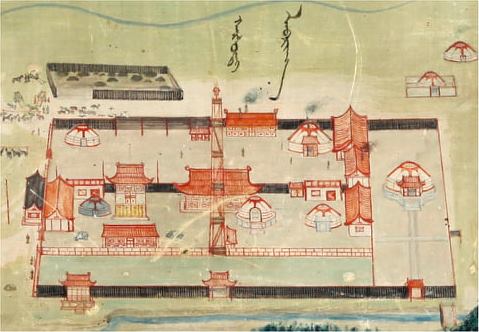
The palace complex was structured within a wider fenced enclosure, featuring a main court. Within this enclosure were the primary residential yurts and a main hall. A distinctive landmark of the Brown Palace was its clock tower. However, the historical significance of the Brown Palace was dramatically altered in 1924. Following the Bogd Khan's era, the property was transferred to the Mongolian People's Revolutionary Party Academy. This transition marked the beginning of the end for the original structures, as most of the palace buildings were subsequently lost.
Artistic Depiction
Despite the physical loss of the complex, the Brown Palace was immortalized in a large monumental painting created by the artist Marzan Sharav. This painting provides a valuable visual record of the palace and its surroundings, and it is presently housed in the Fine Arts Zanabazar Museum, serving as a testament to its former grandeur.
Source: Wikipedia ↗
Frequently Asked Questions
What was the Brown Palace used for?
The Brown Palace was primarily used as the imperial summer residence for the Bogd Khan, the ruler of Mongolia. It also held religious significance, being known as the Haistai Temple or Great Temple of Knowledge.
When was the Brown Palace built?
Construction of the Brown Palace occurred at the Tuul River from the end of the 19th century into the beginning of the 20th century.
What happened to the Brown Palace after the Bogd Khan's reign?
In 1924, the palace was transferred to the Mongolian People's Revolutionary Party Academy. Following this transfer, most of the structures within the complex were subsequently lost.
What notable features did the Brown Palace complex have?
The complex was enclosed by a fence and featured a main court. It included a main hall, residential yurts, and a prominent landmark clock tower.
Related Buddhist Temples

Danzandarjaa Monastery
Danzandarjaa Monastery is a Buddhist monastic complex located in Mörön, Khövsgöl Province, Mongolia. It was built in the 1990s to replace the original Mörön Monastery, which was destroyed in 1937 during the Stalinist repressions. The rebuilt monastery serves as a center for religious practice and houses an impressive collection of thangka.
Choijin Lama Temple
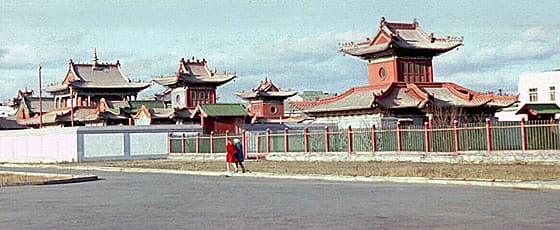
The Choijin Lama Temple, originally known as the Compassion Perfection Temple, is a significant Buddhist monastery complex located in Ulaanbaatar, Mongolia. It was constructed between 1904 and 1908 to honor Choijin Lama Luvsankhaidav, the brother of the eighth Bogd Jetsun Dampa Khan and the state oracle. The complex, comprising six temples, served as an active monastery until 1937 and was subsequently preserved as a museum, showcasing a rich collection of Buddhist art and artifacts.
Baldan Bereeven Monastery
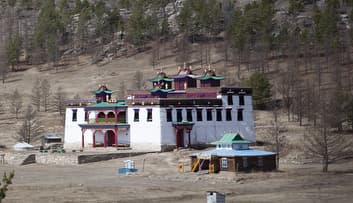
Baldan Bereeven Monastery is a significant Gelugpa Buddhist monastery located in the Khentii Province of Mongolia. Originally founded in 1654 and modeled after Tibetan monasteries, it grew to become one of Mongolia's largest and most important religious centers, reaching its zenith in the mid-19th century with up to 8,000 monks. Although destroyed by the communist regime in 1937, restoration efforts have been underway since 1990, with three temples currently rebuilt.