
Choijin Lama Temple
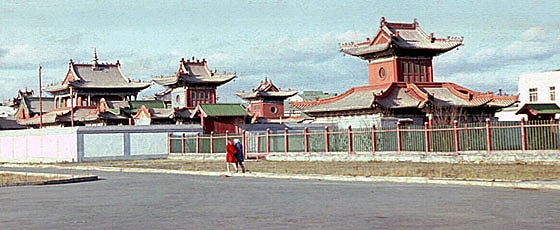
The Choijin Lama Temple, originally known as the Compassion Perfection Temple, is a significant Buddhist monastery complex located in Ulaanbaatar, Mongolia. It was constructed between 1904 and 1908 to honor Choijin Lama Luvsankhaidav, the brother of the eighth Bogd Jetsun Dampa Khan and the state oracle. The complex, comprising six temples, served as an active monastery until 1937 and was subsequently preserved as a museum, showcasing a rich collection of Buddhist art and artifacts.
Key Facts
- ›The complex consists of six temples, originally housing the state oracle Choijin Lama Luvsankhaidav and his religious retinue.
- ›Construction began in 1904 and was completed in 1908, dedicated to the State Oracle Lama Lubsanhaidub.
- ›The temple was active until 1937 before being closed during Communist repression.
- ›It was re-established as a museum in 1938 through preservation efforts.
- ›The main temple houses an 18th-century gilt statue of Buddha Sakyamuni, with significant figures and artifacts.
- ›The museum preserves a vast collection of religious instruments, thangka paintings, sculptures, and cham dance masks.
Important Relationships
- Bogd Jetsun Dampa Khan (Eighth)
- Choijin Lama Luvsankhaidav
- Bogd Jevzundamba (First Mongolian reincarnation)
18th-Century Gilt Statue of Buddha Sakyamuni, Statue of Choijin Lama Luvsankhaidav, Embalmed Corpse of Baldan Choephel, Collection of Religious Instruments, Thangka Paintings, Silk Embroideries, Wood Carvings, Statues, Cham Dance Masks, Papier-Mache Sculptures of Buddha, Gilt Bronze Sculpture of A Mahasiddha, Depictions of Tantric Gods and Their Shakti
Construction of the Complex, Closure During Communist Repression, Re-Establishment As A Museum
About Choijin Lama Temple
The Choijin Lama Temple, whose official Mongolian name translates to 'Compassion Perfection Temple,' is a significant Buddhist monastery complex situated in Sükhbaatar District, Ulaanbaatar, Mongolia. Originally comprising a main temple and five branch temples, its construction was initiated in 1904 and concluded in 1908. The complex was established in honor of Choijin Lama Luvsankhaidav, the brother of the eighth Bogd Jetsun Dampa Khan, who served as the state oracle. The temple complex was an active religious center until 1937, when it was closed amidst the Communist government's suppression of religious institutions.
Preservation as a Museum
Following its closure as an active monastery, the Choijin Lama Temple complex was re-established as a museum in 1938. This transition is attributed to the "skillful efforts of wise people" and was instrumental in preserving the site and its valuable contents throughout the period of Communist rule. Today, the Choijin Lama Museum stands as a testament to the rich history of Mongolian Buddhism and its artistic heritage.
Notable Features and Collections
The main temple of the complex is distinguished by an 18th-century gilt statue of Buddha Sakyamuni. To the Buddha's right is a statue of Choijin Lama Luvsankhaidav, and to his left rests the embalmed corpse of Baldan Choephel. The temple is also home to an extensive collection of religious instruments, thangka paintings, silk embroideries, wood carvings, and statues. A particularly notable aspect of the collection is its extensive array of cham dance masks.
Within the complex, the Zankhang temple served as a venue for Oracle trance rituals performed by Choijin Lama Luvsankhaidav. The Zuu Temple is dedicated to Buddha Shakyamuni and features papier-mache sculptures depicting the Buddha in various time periods, along with depictions of his disciples and protectors. The Yidam Temple, formerly a private prayer space for Choijin Lama Luvsankhaidav, now welcomes visitors and contains a gilt bronze sculpture of a Mahasiddha, as well as representations of tantric deities.
The museum's artifacts highlight the intricate handcrafts, fine arts, and sculpting traditions of Mongolia in the late 19th and early 20th centuries. The museum also offers insights into the re-emergence of Buddhism in Mongolia following the Communist era, with a special focus on Buddhist cham dancing and its contemporary revival.
Source: Wikipedia ↗
Frequently Asked Questions
When was the Choijin Lama Temple built?
The construction of the Choijin Lama Temple complex began in 1904 and was completed in 1908. It was built in honor of the State Oracle Lama Lubsanhaidub.
What is the historical significance of the Choijin Lama Temple?
The temple was originally occupied by Choijin Lama Luvsankhaidav, the brother of the eighth Bogd Jetsun Dampa Khan and the state oracle. It was an active monastery until 1937 and was saved from destruction during Communist repression by being re-established as a museum in 1938.
What can be found inside the Choijin Lama Temple?
The main temple features an 18th-century gilt statue of Buddha Sakyamuni. The complex also houses a large collection of religious instruments, thangka paintings, silk embroideries, wood carvings, statues, and cham dance masks.
What happened to the temple during the Communist era?
The Choijin Lama Temple was an active monastery until 1937, when it was closed during the height of Communist repression against religious traditions. In 1938, it was re-established as a museum, which likely contributed to its preservation.
What are some of the notable temples within the complex?
The complex includes the main temple, the Zankhang which was used for oracle trance rituals, the Zuu Temple dedicated to Buddha Shakyamuni, and the Yidam Temple used for prayer by Choijin Lama Luvsankhaidav. There is also a temple dedicated to the first Mongolian reincarnation of Boghda Jevzundamba.
Related Buddhist Temples

Danzandarjaa Monastery
Danzandarjaa Monastery is a Buddhist monastic complex located in Mörön, Khövsgöl Province, Mongolia. It was built in the 1990s to replace the original Mörön Monastery, which was destroyed in 1937 during the Stalinist repressions. The rebuilt monastery serves as a center for religious practice and houses an impressive collection of thangka.
Brown Palace
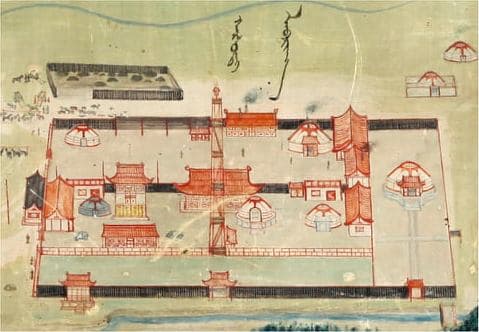
The Brown Palace, also known as Khüren ordon (Imperial Palace) and Haistai Temple (Great Temple of Knowledge), served as the summer residence of the Bogd Khan, the ruler of Mongolia. Constructed at the turn of the 20th century, it was a significant imperial complex that was later transferred to the Mongolian People's Revolutionary Party Academy, leading to the loss of most of its original structures.
Baldan Bereeven Monastery
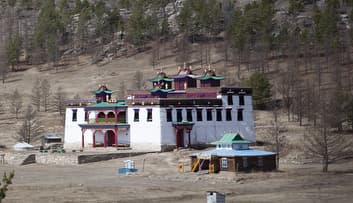
Baldan Bereeven Monastery is a significant Gelugpa Buddhist monastery located in the Khentii Province of Mongolia. Originally founded in 1654 and modeled after Tibetan monasteries, it grew to become one of Mongolia's largest and most important religious centers, reaching its zenith in the mid-19th century with up to 8,000 monks. Although destroyed by the communist regime in 1937, restoration efforts have been underway since 1990, with three temples currently rebuilt.