
Qifo Temple
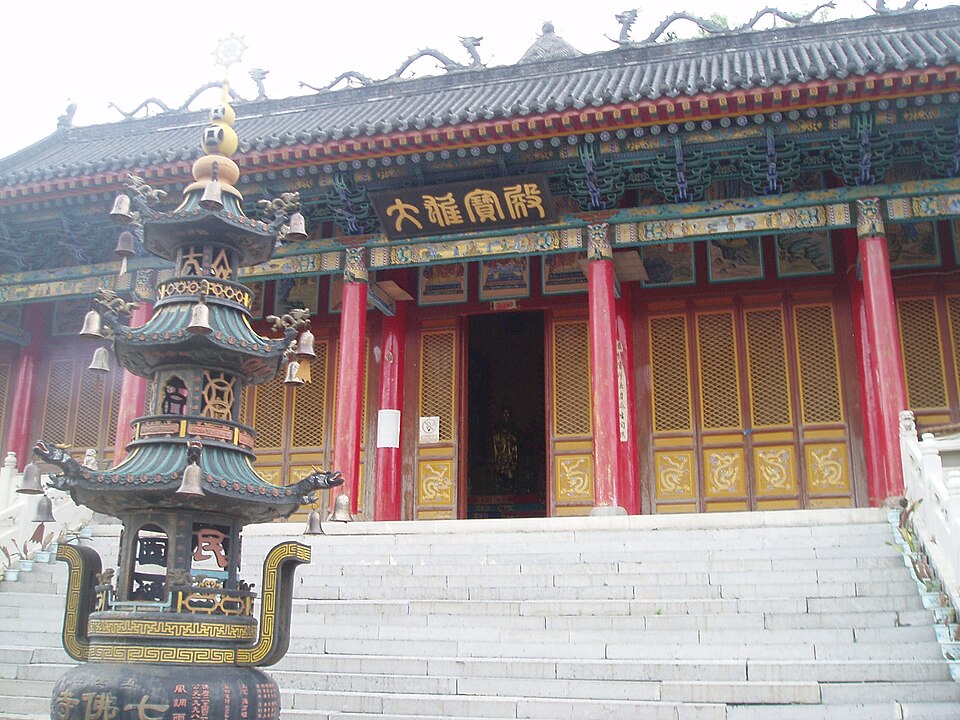
Qifo Temple is a significant Buddhist temple located in Taihuai Town, Shanxi, China. Originally constructed during the Northern Song dynasty, it has undergone several reconstructions and conversions, most notably to Tibetan Buddhism in 1734. Despite being destroyed during the Cultural Revolution, it was rebuilt starting in 1991 and features several halls and a notable white marble pagoda.
Key Facts
- ›The temple was first constructed in the Northern Song dynasty (960-1127).
- ›It was rebuilt in 1466 and again in 1734, when it converted to Tibetan Buddhism.
- ›Qifo Temple was completely destroyed during the Cultural Revolution.
- ›Reconstruction efforts began in 1991, adding multiple halls and structures.
- ›The Qifo Tower is a 22-meter high white marble pagoda, the tallest of its kind on Mount Wutai.
- ›A bell cast in 1466 during the Ming dynasty is housed within the temple.
Important Relationships
- Mount Wutai
Qifo Tower, Seven Jade Statues of Buddha From Myanmar, Statues of the Three Saints of Hua-Yan, Ming Dynasty Bell
- First Construction In Northern Song Dynasty
- Rebuilt In 1466
- Rebuilt and Converted To Tibetan Buddhism In 1734
- Completely Destroyed During the Cultural Revolution
- Reconstruction Began In 1991
Chinese Buddhist Architecture, Tibetan Buddhist Architecture
About Qifo Temple
Qifo Temple (七佛寺; Qīfó Sì) is a Buddhist temple situated in Taihuai Town, within Wutai County of Xinzhou, Shanxi province, China. Its history stretches back to the Northern Song dynasty, with initial construction occurring between 960 and 1127 CE. The temple has undergone significant transformations over the centuries, including rebuilds in 1466 during the Chenghua period and in 1734 during the Yongzheng period, the latter marking its conversion to Tibetan Buddhism.
History and Reconstruction
Despite its long history, Qifo Temple suffered complete destruction during the Cultural Revolution. The process of rebuilding the temple commenced in 1991, spearheaded by monks Zhengti and Bentong. Following this revival, several important halls were successively added, including the Mahavira Hall, Hall of Four Heavenly Kings, Qifo Hall, Three Saints Hall, Hall of Guru, Hall of Manjushri, and the Buddhist Texts Hall. These additions have helped restore the temple's spiritual and architectural prominence.
Architectural Highlights
The temple complex features several notable halls. The Qifo Hall, located on the west side, enshrines seven jade statues of Buddha sourced from Myanmar. To the east is the Three Saints Hall, which houses statues of the Three Saints of Hua-yan, with Sakyamuni at the center, flanked by Manjushri and Samantabhadra. The Hall of Guru, situated to the south, displays statues of Buddha. A particularly striking structure is the Qifo Tower, a 22-meter high white marble pagoda. This hexagonal, seven-story tower is the tallest white marble pagoda on Mount Wutai, featuring intricate carvings of lotuses, flowers, and grasses on its base, and small Buddha statues on each story representing the seven Buddhas of the past and present.
National Treasures
Among its valuable artifacts, Qifo Temple houses a bell cast in 1466, during the second year of the Chenghua period of the Ming dynasty. This ancient bell is considered a national treasure and underscores the temple's historical significance and enduring presence in Chinese Buddhist culture.
Source: Wikipedia ↗
Frequently Asked Questions
When was Qifo Temple first built?
The initial construction of Qifo Temple took place during the Northern Song dynasty, which spanned from 960 to 1127 CE. The temple has since been rebuilt multiple times.
What significant architectural features does Qifo Temple have?
A prominent feature is the Qifo Tower, a 22-meter tall white marble pagoda, which is the highest of its kind on Mount Wutai. The temple also includes the Qifo Hall, Three Saints Hall, and Hall of Guru, among others.
Has Qifo Temple always followed the same Buddhist tradition?
No, Qifo Temple converted to Tibetan Buddhism in 1734. Previously, its construction and rebuilds occurred during periods associated with different phases of Chinese Buddhism.
What is the history of Qifo Temple during the 20th century?
Qifo Temple was completely destroyed during the Cultural Revolution. However, efforts to rebuild it began in 1991, leading to the addition of several new halls and structures.
What national treasures are kept at Qifo Temple?
A significant national treasure housed at Qifo Temple is a bell that was cast in 1466 during the Chenghua period of the Ming dynasty. This bell is a testament to the temple's long history.
Related Buddhist Temples

Tabo Monastery
Tabo Monastery, also known as Tabo Chos-Khor Monastery, is a significant Buddhist enclave in Spiti Valley, Himachal Pradesh, India, renowned for its age and artistic treasures. Founded in 996 CE, it is distinguished as the oldest continuously operating Buddhist site in India and the Himalayas, housing extensive frescoes, manuscripts, and statues that depict Buddhist narratives and deities.

Pusading
Pusading, also known as the Bodhisattva Summit Temple, is a significant Buddhist temple located in Taihuai Town, Shanxi, China. It is considered the finest temple among all those situated on Mount Wutai and holds historical importance, having been established during the Northern Wei dynasty and later converted to Tibetan Buddhism in the Qing dynasty.

Shifang Temple
Shifang Temple, also known as Guangren Temple, is a significant Buddhist temple located on Mount Wutai in China's Shanxi province. Established during the Qing dynasty, it is recognized as a National Key Buddhist Temple and maintains traditional architectural styles.