
Ram Mandir, Janpath
Ram Mandir is a prominent Hindu temple situated in Bhubaneswar, Odisha, India. It is renowned for its beautiful marble idols of Lord Rama, Goddess Sita, and Lord Lakshmana, with its iconic, high-rising spire being a significant landmark visible from various parts of the city. Managed by a private trust, the temple complex also features shrines dedicated to Hanuman, Shiva, and other deities.
Key Facts
- ›Located in Bhubaneswar, Odisha, India, near Kharavel Nagar, Janpath.
- ›Houses marble idols of Lord Rama, Goddess Sita, and Lord Lakshmana.
- ›Features a distinctive high-rising spire that is a prominent city landmark.
- ›The temple complex includes shrines dedicated to Hanuman, Shiva, and other gods.
- ›Celebrates numerous Hindu festivals throughout the year, including Ram Navami and Shivaratri.
- ›Managed and maintained by a private trust.

Rama, Sita, Lakshmana, Hanuman, Shiva
Prominent Landmark In Bhubaneswar, Center For Hindu Religious Festivals
Ram Navami, Vivaha Panchami, Janmashtami, Dussehra, Shivaratri, Pana Sankranti, Raksha Bandhan
Marble
- Ochre-Painted Marble Idols of Hanuman, Shiva, and Other Gods
About Ram Mandir, Janpath
Ram Mandir is a significant Hindu temple located in Bhubaneswar, Odisha, India, specifically near Kharavel Nagar on Janpath. It is recognized as one of the notable temples in Bhubaneswar, often referred to as the ‘Temple City of India’. The temple is a popular destination for devotees and visitors alike, drawing attention for its religious importance and architectural features.
Deities and Shrines
The primary deities enshrined at Ram Mandir are Lord Rama, his consort Goddess Sita, and his brother Lord Lakshmana. The temple complex also houses separate shrines dedicated to other Hindu gods, including Hanuman and Shiva. These idols are described as being made of marble and painted in an ochre hue.
Architectural Features
A prominent attraction of Ram Mandir is its distinctive, high-rising spire, which serves as an iconic landmark in the city. This spire is visible from many parts of Bhubaneswar, contributing to the temple's recognizable profile. The temple complex is managed by a private trust, ensuring its upkeep and daily operations.
Festivals and Worship
Ram Mandir observes a wide array of Hindu festivals throughout the year. Major celebrations include Ram Navami, Vivaha Panchami, Janmashtami, Dussehra, Shivaratri, and Pana Sankranti. The temple also organizes an annual fair on the occasion of Raksha Bandhan. Devotees are drawn to the magnificent morning and evening aarti ceremonies.
Source: Wikipedia ↗
Frequently Asked Questions
What deities are worshipped at Ram Mandir, Janpath?
Ram Mandir primarily houses images of Lord Rama, his consort Goddess Sita, and his brother Lord Lakshmana. The temple complex also includes shrines dedicated to Hanuman, Shiva, and other Hindu deities, featuring ochre-painted marble idols.
What are the major festivals celebrated at Ram Mandir, Janpath?
Nearly all Hindu festivals are celebrated at Ram Mandir throughout the year. Key festivals include Ram Navami, Vivaha Panchami, Janmashtami, Dussehra, Shivaratri, and Pana Sankranti. An annual fair is also organized on the occasion of Raksha Bandhan.
What is a notable architectural feature of Ram Mandir, Janpath?
The most striking architectural feature of Ram Mandir is its high-rising, iconic spire. This spire is a significant attraction and is visible from many parts of Bhubaneswar, the capital city.
Who manages Ram Mandir, Janpath?
Ram Mandir is built and managed by a private trust. This trust oversees the maintenance and operations of the temple complex and its various shrines.
Related Temples (Hindu)

Taraknath Temple
The Taraknath Temple, located in Tarakeswar, West Bengal, India, is a significant Hindu pilgrimage site dedicated to Lord Shiva, worshiped here as Tarakanatha. Constructed in 1729, it features a distinct Bengal architectural style with an 'atchala' structure and an adjacent 'natmandir'. The temple is renowned for its belief that a dip in the nearby Dudhpukur tank fulfills prayers and is considered one of the 64 Jyotirlingas.

Tanot Mata Temple
The Tanot Mata Temple is a significant Hindu shrine located in the Jaisalmer district of Rajasthan, India, near the Pakistan border. Revered as a form of Goddess Hinglaj Mata, the temple is famously associated with the Indian victories in the Indo-Pakistani Wars of 1965 and 1971, with local folklore attributing the successful outcomes to divine intervention. The Border Security Force of India now manages the temple complex, which also includes a victory tower and a war museum.
Thriprayar Temple
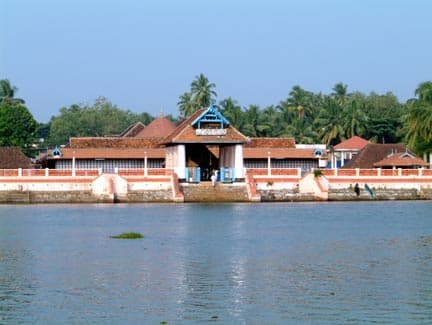
The Thriprayar Temple, also known as the Shree Ramaswami Temple, is a significant Hindu temple located in Triprayar, Thrissur district, Kerala, India. It is dedicated to Lord Rama, the seventh incarnation of Vishnu, who is depicted with four arms holding a conch, discus, bow, and garland. The temple's origin story involves the idol being worshipped by Krishna in Dwarka, later immersed in the sea, and eventually found by fishermen.