
Ram Mandir
The Ram Mandir is a significant Hindu temple complex located in Ayodhya, Uttar Pradesh, India, believed by many to be situated at the birthplace of the deity Rama. Its construction followed decades of religious and legal disputes involving the site of the former Babri Masjid, culminating in a Supreme Court decision in 2019 that awarded the land for the temple's construction. The temple was consecrated on January 22, 2024, and has since drawn immense numbers of visitors.
Key Facts
- ›The temple is believed to be located at Ram Janmabhoomi, the mythical birthplace of the Hindu deity Rama.
- ›Its construction followed the demolition of the Babri Masjid in 1992 and a subsequent Supreme Court ruling in 2019.
- ›The consecration ceremony (prāṇa pratiṣṭhā) was performed by Indian Prime Minister Narendra Modi on January 22, 2024.
- ›The temple's design is in the Maru-Gurjara architecture of Nagara style.
- ›It is built on a raised platform with three stories and features five mandapas.
- ›The construction utilized 600,000 cubic feet of sandstone and ten thousand copper plates, with no iron or steel used.

Rama, Ram Lalla
- Believed To Be the Birthplace of Lord Rama
- Site of Historical Religious and Communal Disputes
- Symbol of Hindu Nationalist Aspirations
- Major Pilgrimage Destination
Mughal Empire
Sandstone, Copper Plates
Shri Ram Janmabhoomi Teerth Kshetra, Prime Minister Narendra Modi
About Ram Mandir
The Ram Mandir is a significant Hindu temple complex located in Ayodhya, Uttar Pradesh, India. It is widely believed by many Hindus to be situated at the site of Ram Janmabhoomi, the mythical birthplace of Rama, a principal deity in Hinduism and considered a Pūrṇāvatāra of Vishnu.
Historical Context and Dispute
The site has been the subject of considerable communal tension due to its history as the location of the Babri Masjid, a mosque constructed around 1529 by Mir Baqi, a commander under Babur. Historical accounts suggest local populations believed the mosque replaced a Hindu temple. In the modern era, tensions escalated, leading to the placement of a sacred idol of Rama inside the mosque's fenced area in 1949. A campaign by the Vishva Hindu Parishad (VHP) in the 1980s to reclaim the site for Hindus resulted in the mosque's demolition in 1992.
Legal Resolution and Construction
Following years of legal disputes, the Supreme Court of India, in a landmark 2019 judgment, awarded the disputed site to Hindus for the construction of a temple. Muslims were allocated land nearby for the construction of a mosque. The court's decision referenced a report from the Archaeological Survey of India indicating the presence of a non-Islamic structure beneath the demolished Babri Masjid.
The groundbreaking ceremony (bhūmi pūjana) for the Ram Mandir was performed by Indian Prime Minister Narendra Modi in August 2020. The construction was overseen by the Shri Ram Janmabhoomi Teerth Kshetra trust. The consecration ceremony (prāṇa pratiṣṭhā) of the temple was also led by Prime Minister Modi on January 22, 2024.
Architectural Features and Scale
The temple is designed in the Maru-Gurjara architecture of the Nagara style. It features a three-story main structure built on a raised platform, with five mandapas and dedicated shrines for various deities. The construction utilized 600,000 cubic feet of sandstone and ten thousand copper plates, with a deliberate exclusion of iron and steel. Upon completion, the temple complex is noted for its scale, with the capacity to accommodate a large number of visitors and a significant portion of its grounds preserved as green space.
Source: Wikipedia ↗
Frequently Asked Questions
What is the significance of the Ram Mandir?
The Ram Mandir is significant as it is believed by many Hindus to be located at the mythical birthplace of Lord Rama, a principal deity in Hinduism. Its construction marks the culmination of a long-standing religious and legal dispute over the site.
What was the history of the site before the Ram Mandir was built?
The site was formerly occupied by the Babri Masjid, a mosque built around 1529. The mosque was demolished in 1992, following which a protracted legal battle ensued over the ownership of the land.
When was the Ram Mandir consecrated?
The consecration ceremony, known as prāṇa pratiṣṭhā, was performed by Indian Prime Minister Narendra Modi on January 22, 2024. The temple officially opened to the public on the same day.
What architectural style is the Ram Mandir designed in?
The temple is designed in the Maru-Gurjara architecture of Nagara style, a style predominantly found in northern India. The design was prepared by the Sompura family, who have a long history of temple architecture.
What materials were used in the construction of the Ram Mandir?
The main construction utilized 600,000 cubic feet of sandstone from Rajasthan. Notably, no iron or steel was used in its construction; instead, stone blocks were fused using ten thousand copper plates.
How many visitors does the Ram Mandir complex accommodate?
The temple complex has the capability to handle approximately 70,000 visitors. A pilgrims facility center is also available, offering services for up to 25,000 people.
Related Temples (Hindu)

Radha Madan Mohan Temple, Vrindavan
The Radha Madan Mohan Temple in Vrindavan is a significant 16th-century Hindu temple, considered one of the oldest in the city. It is dedicated to Madan Mohan, a form of Lord Krishna, accompanied by Goddess Radha and Lalita gopi. The temple showcases a blend of Mughal and Kalinga Nagara architectural influences.
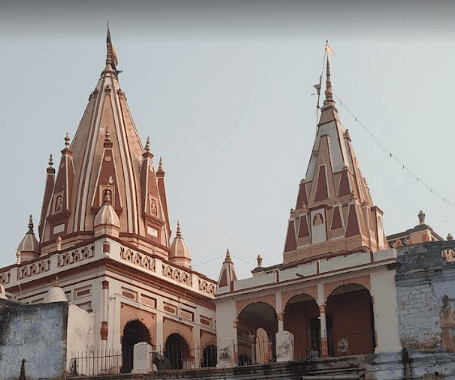
Budhanath Temple, Bhagalpur
The Budhanath Temple, also known as Vriddheshwarnath or Baba Bal Vridheshwarnath Temple, is a significant Hindu temple dedicated to Lord Shiva, located on the banks of the Uttarvahini Ganga in Bhagalpur, India. It is believed to be one of the 108 Nath temples mentioned in the Shiva Purana and is celebrated for its spiritual ambiance and as a focal point for regional cultural identity.

Mundeshwari Temple
The Mundeshwari Devi Temple, located on the Mundeshwari Hills in Bihar, India, is an ancient Hindu temple dedicated to Goddess Durga and Lord Shiva. It is recognized by the Archaeological Survey of India as a protected monument and is claimed by some scholars to be the oldest functional Hindu temple in the world, with evidence suggesting continuous worship since at least the 6th-7th century CE.