
Nilamadhav Temple
The Sri Nilamadhava Temple in Kantilo, Odisha, is an ancient and revered Hindu temple dedicated to Lord Vishnu. Situated near the banks of the Mahanadi River, it holds significant importance in the cult of Lord Jagannath and is known for its holy water spring. The temple's architecture is reminiscent of the Jagannath Temple in Puri, and it is a place of active worship and pilgrimage.
Key Facts
- ›Dedicated to Lord Vishnu in his form as Nilamadhava.
- ›Located on the banks of the Mahanadi River in Kantilo, Odisha, India.
- ›Holds a central position in the cult of Lord Jagannath.
- ›Features a permanent flow of holy water from the feet of the deity.
- ›Architecture is similar to the Jagannath Temple in Puri.
- ›Associated with the 'triveni sangam' of Odisha, a confluence of three rivers.

Vishnu, Nilamadhava
Central To the Cult of Lord Jagannath, Pilgrimage Site, Historical Importance
Maagha Saptami Festival, Ratha Saptami, Ekadashi of Magha, Pausa Purnima
Biswabasu
Mahanadi River
About Nilamadhav Temple
Sri Nilamadhava Temple
The Sri Nilamadhava Temple, located in Kantilo, Odisha, India, is an ancient and renowned Hindu temple dedicated to Lord Vishnu, particularly in his manifestation as Nilamadhava. The temple is situated near the fertile banks of the Mahanadi River, nestled between twin hills and surrounded by a tranquil forest.
Historical Context and Religious Significance
The deity worshipped here, Nilamadhava, holds a pivotal role in the broader tradition of Lord Jagannath. Historically, the deity was originally venerated as an Indranila gem image, known as 'Nilamadhava,' with origins tracing back to worship in a cave on the Brahmadri hills. The local Sabara Chief, Biswabasu, is credited with initiating this worship, referring to the deity as 'Kitung' in the Sabara dialect. The current temple structure bears architectural resemblances to the famous Jagannath Temple in Puri and is located near the confluence of three rivers—the Mahanadi, Kuanria, and Kusumi—a site referred to as the 'triveni sangam' of Odisha.
Features and Festivals
One of the distinctive attractions of the Sri Nilamadhava Temple is a perpetual spring of holy water that flows from the feet of the presiding deity. The temple complex also houses the shrine of Lord Siddheswar, adding to its spiritual importance. Major festivals celebrated here include Magha Saptami, also known as Ratha Saptami, and a significant fair takes place on the Ekadashi of the month of Magha. A special observance occurs on Pausa Purnima, during which Lord Neelamadhab is elaborately decorated with gold ornaments.
Location and Accessibility
Kantilo is strategically located near the Mahanadi River, within the Khandapada block of Nayagarh District. The nearest railway station is Nayagarh Town, and the closest airport is in Bhubaneswar. While accessible by road with regular bus services, visitors arriving by train are often advised to disembark at Bhubaneswar for more frequent bus connections to Kantilo. The temple is approximately 82 km from the state capital, Bhubaneswar, and 33 km from Nayagarh town.
Source: Wikipedia ↗
Frequently Asked Questions
What is the significance of the Nilamadhava Temple in relation to Lord Jagannath?
Lord Nilamadhava occupies a central position in the cult of Lord Jagannath. The shrine of Lord Nilamadhava is still present on the right side of the Lakshmi temple within the Puri Jagannath Temple complex.
Where is the Nilamadhava Temple located?
The temple is situated in Kantilo, within the Khandapada block of Nayagarh District, Odisha, India. It is located near the bank of the Mahanadi River, between twin hills and surrounded by forest.
What are the main festivals celebrated at the Nilamadhava Temple?
The primary festival observed is Magha Saptami, also known as Ratha Saptami. A fair is held on the Ekadashi of the month of Magha, and a special festival occurs on Pausa Purnima, during which Lord Neelamadhab is adorned with gold ornaments.
Are there any unique features of the Nilamadhava Temple?
Yes, a notable attraction is the permanent flow of holy water from the feet of Lord Nilamadhava. The temple structure itself is designed similarly to the Jagannath Temple in Puri and is located near the confluence of the Mahanadi, Kuanria, and Kusumi rivers, known as the 'triveni sangam' of Odisha.
What is the historical origin of the deity worshipped at the temple?
According to the Puranas, the deity was originally worshipped in the form of an Indranila gem image known as 'Nilamadhava'. The worship originated in a small cave in the Brahmadri hills, where the local Sabara Chief, Biswabasu, worshipped the deity known as 'Kitung' in the Sabara dialect.
Related Temples (Hindu)

Taraknath Temple
The Taraknath Temple, located in Tarakeswar, West Bengal, India, is a significant Hindu pilgrimage site dedicated to Lord Shiva, worshiped here as Tarakanatha. Constructed in 1729, it features a distinct Bengal architectural style with an 'atchala' structure and an adjacent 'natmandir'. The temple is renowned for its belief that a dip in the nearby Dudhpukur tank fulfills prayers and is considered one of the 64 Jyotirlingas.

Tanot Mata Temple
The Tanot Mata Temple is a significant Hindu shrine located in the Jaisalmer district of Rajasthan, India, near the Pakistan border. Revered as a form of Goddess Hinglaj Mata, the temple is famously associated with the Indian victories in the Indo-Pakistani Wars of 1965 and 1971, with local folklore attributing the successful outcomes to divine intervention. The Border Security Force of India now manages the temple complex, which also includes a victory tower and a war museum.
Thriprayar Temple
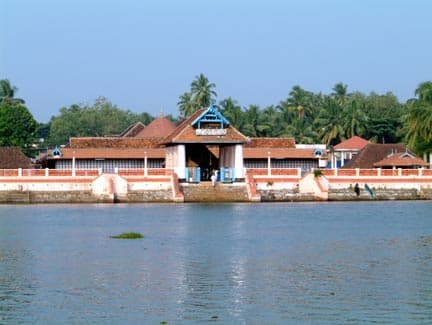
The Thriprayar Temple, also known as the Shree Ramaswami Temple, is a significant Hindu temple located in Triprayar, Thrissur district, Kerala, India. It is dedicated to Lord Rama, the seventh incarnation of Vishnu, who is depicted with four arms holding a conch, discus, bow, and garland. The temple's origin story involves the idol being worshipped by Krishna in Dwarka, later immersed in the sea, and eventually found by fishermen.