
Jagannath Temple, Ahmedabad
The Jagannath Temple in Ahmedabad, Gujarat, is a significant Hindu shrine dedicated to Lord Jagannath. It is renowned for its annual Rath Yatra festival, which is considered the third largest in India, drawing large crowds and featuring a symbolic chariot procession through the city.
Key Facts
- ›Dedicated to the Hindu God Jagannath.
- ›Hosts the third largest Rath Yatra festival in India.
- ›The Rath Yatra procession covers approximately 14 km through Ahmedabad.
- ›The temple is open daily from 04:30 AM to 01:00 PM and 03:00 PM to 09:00 PM.
- ›Experienced violence and damage during the 1969 Gujarat Riots.
- ›The Rath Yatra is celebrated as 'Lokotsav' or public festival of Gujarat.

Jagannath
Major Site For the Rath Yatra Festival, Cultural and Religious Center of Ahmedabad
Rath Yatra
About Jagannath Temple, Ahmedabad
The Jagannath Temple in Ahmedabad, Gujarat, is a prominent Hindu place of worship dedicated to Lord Jagannath. It holds significant cultural and religious importance, particularly for its annual Rath Yatra festival, which is recognized as the third largest in India, following those in Puri and Kolkata. The temple serves as a central hub for devotees and plays a crucial role in the city's religious landscape.
The Rath Yatra Festival
The annual Rath Yatra festival at this temple aligns with the tradition observed in Puri. The procession is a grand affair, often led by elephants, carrying the deities Jagannath, his brother Balabhadra, and sister Subhadra. A unique ritual involves the Chief Minister of Gujarat performing the 'Pahind Vidhi,' a symbolic cleaning of the path for the chariots. The elaborate procession traverses approximately 14 kilometers through Ahmedabad, with a notable halt at Saraspur where locals offer 'Maha Bhoj' (great feast) to the devotees. This event is celebrated as 'Lokotsav,' a public festival of Gujarat, highlighting its widespread appeal and participation.
Historical Context: 1969 Gujarat Riots
The Jagannath Temple was affected by violence during the 1969 Gujarat Riots. The unrest began when Sadhus attempting to return cows to the temple compound through crowded streets during a Muslim Urs festival led to injuries among some Muslim women and damage to vendors' carts. This incident escalated into violence, with some Muslim youths attacking the sadhus and damaging temple windows. Although a period of reconciliation followed, a dargah near the temple was later damaged by Hindus, leading to further protests and a large-scale attack on the temple by a crowd of Muslims. The ensuing rumors and escalated violence resulted in widespread arson, murders, and attacks on places of worship in the vicinity.
Temple Operations and Connectivity
The temple maintains specific visiting hours, remaining open for devotees daily from 04:30 AM to 01:00 PM and from 03:00 PM to 09:00 PM. Ahmedabad, as a major city, is well-connected by road, air, and rail, with the Sardar Vallabhbhai Patel International Airport facilitating international and domestic travel. The city's railway station is a key junction, and bus services are abundant, ensuring accessibility to the Jagannath Temple for pilgrims and visitors from across the region and beyond.
Source: Wikipedia ↗
Frequently Asked Questions
What is the significance of the Jagannath Temple in Ahmedabad?
The Jagannath Temple in Ahmedabad is significant for its dedication to Lord Jagannath and for hosting the third largest Rath Yatra festival in India. This annual chariot festival is a major event, drawing devotees and showcasing the cultural vibrancy of Gujarat.
When is the Rath Yatra celebrated at the Jagannath Temple, Ahmedabad?
The annual Rath Yatra festival at the Jagannath Temple in Ahmedabad coincides with the Rath Yatra celebrated in Puri. The timing aligns with the traditional observance of this important Hindu festival.
What happens during the Rath Yatra procession in Ahmedabad?
During the Rath Yatra, elephants lead the procession of Lord Jagannath, his brother Balabhadra, and sister Subhadra. The Chief Minister of Gujarat performs a symbolic cleaning of the path before the chariots begin their journey through the city, covering about 14 km.
What is the historical context of the 1969 Gujarat Riots in relation to the temple?
In 1969, the Jagannath Temple was attacked by a Muslim crowd following an incident involving cows belonging to the temple and injured Muslim women during a local Urs festival. This led to violence, damage to the temple, and subsequent escalations in the area.
What are the visiting hours for the Jagannath Temple in Ahmedabad?
The Jagannath Temple is open daily for devotees from 04:30 AM to 01:00 PM and again from 03:00 PM to 09:00 PM. These timings allow for worship and darshan throughout the day.
Related Temples (Hindu)

Taraknath Temple
The Taraknath Temple, located in Tarakeswar, West Bengal, India, is a significant Hindu pilgrimage site dedicated to Lord Shiva, worshiped here as Tarakanatha. Constructed in 1729, it features a distinct Bengal architectural style with an 'atchala' structure and an adjacent 'natmandir'. The temple is renowned for its belief that a dip in the nearby Dudhpukur tank fulfills prayers and is considered one of the 64 Jyotirlingas.

Tanot Mata Temple
The Tanot Mata Temple is a significant Hindu shrine located in the Jaisalmer district of Rajasthan, India, near the Pakistan border. Revered as a form of Goddess Hinglaj Mata, the temple is famously associated with the Indian victories in the Indo-Pakistani Wars of 1965 and 1971, with local folklore attributing the successful outcomes to divine intervention. The Border Security Force of India now manages the temple complex, which also includes a victory tower and a war museum.
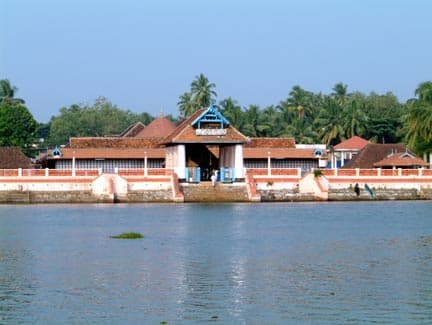
Thriprayar Temple
The Thriprayar Temple, also known as the Shree Ramaswami Temple, is a significant Hindu temple located in Triprayar, Thrissur district, Kerala, India. It is dedicated to Lord Rama, the seventh incarnation of Vishnu, who is depicted with four arms holding a conch, discus, bow, and garland. The temple's origin story involves the idol being worshipped by Krishna in Dwarka, later immersed in the sea, and eventually found by fishermen.