
Chintamani Temple, Theur
The Chintamani Temple in Theur is a significant Hindu temple dedicated to Lord Ganesha, considered one of the eight revered Ashtavinayaka shrines in Maharashtra, India. The temple's lore centers on Ganesha retrieving a wish-granting jewel and pacifying Brahma's restless mind, with historical patronage from the Peshwa rulers, particularly Madhavrao I.
Key Facts
- ›Dedicated to Lord Ganesha as the Supreme being according to the Ganapatya Sect.
- ›Located near the confluence of rivers Bhima and Mula-Mutha in Pune district, Maharashtra.
- ›Associated with the sage Kapila and the legend of the wish-granting jewel Chintamani.
- ›Renovated and expanded by Peshwa ruler Madhavrao I, who considered Ganesha his family deity.
- ›The central icon of Ganesha is self-manifested and faces East.
- ›Celebrates major festivals like Ganesha Chaturthi (Ganesha Prakatostav) and Ganesha Jayanti (Maghotsav).

Ganesha
Ashtavinayaka Shrine, Pilgrimage Site, Historical Patronage By Peshwa Rulers
Peshwa
Ganesha Prakatostav, Maghotsav, Rama-Madhav Punyostav
Black Stone, Wood
Morya Gosavi, Dharmadhar, Madhavrao I, Chimaji Appa
Central Icon of Chintamani-Ganesha
River Bhima, River Mula-Mutha
About Chintamani Temple, Theur
The Chintamani Temple of Theur is a significant Hindu temple dedicated to Lord Ganesha, recognized as one of the eight revered Ashtavinayaka shrines in the Indian state of Maharashtra. Located approximately 25 km from Pune, near the confluence of the Bhima and Mula-Mutha rivers, the temple is a prominent pilgrimage destination.
Religious Lore and Significance
The temple's lore recounts how Lord Ganesha retrieved the wish-granting jewel, Chintamani, for the sage Kapila from a greedy king named Gana. It is also said that Ganesha pacified the restless mind of Lord Brahma, who meditated at Theur, leading to the deity being known as Chintamani. Historically, Theur is believed to have been a Ganapatya pilgrimage center since ancient times, with the current structure attributed to the Ganapatya saint Morya Gosavi or his descendant.
Historical Patronage
The temple received considerable royal patronage from the Peshwa rulers of the Maratha Empire during the 18th century, who considered Ganesha their family deity. Madhavrao I was a particularly devoted patron, undertaking renovations and additions to the temple. He frequently visited the temple before engaging in battles and to express gratitude for victories. Madhavrao I spent his final days within the temple complex, and his wife Ramabai is said to have performed Sati on his funeral pyre.
Architecture and Features
The Chintamani Temple is described as one of the larger and more famous Ashtavinayaka temples. The central icon of Chintamani-Ganesha, considered self-manifested, faces East. The temple features a wooden Sabha-mandapa (assembly hall) constructed by Madhavrao, which includes a black stone water fountain. Beyond the main shrine, the complex contains smaller shrines dedicated to deities such as Mahadeva and Vishnu-Lakshmi. The Peshwa Wada, a former residence of Madhavrao, now serves as the administrative center for the temple's day-to-day activities.
Source: Wikipedia ↗
Frequently Asked Questions
What is the story behind the Chintamani Temple's name?
The temple is named Chintamani because Lord Ganesha retrieved the wish-granting jewel Chintamani for the sage Kapila. Another legend states that Ganesha blessed the god Brahma, who was meditating at Theur, and pacified his restless mind (chintas), thus becoming known as Chintamani.
What is the religious significance of Theur in the Ashtavinayaka circuit?
Theur is considered the fifth temple to be visited in the Ashtavinayak circuit. However, many pilgrims choose to visit it second, after Morgaon, due to a more convenient travel route.
Who built or significantly contributed to the current structure of the Chintamani Temple?
While the temple is believed to have existed since antiquity, the current structure was built by the Ganapatya saint Morya Gosavi or his descendant. The Peshwa ruler Madhavrao I also renovated and made significant additions to the temple.
What is the architectural style of the Chintamani Temple?
The temple features a main gate to the North and the central icon of Ganesha facing East. It includes a wooden Sabha-mandapa (assembly hall) built by Madhavrao, which contains a black stone water fountain. The complex also houses smaller shrines dedicated to other deities.
Which Peshwa ruler was particularly associated with the Chintamani Temple?
Madhavrao I (1745–1772) was a prominent patron of the Chintamani Temple. He renovated it, made additions, and used to visit before battles and to offer thanks for victories. He also spent his final days within the temple precincts.
What are the main festivals celebrated at the Chintamani Temple?
The temple celebrates three main festivals: the Ganesha Prakatostav (corresponding to Ganesh Chaturthi), the Maghotsav (commemorating Ganesha Jayanti), and the Rama-Madhav Punyostav (commemorating the death anniversary of Madhavrao I and his wife Ramabai).
Related Temples (Hindu)

Taraknath Temple
The Taraknath Temple, located in Tarakeswar, West Bengal, India, is a significant Hindu pilgrimage site dedicated to Lord Shiva, worshiped here as Tarakanatha. Constructed in 1729, it features a distinct Bengal architectural style with an 'atchala' structure and an adjacent 'natmandir'. The temple is renowned for its belief that a dip in the nearby Dudhpukur tank fulfills prayers and is considered one of the 64 Jyotirlingas.

Tanot Mata Temple
The Tanot Mata Temple is a significant Hindu shrine located in the Jaisalmer district of Rajasthan, India, near the Pakistan border. Revered as a form of Goddess Hinglaj Mata, the temple is famously associated with the Indian victories in the Indo-Pakistani Wars of 1965 and 1971, with local folklore attributing the successful outcomes to divine intervention. The Border Security Force of India now manages the temple complex, which also includes a victory tower and a war museum.
Thriprayar Temple
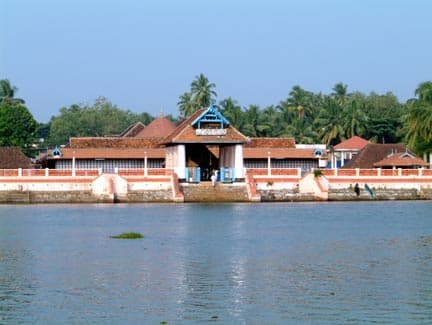
The Thriprayar Temple, also known as the Shree Ramaswami Temple, is a significant Hindu temple located in Triprayar, Thrissur district, Kerala, India. It is dedicated to Lord Rama, the seventh incarnation of Vishnu, who is depicted with four arms holding a conch, discus, bow, and garland. The temple's origin story involves the idol being worshipped by Krishna in Dwarka, later immersed in the sea, and eventually found by fishermen.