
Bhavnath
Bhavnath is a significant locality and temple complex situated in Junagadh, Gujarat, India, at the foothills of the Girnar mountain range. It is renowned for the Bhavnath Mahadev temple, believed to be a site of divine origin, and hosts ancient, vibrant festivals that draw large crowds of devotees and spiritual practitioners.
Key Facts
- ›Bhavnath is located in Junagadh city, Gujarat, India, near the Girnar mountain range.
- ›The Bhavnath Mahadev temple is believed to have a Shiva ling that emerged divinely.
- ›A legend states that Shiva and Parvati's divine garment fell into the Mrgi Kund, making it an auspicious site.
- ›Naked sadhus (Naga Bavas) bathe in the Mrgi Kund before the Mahashivaratri procession.
- ›The Bhavnath fair is a five-day event culminating on Maha Shivaratri, attracting hundreds of Naga Sadhus.
- ›The fair's origins are ancient and not precisely known.

Shiva
Mythological Origins, Site of Ancient Festivals, Pilgrimage Destination, Spiritual Gathering For Naga Sadhus
Maha Shivaratri, Girnar Lili Parikrama
Statue of Lord Dattatreya
Mrgi Kund
About Bhavnath
Bhavnath is a significant locality and temple complex situated in Junagadh city of Gujarat, India, nestled at the foothills of the revered Girnar mountain range. It is closely associated with the Bhavnath Mahadev temple, a shrine steeped in ancient myths and legends dating back to the Puranic era. The Shiva ling at this temple is believed to have emerged of its own divine volition, adding to its sacred aura.
History and Legends
According to local lore, the site gained its auspiciousness when Lord Shiva and Goddess Parvati were journeying over the Girnar Hills, and their divine garment inadvertently fell upon the present-day Mrgi Kund. This event consecrated the location as a prime spot for Shiva worship. The origins of the Bhavnath fair are so ancient that they are lost to precise historical record. The fair is a major five-day event held annually in the month of Magha (February-March), culminating on the auspicious night of Maha Shivaratri.
Festivals and Devotion
The Maha Shivaratri festival is a grand spectacle, drawing hundreds of Naga Sadhus, or naked ascetics of the Dashanami Sampradaya, who perform a ritualistic bath in the holy Mrgi Kund before joining the procession. Devotees believe that Lord Shiva himself graces the shrine with his presence on this holiest of nights. The fair attracts lakhs of pilgrims from various parts of Gujarat and beyond, as well as international tourists captivated by the vibrant marketplace selling religious artifacts and the displays of spiritual practices by the Naga Sadhus. The atmosphere is filled with music, the blowing of conch shells, and the grand procession featuring elephants, religious flags, and a palanquin carrying a decorated statue of Lord Dattatreya.
Source: Wikipedia ↗
Frequently Asked Questions
Where is the Bhavnath temple located?
The Bhavnath temple is situated in Bhavnath village, at the base of Mount Girnar in Junagadh city, Gujarat, India. It is close to Girnar Taleti, the starting point for pilgrims ascending the Girnar hills.
What is the significance of the Mrgi Kund?
The Mrgi Kund is considered an auspicious site because, according to legend, a divine garment of Shiva and Parvati fell into it while they were traveling over the Girnar Hills. It is a holy bathing spot for Naga Sadhus before they join the Mahashivaratri procession.
What are the main festivals celebrated at Bhavnath?
The two main annual festivals are Maha Shivaratri and Girnar Lili Parikrama. The Bhavnath fair, held during Maha Shivaratri, is particularly famous and attracts large numbers of devotees and Naga Sadhus.
What happens during the Maha Shivaratri festival at Bhavnath?
The Maha Shivaratri celebration culminates with the auspicious worship of Lord Shiva at midnight. Hundreds of Naga Sadhus bathe in the Mrgi Kund and offer prayers. Devotees believe Lord Shiva himself visits the shrine on this day.
Who attends the Bhavnath fair?
The Bhavnath fair is attended by lakhs of pilgrims from regions like Mewar, Kutch, and Gujarat. Foreign tourists are also drawn to the event, attracted by the stalls selling religious items and the displays of Hatha Yoga and occult practices by Naga Sadhus.
Related Temples (Hindu)

Taraknath Temple
The Taraknath Temple, located in Tarakeswar, West Bengal, India, is a significant Hindu pilgrimage site dedicated to Lord Shiva, worshiped here as Tarakanatha. Constructed in 1729, it features a distinct Bengal architectural style with an 'atchala' structure and an adjacent 'natmandir'. The temple is renowned for its belief that a dip in the nearby Dudhpukur tank fulfills prayers and is considered one of the 64 Jyotirlingas.

Tanot Mata Temple
The Tanot Mata Temple is a significant Hindu shrine located in the Jaisalmer district of Rajasthan, India, near the Pakistan border. Revered as a form of Goddess Hinglaj Mata, the temple is famously associated with the Indian victories in the Indo-Pakistani Wars of 1965 and 1971, with local folklore attributing the successful outcomes to divine intervention. The Border Security Force of India now manages the temple complex, which also includes a victory tower and a war museum.
Thriprayar Temple
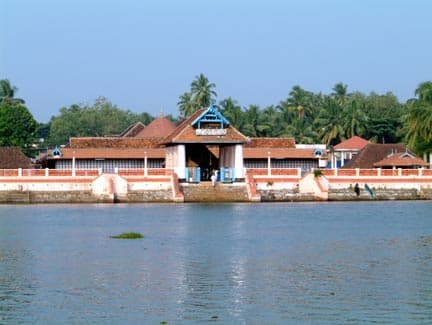
The Thriprayar Temple, also known as the Shree Ramaswami Temple, is a significant Hindu temple located in Triprayar, Thrissur district, Kerala, India. It is dedicated to Lord Rama, the seventh incarnation of Vishnu, who is depicted with four arms holding a conch, discus, bow, and garland. The temple's origin story involves the idol being worshipped by Krishna in Dwarka, later immersed in the sea, and eventually found by fishermen.