
Noah
c. 350 years after flood·Natural causes
Noah is a pivotal figure in Abrahamic religions, most famously known for building the Ark to save his family and all land animals from a divine flood. God made a covenant with Noah after the flood, promising never to destroy the earth by water again. He is also remembered as the first cultivator of the vine and a figure associated with the Seven Laws of Noah.
Key Facts
- ›Noah was the tenth and final antediluvian patriarch.
- ›He built the Ark at God's command to survive a great flood.
- ›God made a covenant with Noah, symbolized by the rainbow.
- ›Noah is traditionally credited as the first to cultivate the vine.
- ›The seven Laws of Noah are a set of ethical and legal principles attributed to him.
- ›He died at the age of 950, 350 years after the flood.
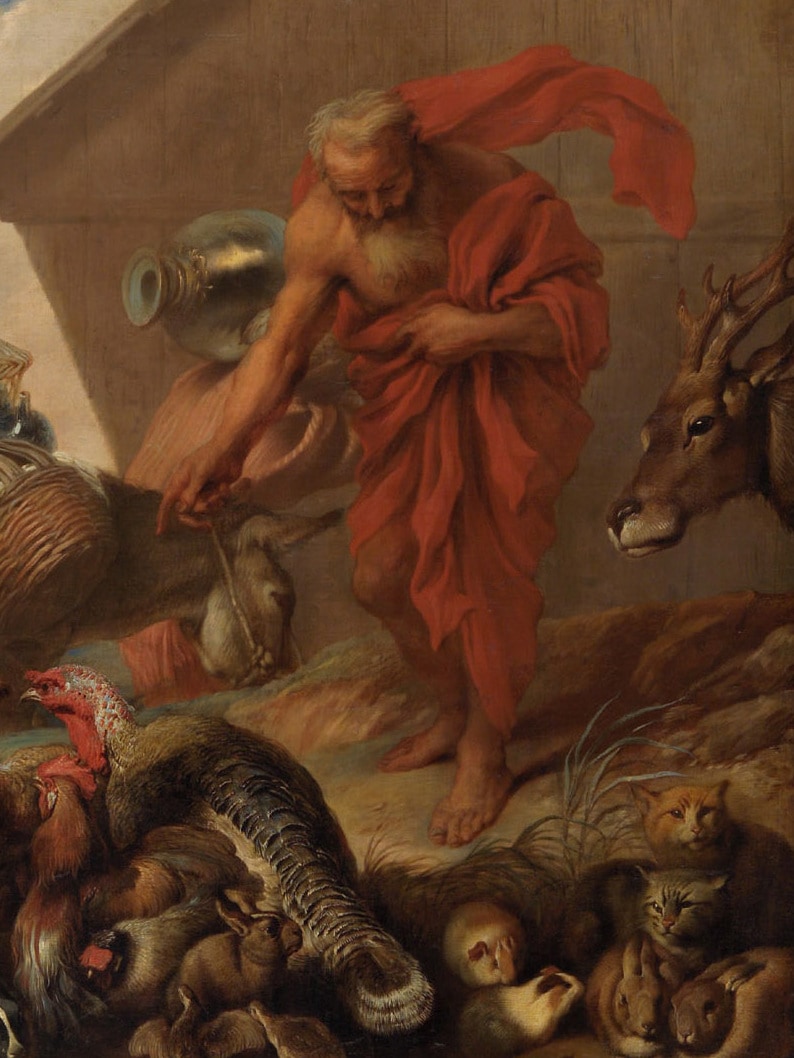
Noach
Ark, Rainbow, Vineyard
About Noah
Noah is a central figure in the traditions of Judaism, Christianity, Islam, and other Abrahamic religions, renowned for his role in the Genesis flood narrative. He is depicted as the last of the antediluvian patriarchs, a righteous man chosen by God to preserve humanity and all land animals from a catastrophic flood sent to cleanse the earth of wickedness.
The Genesis Flood Narrative
According to the Book of Genesis, God resolved to destroy all life on Earth through a great flood. Noah, however, found favor in God's eyes and was instructed to build a massive ark. He was commanded to gather his family, along with male and female pairs of every kind of land animal, into the ark. The floodwaters covered the earth, wiping out all other life. After the flood subsided, the ark came to rest on the mountains of Ararat, and Noah and his companions emerged to repopulate the earth. Following this event, God established a covenant with Noah and all living creatures, symbolized by the rainbow, promising never to repeat such a destruction by flood.
Noah's Legacy and Teachings
Beyond his role in the flood, Noah is also recognized as the first cultivator of the vine and the first to experience the effects of wine. This aspect of his story has been interpreted in various ways, with some commentators excusing his behavior due to his inexperience with wine and others focusing on the subsequent events involving his son Ham and grandson Canaan. In Jewish tradition, Noah is associated with the Seven Laws of Noah, a set of divine commandments considered binding on all humanity, encompassing prohibitions against idolatry, blasphemy, murder, adultery, theft, eating a limb from a living animal, and mandating the establishment of courts of justice.
Religious Significance
In Islam, Noah (Nuḥ) is an esteemed prophet, with a chapter of the Quran named after him. He is praised for his perseverance in preaching God's message to his disbelieving people and for his gratitude. Christian theology often views the Ark as a prefiguration of the Church, symbolizing salvation through Christ, and the sacrament of baptism. His story serves as a powerful reminder of divine judgment, mercy, and the renewal of God's relationship with creation.
Source: Wikipedia ↗
Frequently Asked Questions
Who was Noah?
Noah was a patriarch in Abrahamic religions, known for his righteousness in a wicked generation. He is most famous for building the Ark to save his family and pairs of all land animals from a great flood sent by God.
What is the story of Noah's Ark?
According to the Book of Genesis, God decided to destroy the world with a flood due to humanity's wickedness. He instructed Noah to build a large ark and take his family, along with animals, to preserve life. After the floodwaters receded, life was repopulated from the ark.
What was the covenant God made with Noah?
After the flood, God made a covenant with Noah and all living creatures, promising never again to destroy the earth with a flood. The rainbow is set as a visible sign of this covenant.
What are the Seven Laws of Noah?
These are a set of commandments traditionally enumerated in Jewish tradition that are considered binding on all humanity. They include prohibitions against idolatry, blasphemy, murder, adultery, theft, eating flesh torn from a living animal, and the requirement to establish courts of justice.
Why is Noah sometimes depicted as a farmer and vintner?
After the flood, Noah is described as a "tiller of the soil" and the first to cultivate a vineyard. His subsequent intoxication and the events that followed are part of his narrative in Genesis.
How is Noah viewed in Islam?
In Islam, Noah (Nuḥ) is considered a highly important prophet and one of the most significant figures. The Quran details his preaching, the story of the Deluge, and refers to him with titles such as 'Trustworthy Messenger of God' and 'Grateful Servant of God'.
Related Saints
Abraham
Abraham is a foundational patriarch in Judaism, Christianity, and Islam, revered as the ancestor of the Jewish and Arab peoples. His story, primarily found in the Book of Genesis, emphasizes God's promises of progeny and land, and his unwavering faith and obedience to divine commands. He is remembered for his covenant with God, his role in establishing the lineage of Isaac and Ishmael, and his willingness to sacrifice his son Isaac, an act that solidified his status as a model of faith.
Adam
Adam is the first human being, created by God according to the Book of Genesis and revered in Judaism, Christianity, Islam, and other belief systems. He is remembered for his creation from dust, his sin in the Garden of Eden by eating forbidden fruit, and his subsequent expulsion, which introduced death and sin into the world. His story serves as a foundational narrative for understanding humanity's relationship with God, the origins of sin, and the concept of redemption.
Seth
Seth is recognized in Abrahamic religions as the third son of Adam and Eve, born after the murder of his brother Abel. He is considered an important ancestor, particularly in Jewish and Islamic traditions, where he is seen as the progenitor of humanity after the Great Flood and the recipient of divine teachings.