
Milutin
October 30·14th century·Serbia
Stefan Uroš II Milutin, posthumously known as "the Holy King," was a powerful medieval Serbian monarch and member of the Nemanjić dynasty. He is remembered for his strong resistance to Byzantine attempts to impose Roman Catholicism and for significantly growing Serbia's economic power through the development of mining, founding the important silver mining site of Novo Brdo. Milutin was proclaimed a saint by the Serbian Orthodox Church.
Key Facts
- ›Milutin reigned as King of Serbia from 1282 to 1321.
- ›He conquered northern Macedonia, making Skopje his capital.
- ›His reign saw rapid economic growth, largely due to the development of silver mines like Novo Brdo.
- ›Milutin resisted Byzantine Emperor Michael VIII Palaiologos's efforts to impose Roman Catholicism.
- ›He was married five times, including to Simonis, daughter of Byzantine Emperor Andronikos II Palaiologos.
- ›Milutin was proclaimed a saint by the Serbian Orthodox Church.
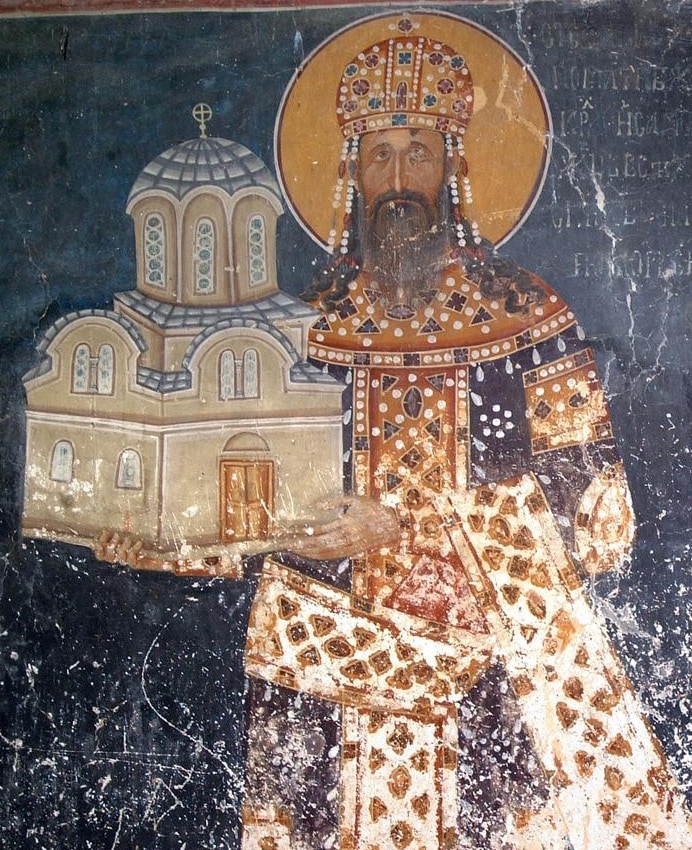
the Holy King
About Milutin
Stefan Uroš II Milutin: The Holy King
Stefan Uroš II Milutin, revered posthumously as "the Holy King," was a pivotal monarch of Serbia during the Middle Ages, reigning from 1282 to 1321 as a member of the illustrious Nemanjić dynasty. He is recognized as one of Serbia's most powerful rulers and a significant European monarch of his era. Milutin's reign was marked by his strong defense against Byzantine Emperor Michael VIII Palaiologos's attempts to enforce Roman Catholicism in the Balkans following the Union of Lyons in 1274. His rule also witnessed a substantial surge in Serbia's economic strength, primarily driven by advancements in mining. A key achievement was the founding of Novo Brdo, a settlement that evolved into a crucial international hub for silver extraction.
Life and Reign
Born around 1253, Milutin unexpectedly ascended to the Serbian throne in 1282 after his brother Stefan Dragutin's abdication. Early in his reign, he launched an invasion of Byzantine territories, capturing northern Macedonia and establishing Skopje as his capital. His military campaigns extended into Byzantine lands and secured control over northern Albania and the city of Durrës. Peace with the Byzantine Empire was established in 1299, with Milutin retaining conquered territories as part of the dowry for his fourth wife, Simonis, daughter of Emperor Andronikos II Palaiologos. Milutin's reign was also characterized by complex relationships and conflicts with Bulgarian lords and the Mongol Golden Horde, as well as internal disputes with his brother Dragutin over territorial succession.
Economic and Cultural Impact
Serbia experienced remarkable economic growth under Milutin, largely due to his focus on developing mining operations, particularly in the Kosovo region. Novo Brdo emerged as the richest silver mine in the Balkans, significantly contributing to the kingdom's wealth. Milutin's administration also saw the imitation of Venetian coinage, a practice that, while controversial, facilitated economic activity. His reign saw a significant influx of Byzantine culture into Serbia, influencing court ceremonies and artistic endeavors. Milutin was also a prolific builder, founding numerous churches and monasteries across Serbian lands, including Vitovnica Monastery, Our Lady of Ljeviš, and Gračanica Monastery.
Legacy and Veneration
By the end of Milutin's life, Serbia had become the second most powerful state in Southeast Europe, trailing only Hungary. Following his death, a brief civil war ensued before his eldest son, Stefan Dečanski, assumed the throne. Milutin's remains were eventually transferred to Bulgaria and later housed in St Nedelya Church, which acquired the name "Holy King" in his honor. He is mentioned in Dante Alighieri's Divine Comedy due to his coinage practices and is recognized among the "100 most prominent Serbs." The Serbian Orthodox Church proclaimed him a saint, with a feast day observed on October 30, commemorating his significant contributions to the kingdom and its faith.
Source: Wikipedia ↗
Frequently Asked Questions
When did Stefan Uroš II Milutin reign as King of Serbia?
Stefan Uroš II Milutin reigned as King of Serbia from 1282 until his death in 1321.
What were Milutin's major territorial conquests?
Upon his accession, Milutin invaded Byzantine lands, conquering northern Macedonia and making Skopje his capital. He also gained control of northern Albania and the city of Dyrrachion (Durrës).
How did Milutin contribute to Serbia's economy?
Milutin is credited with significantly boosting Serbia's economic power through the development of mining, particularly silver mines. He founded Novo Brdo, which became an internationally important silver mining site.
Was Milutin involved in conflicts with other powers?
Yes, Milutin engaged in conflicts with Bulgarian feudal lords, the Golden Horde (Mongols), and the Byzantine Empire. He also faced opposition from Hungarian King Charles I and Pope John XXII.
Who was Milutin's father and mother?
Milutin was the youngest son of King Stefan Uroš I and Queen Helen.
What is Milutin's religious significance?
Milutin was proclaimed a saint by the Serbian Orthodox Church and is known posthumously as "the Holy King." His feast day is celebrated on October 30.
Related Saints
Gregory of Gornjak
Gregory of Gornjak was a Serbian Orthodox monk and hesychast who studied at Mount Sinai. He is remembered for establishing a monastic colony in Moravian Serbia under the patronage of Prince Lazar, who founded the Gornjak monastery for him and his fellow monks. Gregory was later canonized as a saint and is commemorated for his spiritual leadership and the founding of this significant monastic center.
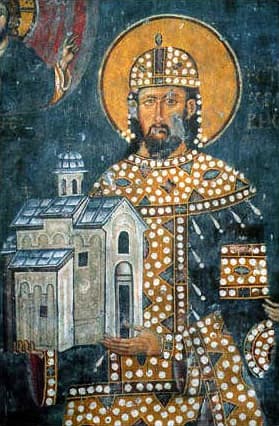
Theoctistus of Serbia
Theoctistus of Serbia, formerly known as Stefan Dragutin, was King of Serbia from 1276 to 1282 and subsequently ruled a separate northern kingdom. He is remembered for his complex political maneuvering, including his rebellion against his father, abdication in favor of his brother, and ruling significant Hungarian territories as a vassal king. Before his death, he became a monk, taking the name Theoctistus, and is venerated as a Serbian saint.
Gregory II of Ras
Grigorije II of Ras was a Serbian medieval monk and scribe who lived from approximately 1250 to 1321. He is venerated as a saint in the Serbian Orthodox Church and is remembered for his elegant, illuminated manuscripts and his work on the "Raška krmčija."