
Wettingen Abbey
Cistercian·Switzerland·Active (community re-founded in Austria), Buildings used for education and public visits·13th century
Wettingen Abbey was a significant Cistercian monastery founded in 1227 in Wettingen, Switzerland. Despite periods of financial hardship and religious upheaval, it experienced revivals and played a role in sheltering refugees. Dissolved in 1841 during secularization, its community re-established itself in Austria, while the original buildings in Switzerland now serve educational purposes but retain their heritage status and are open for public tours.
Key Facts
- ›Founded in 1227 by Cistercian monks dispatched from Salem Abbey.
- ›Its Latin name was Stella Maris, meaning 'Star of the sea'.
- ›Experienced a significant revival under Abbot Peter Schmid in the late 16th and early 17th centuries.
- ›Dissolved in 1841 by the Canton of Aargau, leading to the Aargau Monastic Conflict.
- ›The monks re-founded the community at Mehrerau, Austria, in 1854.
- ›The original buildings are now part of the Wettingen Canton School and are a heritage site of national significance.

Romanesque, Gothic
- Infant Jesus of Wettingen Painting
- Extensive Abbey Library
- Konversenkirch With Romanesque-Gothic Stained Glass Windows
- Cloister Garden With Ancient Trees
Kloster Wettingen, Stella Maris
Count Heinrich Ii of Rapperswil, Mechtidis Von Wetter, Lutold I Von Wetter, Eberhard of Rohrdorf, Konrad, Peter Schmid, Alberich Zwyssig, Vinzenz Wohlwend
- Founded In 1227.
- Suffered Financial Difficulties In the Early 16th Century.
- Fire In 1507 Destroyed Parts of the Monastery.
- Most Monks Converted To the Reformed Faith In 1529.
- Re-Catholicised After the Second War of Kappel In 1531.
- Sheltered Refugees From France After the French Revolution.
- Came Into Possession of the Canton of Aargau In 1803.
- Dissolved By Decree In 1841, Leading To the Aargau Monastic Conflict.
- Re-Founded At Mehrerau, Austria, In 1854.
About Wettingen Abbey
Wettingen Abbey, historically known as Kloster Wettingen and in Latin as Stella Maris, was a prominent Cistercian monastery located in Wettingen, within the Swiss canton of Aargau. Founded in 1227 by monks from Salem Abbey, it was established on lands provided by Count Heinrich II of Rapperswil. The monastery quickly grew, acquiring possessions and legal authority in various regions, including the Limmat valley.
History and Significance
The abbey's history is marked by periods of both prosperity and significant challenges. In the early 16th century, it faced severe financial difficulties, exacerbated by a fire in 1507 that damaged parts of the complex. A notable spiritual event during this time was the miraculous survival of the Infant Jesus of Wettingen painting from the blaze. The abbey also underwent religious shifts, with many monks converting to the reformed faith in 1529, followed by a re-Catholicization and a period of nominated abbots after the Second War of Kappel in 1531.
A revival occurred under Abbot Peter Schmid (1594–1633), during which the buildings were restored and expanded, and intellectual life flourished with the opening of a school of philosophy and theology and the establishment of a printing press. The abbey also served as a sanctuary, providing shelter to thousands of refugees during the turmoil following the French Revolution.
Dissolution and Legacy
In 1803, Wettingen Abbey came under the control of the newly formed Canton of Aargau. Despite initial assurances of its continuation, increasing financial demands from the cantonal government led to the ban on accepting novices and the closure of the abbey school. On January 13, 1841, the cantonal parliament decreed the dissolution of all monasteries in Aargau, resulting in the Aargau Monastic Conflict. The monks, including Alberich Zwyssig, composer of the Swiss national anthem, were forced to depart, and the abbey's extensive library was transferred to the Aargau Canton Library.
The monastic community re-established itself on June 8, 1854, at the secularised monastery of Mehrerau in Bregenz, Austria, a foundation that continues today as Wettingen-Mehrerau Abbey. The original buildings in Wettingen were repurposed for educational use, first by a teachers' training college and later by the Wettingen Canton School, which occupies them since 1976. The former abbey church continues to host weekly Catholic services and weddings. The buildings are recognized as a heritage site of national significance and are open to the public, offering tours that showcase historical elements like the Konversenkirch and its stained glass, as well as the ancient cloister garden.
Source: Wikipedia ↗
Frequently Asked Questions
When was Wettingen Abbey founded?
Wettingen Abbey was founded on October 14, 1227. The monks began building the monastery on this date, which was known in Latin as Stella Maris.
What religious order was Wettingen Abbey a part of?
Wettingen Abbey was a Cistercian monastery. It was founded by twelve monks and lay-brothers dispatched from Salem Abbey, another Cistercian house.
Why was Wettingen Abbey dissolved?
Wettingen Abbey was dissolved on January 13, 1841, by a decree from the cantonal parliament of Aargau as part of a broader secularization. This led to the events known as the Aargau Monastic Conflict.
What happened to the monks after the abbey was dissolved?
The monks were forced to leave the abbey. After several years of moving, they settled in the secularised monastery at Mehrerau in Bregenz, Austria, on June 8, 1854. This new foundation is now known as Wettingen-Mehrerau Abbey.
Are the buildings of Wettingen Abbey still in use?
Yes, the original buildings of Wettingen Abbey are still in use. They were made available to a teachers' training college and have been used by the Wettingen Canton School since 1976. Catholic services are still held weekly in the former abbey church.
Can visitors tour Wettingen Abbey?
Yes, the abbey is open to the public and offers tours. Visitors can see the monks' church, the Konversenkirch with its Romanesque-Gothic stained glass windows, and the cloister garden featuring trees over 200 years old.
Related Monasteries

Wurmsbach Abbey
Wurmsbach Abbey is a Cistercian monastery for nuns situated on the northern shore of upper Lake Zürich in Bollingen, Switzerland. Founded in 1259 by Count Rudolf of Rapperswil, it initially served as a dependency of the Cistercian monks of St. Urban Abbey. The abbey church was consecrated in 1281, and the monastery has endured pillaging during historical conflicts, yet remains active and is recognized for its scenic location and herbal gardens.

Hauterive Abbey
Hauterive Abbey is a historic Cistercian monastery located in Hauterive, Fribourg, Switzerland, recognized as a Swiss heritage site of national significance. Founded between 1132 and 1137, it flourished economically and culturally in its early centuries, becoming closely tied to the city of Fribourg. Despite periods of decline due to conflict and damage, the abbey underwent baroque reconstruction and was eventually secularized before being re-settled by monks and regaining its status as an abbey.
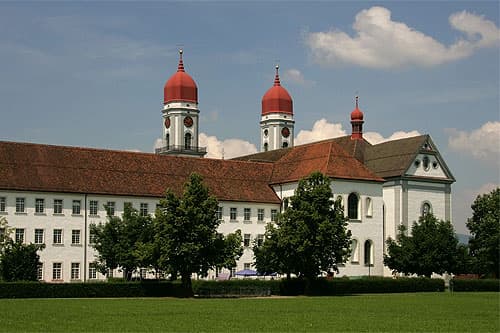
St. Urban's Abbey
St. Urban's Abbey, a former Cistercian monastery located in Pfaffnau, Switzerland, was founded in 1194. Over centuries, it grew into a significant landowner and a leading Cistercian house, developing a notable school that became Switzerland's first teacher training college. Despite secularization in the 19th century, parts of the abbey now serve cultural purposes.