
Hauterive Abbey
Hauterive Abbey is a historic Cistercian monastery located in Hauterive, Fribourg, Switzerland, recognized as a Swiss heritage site of national significance. Founded between 1132 and 1137, it flourished economically and culturally in its early centuries, becoming closely tied to the city of Fribourg. Despite periods of decline due to conflict and damage, the abbey underwent baroque reconstruction and was eventually secularized before being re-settled by monks and regaining its status as an abbey.
Key Facts
- ›Founded between 1132-1137 with land donated by Baron Guillaume de Glâne.
- ›Consecrated on February 25, 1138.
- ›Was home to 30-40 monks and about 50 lay brothers at its peak in the late 12th/early 13th centuries.
- ›Established a significant scriptorium and library from the MID-12th to the 14th century.
- ›Founded Kappel Abbey in 1185 and placed La Maigrauge nunnery under its authority in 1261.
- ›Underwent baroque reconstruction of its convent buildings from 1715 to 1770.

Gothic, Baroque, Late Gothic
Significant Scriptorium and Library, Tracery Windows, Stained Glass Windows, Late Gothic Choir Stalls, Baroque Reconstruction of Convent Buildings
Abbaye D’Hauterive
Guillaume De GlâNe, Pope Innocent Ii, Pope Innocent Iii, Pope Innocent Iv, Pope Martin V, Abbot Peter Rych, Abbot Jean Philibert, Abbot Peter Affry, Abbot MoëNnat Guillaume, Abbot Henri De Fivaz, Abbot Bernhard Emmanuel of Lenzburg, Dom Sighard Kleiner, Dom Bernard Kaul, Dom Mauro-Giuseppe Lepori, Dom Marc De Pothuau
- Consecration In 1137/1138
- Confirmation By Pope Innocent Ii In 1142
- Grant of Protection and Toll Exemption By Dukes of ZäHringen In 1157
- Founding of Kappel Abbey In 1185
- La Maigrauge Nunnery Placed Under Authority In 1261
- Support of Fribourg and Plundering During Sempach War
- Pillage By Bernese Troops In 1448
- Reforms Enacted In 1562
- Visit By Papal Nuncio Giovanni Francesco Bonomi In 1579
- Reorganization of La Maigrauge and La Fille-Dieu Nunneries
- French Invasion and Payment of War Indemnity In 1798
- Secularization In 1848 After the Sonderbund War
- Re-Settlement By Monks In 1939
- Became An Abbey Again In 1973
About Hauterive Abbey
Hauterive Abbey, known in French as Abbaye d’Hauterive, is a significant Cistercian monastery situated in the municipality of Hauterive, within the canton of Fribourg, Switzerland. It is recognized as a Swiss heritage site of national importance, with the entire area included in the Inventory of Swiss Heritage Sites. The abbey's origins trace back to the donation of land between 1132 and 1137 by Baron Guillaume de Glâne. It received permission for consecration from the Bishop of Lausanne in 1137 and was officially consecrated on February 25, 1138.
History and Development
During the 12th and early 13th centuries, Hauterive Abbey experienced considerable economic and cultural growth, bolstered by support from local nobility and the Bishop of Lausanne. In 1157, the Dukes of Zähringen granted the abbey protection and exemptions, fostering its prosperity. The abbey developed close ties with the burgeoning city of Fribourg, providing wool for the city's textile industry and eventually allowing citizens of Fribourg to be buried at the abbey after 1182. Historical records, including the Chartular of Hauterive, indicate extensive landholdings and a prosperous community, supported by nine villages across various regions.
The abbey was also a center of intellectual activity, featuring a significant scriptorium and library from the mid-12th to the 14th century. This period saw the construction of canals enabling grain and fulling mills, and later, a paper mill in 1445. The monks of Hauterive were instrumental in establishing other monastic foundations, including Kappel Abbey in 1185, and exerted authority over the La Maigrauge nunnery near Fribourg. At its peak in the late 12th and early 13th centuries, the monastery housed approximately 30-40 monks and around 50 lay brothers.
Challenges and Reconstruction
Despite its early success, Hauterive Abbey faced numerous challenges throughout its history. It suffered damage and plunder during periods of conflict, such as the Sempach war (1386–87) and subsequent wars between Bern and Fribourg. Internal conflicts and damage to its estates contributed to a decline. In the 16th century, Fribourg initiated reforms within neighboring monasteries, impacting Hauterive. The abbey underwent a significant baroque reconstruction of its convent buildings, beginning in 1715 and concluding in 1770.
A period of resurgence was interrupted in 1798 by the French invasion, which led to the abbey paying a war indemnity and losing its self-rule. The abbey and its lands were secularized in 1848 following the Sonderbund war, with its valuable archives and manuscript collection transferred to Fribourg. The buildings were subsequently used for an agricultural school and later a teacher's college.
Modern Era
In 1939, monks from Wettingen-Mehrerau Abbey settled at Hauterive, and the site officially regained its status as an abbey in 1973. Today, Hauterive Abbey remains an active monastic community, with the monks engaged in farming and providing hospitality to guests. The buildings and lands are managed by a foundation.
Source: Wikipedia ↗
Frequently Asked Questions
When was Hauterive Abbey founded?
Hauterive Abbey was founded between 1132 and 1137, with land donated by Baron Guillaume de Glâne. It was officially consecrated on February 25, 1138.
What is the religious order of Hauterive Abbey?
Hauterive Abbey belongs to the Cistercian order. It became a member of the Upper-Germanies Cistercian Congregation in 1618.
What historical significance does Hauterive Abbey hold?
The abbey flourished economically and culturally in its early centuries, supported by local nobility and the Bishop of Lausanne. It also played a role in the development of Fribourg and housed a significant scriptorium and library.
What happened to Hauterive Abbey after its peak?
The abbey faced decline due to conflicts like the Sempach war and pillaging by troops. It was secularized in 1848, with its archives and library transferred to Fribourg, and its buildings used for educational purposes before being re-settled by monks in 1939 and becoming an abbey again in 1973.
Is Hauterive Abbey still active?
Yes, Hauterive Abbey is an active abbey. It was re-settled by monks from Wettingen-Mehrerau Abbey in 1939 and became an abbey again in 1973. The monks are involved in farming and housing guests.
Related Monasteries
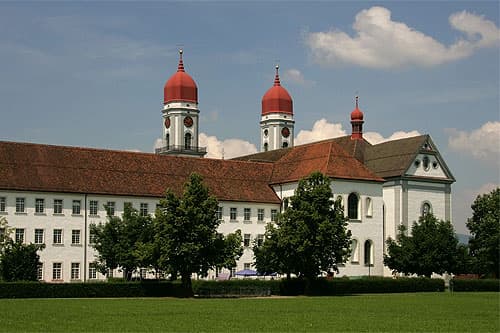
St. Urban's Abbey
St. Urban's Abbey, a former Cistercian monastery located in Pfaffnau, Switzerland, was founded in 1194. Over centuries, it grew into a significant landowner and a leading Cistercian house, developing a notable school that became Switzerland's first teacher training college. Despite secularization in the 19th century, parts of the abbey now serve cultural purposes.

Wurmsbach Abbey
Wurmsbach Abbey is a Cistercian monastery for nuns situated on the northern shore of upper Lake Zürich in Bollingen, Switzerland. Founded in 1259 by Count Rudolf of Rapperswil, it initially served as a dependency of the Cistercian monks of St. Urban Abbey. The abbey church was consecrated in 1281, and the monastery has endured pillaging during historical conflicts, yet remains active and is recognized for its scenic location and herbal gardens.

Wettingen Abbey
Wettingen Abbey was a significant Cistercian monastery founded in 1227 in Wettingen, Switzerland. Despite periods of financial hardship and religious upheaval, it experienced revivals and played a role in sheltering refugees. Dissolved in 1841 during secularization, its community re-established itself in Austria, while the original buildings in Switzerland now serve educational purposes but retain their heritage status and are open for public tours.