
Wurmsbach Abbey
Wurmsbach Abbey is a Cistercian monastery for nuns situated on the northern shore of upper Lake Zürich in Bollingen, Switzerland. Founded in 1259 by Count Rudolf of Rapperswil, it initially served as a dependency of the Cistercian monks of St. Urban Abbey. The abbey church was consecrated in 1281, and the monastery has endured pillaging during historical conflicts, yet remains active and is recognized for its scenic location and herbal gardens.
Key Facts
- ›Founded in 1259 by Count Rudolf of Rapperswil.
- ›Established as a dependency of the Cistercian monks of Abbey of St. Urban.
- ›The abbey church was dedicated in 1281.
- ›Nuns fled and the abbey was pillaged during the First Battle of Villmergen (1656) and French occupation (1799).
- ›As of 2011, the community consisted of 15 nuns led by Abbess Monika Thumm.
- ›Known for its location on the lake and its herbal gardens.

- Location On the North Shore of Upper Lake ZüRich
- Herbal Gardens
Kloster Mariazell-Wurmsbach
Count Rudolf of Rapperswil, Elisabeth Von Rapperswil, Vinzenz of Rapperswil, Abbess Monika Thumm
- Foundation In 1259
- Dedication of Abbey Church In 1281
- Nuns Fled and Abbey Pillaged During the First Battle of Villmergen
- Nuns Fled and Abbey Pillaged By French Revolutionary Army
About Wurmsbach Abbey
Wurmsbach Abbey (German: Kloster Mariazell-Wurmsbach) is a Cistercian monastery for nuns located in Bollingen, within the municipality of Rapperswil-Jona in the Canton of St. Gallen, Switzerland. Its picturesque setting on the north shore of upper Lake Zürich contributes to its renown.
History and Foundation
The abbey's origins trace back to 1259 when Count Rudolf of Rapperswil donated his castle of Wurmsbach, along with a substantial tract of land, for the establishment of a religious house. Initially, Wurmsbach Abbey operated as a dependency of the Cistercian monks from the Abbey of St. Urban in Wettingen. The abbey church itself was dedicated in 1281. Bollinger Sandstein, quarried locally, was utilized in the construction of the abbey buildings. Historical records suggest that Elisabeth von Rapperswil may have been buried at the nunnery, though her specific grave has not been definitively identified. The graves of her younger brother, Vinzenz, and their mother were excavated within the nunnery grounds.
Challenges and Modern Community
Throughout its history, Wurmsbach Abbey has faced periods of significant hardship. During the First Battle of Villmergen in 1656, and again in 1799 when the region was occupied by the French Revolutionary Army, the nuns were compelled to flee. On both occasions, the abbey suffered complete pillaging, leading to the loss of many of its treasures. As of 2011, the community comprised 15 nuns, under the leadership of Abbess Monika Thumm.
Sights and Activities
Beyond its historical significance, Wurmsbach Abbey is celebrated for its beautiful lakeside location, offering views of upper Lake Zürich. The abbey church is recognized as a building of historical importance. The nuns are actively involved in running a secondary boarding school for girls. Furthermore, gardening is a substantial undertaking, given the considerable land owned by the abbey, with its gardens being particularly noted for the herbal remedies cultivated there. The monastery is listed in the Swiss inventory of cultural property as a Class B object of regional importance.
Source: Wikipedia ↗
Frequently Asked Questions
When was Wurmsbach Abbey founded?
Wurmsbach Abbey was founded in 1259. Count Rudolf of Rapperswil donated his castle of Wurmsbach and a significant area of land for its establishment.
What religious order does Wurmsbach Abbey belong to?
Wurmsbach Abbey is a monastery of Cistercian nuns. It is part of the Order of Cistercians of the Common Observance (O.Cist.).
Where is Wurmsbach Abbey located?
The abbey is situated in Bollingen, a locality of Rapperswil-Jona, in the Canton of St. Gallen, Switzerland. It is located on the north shore of upper Lake Zürich.
What are some notable features of Wurmsbach Abbey?
Wurmsbach Abbey is renowned for its picturesque location overlooking upper Lake Zürich. The monastery also maintains considerable gardens known for their herbal remedies.
What activities take place at Wurmsbach Abbey?
The nuns at Wurmsbach Abbey run a secondary boarding school for girls. Gardening also occupies a significant portion of their time due to the extensive land owned by the abbey.
Has Wurmsbach Abbey faced any historical challenges?
Yes, the nuns were forced to flee and the abbey was completely pillaged on two occasions: during the First Battle of Villmergen in 1656 and by the French Revolutionary Army in 1799. These events resulted in the loss of many of its treasures.
Related Monasteries

Wettingen Abbey
Wettingen Abbey was a significant Cistercian monastery founded in 1227 in Wettingen, Switzerland. Despite periods of financial hardship and religious upheaval, it experienced revivals and played a role in sheltering refugees. Dissolved in 1841 during secularization, its community re-established itself in Austria, while the original buildings in Switzerland now serve educational purposes but retain their heritage status and are open for public tours.

Hauterive Abbey
Hauterive Abbey is a historic Cistercian monastery located in Hauterive, Fribourg, Switzerland, recognized as a Swiss heritage site of national significance. Founded between 1132 and 1137, it flourished economically and culturally in its early centuries, becoming closely tied to the city of Fribourg. Despite periods of decline due to conflict and damage, the abbey underwent baroque reconstruction and was eventually secularized before being re-settled by monks and regaining its status as an abbey.
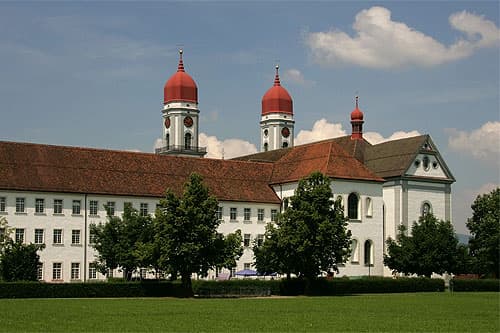
St. Urban's Abbey
St. Urban's Abbey, a former Cistercian monastery located in Pfaffnau, Switzerland, was founded in 1194. Over centuries, it grew into a significant landowner and a leading Cistercian house, developing a notable school that became Switzerland's first teacher training college. Despite secularization in the 19th century, parts of the abbey now serve cultural purposes.