
Kappel Abbey
Christian·Switzerland·hotel and spiritual retreat center·12th century
Kappel Abbey was a former Cistercian monastery founded around 1185 by the Freiherr of Eschenbach in Kappel am Albis, Swiss canton of Zurich. It experienced a spiritual and economic golden age until the mid-14th century, amassing extensive properties. Following the Reformation, the monastery was abolished in 1527, its assets transferred to the city of Zurich, and the church became a parish church. Today, the complex houses a hotel and is used as a spiritual retreat center.
Key Facts
- ›Founded around 1185 by the Freiherr of Eschenbach.
- ›Received the "Privilegium commune Cisterciense" from Pope Innocent III in 1211.
- ›Experienced a golden age from the 13th to MID-14th centuries with significant landholdings.
- ›Abolished in 1527 during the Reformation, with its property becoming that of the city of Zurich.
- ›The former monastery church now serves as the parish church of Kappel.
- ›Currently operates as a hotel and spiritual retreat center.
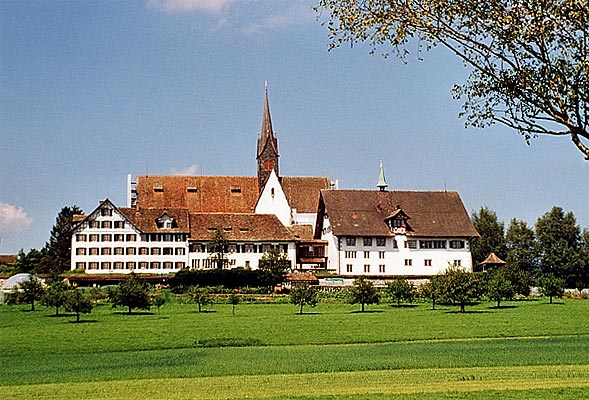
Gothic
- Parts of the Original Church Are Preserved In the Present Structure.
- the Core of the Administration Buildings, Dating To 1209/10, Is the Oldest Part.
Wolfgang Joner, Heinrich Bullinger, Huldrych Zwingli
First War of Kappel, Second War of Kappel
About Kappel Abbey
Kappel Abbey is a historical former Cistercian monastery located in Kappel am Albis, within the Swiss canton of Zurich. Its origins trace back to the late 12th century, with its first mention in 1185 by Bishop Hermann II of Constance, and it was founded by the Freiherr of Eschenbach. The name is said to derive from a chapel where hermits once resided, according to foundation legends.
Foundation and Golden Age
The abbey received significant papal endorsement with Pope Innocent III granting the "Privilegium commune Cisterciense" in 1211, followed by various imperial and royal privileges between the 13th and 15th centuries. Construction of a new church began around 1255, built in the Early Gothic style and completed in the early 14th century. The oldest surviving part of the monastic complex is the core of the administration buildings, likely constructed around 1209/10 as a hospital. The period from the 13th to the mid-14th century marked a spiritual and economic zenith for Kappel Abbey. Through extensive donations, purchases, and exchanges, the abbey accumulated widely dispersed properties, managing various businesses with the aid of lay brothers, including vineyards and granges. However, by the 15th century, these distant operations were largely relinquished, with the abbey focusing on local production.
Reformation and Transformation
The abbey's history took a significant turn due to the involvement of Walters IV von Eschenbach in the regicide of King Albert I of Germany in 1308. This led to the confiscation of Eschenbach possessions by the Habsburgs in 1309. Over time, Kappel Abbey increasingly fell under the authority of Zurich. In 1523, the last abbot, Wolfgang Joner, invited the reformer Heinrich Bullinger to the abbey as a teacher, ushering in the gradual introduction of the Reformation. The monastery was officially abolished in 1527, with its property transferred to the city of Zurich. The former monastic church then became the parish church of Kappel. The complex witnessed events during the Wars of Kappel, including the peaceful resolution of the First War in 1529, marked by the famous "Kappeler Milchsuppe," and the tragic Second War in 1531, where reformer Huldrych Zwingli was killed.
Modern Use
Following the Reformation, the former abbey became the property of the Canton of Zurich. It underwent transformations, serving as a workhouse and an orphanage school in 1836, later incorporating a correctional institution. By the late 19th century, it functioned as a district hospital for the poor. As the facility aged and became inadequate, alternative uses were sought in the 1960s. Since 1983, the cantonal Reformed church has utilized the building as a spiritual retreat. Today, the historic Kappel Abbey complex houses a hotel with 79 rooms, continuing its legacy of providing space for reflection and community.
Source: Wikipedia ↗
Frequently Asked Questions
When was Kappel Abbey founded?
Kappel Abbey is first mentioned in 1185, indicating its foundation around that time. It was established by the Freiherr of Eschenbach.
What was the religious order of Kappel Abbey?
Kappel Abbey was a Cistercian monastery. It received the "Privilegium commune Cisterciense" from Pope Innocent III in 1211, a significant privilege for Cistercian houses.
What led to the abolition of Kappel Abbey?
The Reformation gradually took hold in Kappel, influenced by reformers like Heinrich Bullinger. The monastery was officially abolished in 1527, and its property was taken over by the city of Zurich.
What is the current use of the former Kappel Abbey complex?
After the Reformation, the complex served various purposes, including a workhouse, orphan school, and hospital. Since 1983, it has been used as a spiritual retreat and currently houses a hotel.
Are there any notable historical events associated with Kappel Abbey?
Kappel Abbey was the site of encounters during the Wars of Kappel, particularly the First War of Kappel in 1529, which famously ended with the 'Kappeler Milchsuppe' negotiation. The Second War of Kappel in 1531 resulted in the death of reformer Huldrych Zwingli.
Related Monasteries

Bonmont Abbey
Bonmont Abbey, a former Cistercian monastery in Vaud, Switzerland, was founded between 1110 and 1120. Initially adhering to strict Benedictine and Cistercian rules, it grew wealthy through donations, leading to architectural and decorative changes. Secularized in 1536 during the Reformation, its buildings were repurposed for agricultural and administrative uses, though the church was preserved and later restored as a national monument.

Bubikon Commandery
Bubikon Commandery, also known as Bubikon Castle, was a medieval monastery of the Knights Hospitaller. Founded between 1191 and 1198, it grew to own significant lands across the present-day Canton of Zürich. The commandery was secularized during the Reformation, and its buildings now house a museum dedicated to its history and the Order.
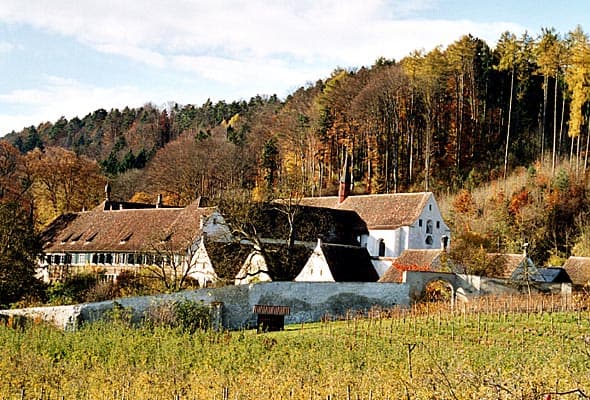
Ittingen Charterhouse
Ittingen Charterhouse, located near Warth in Switzerland's Canton Thurgau, was initially founded as a monastery for Canons Regular in 1150. It later became a Carthusian monastery in 1461, enduring destruction during the Reformation and eventual dissolution in 1848. Today, the meticulously restored precinct serves as an education and seminar center, housing museums, a farm, hotels, and a residential home for individuals with mental illnesses or learning difficulties.