
Tsurphu
Tsurphu Monastery, also known as Tölung Tsurphu, is the historical seat of the Karmapa, the head of the Karma Kagyu lineage of Tibetan Buddhism. Founded in the 12th century, it served as a prominent monastic center until its destruction during the Cultural Revolution. Although rebuilt, it continues to hold significant spiritual importance and was the residence of the 17th Karmapa before his departure to India.
Key Facts
- ›Traditional seat of the Karmapa, head of the Karma Kagyu lineage.
- ›Founded by Düsum Khyenpa, 1st Karmapa Lama, in 1159.
- ›Grew to house approximately 1000 monks.
- ›Completely destroyed in 1966 during the Cultural Revolution.
- ›Began rebuilding in 1980 under the 16th Karmapa.
- ›Served as residence for the 17th Karmapa, Ogyen Trinley Dorje, until 2000.

Traditional Seat of the Karmapa, High Altitude Location
Tsurphu, TöLung Tsurphu, 楚布寺, Mtshur Mdo Bo Lung Dgon, 祖普寺, Okmin Tsurpu, 'Og Min Mtshur Phu
DüSum Khyenpa, 1st Karmapa Lama, Rangjung Rigpe Dorje, 16th Karmapa, Ogyen Trinley Dorje, 17th Karmapa, Yelpa Yeshe Tsek
Destruction During the Cultural Revolution, Rebuilding Efforts Initiated, Enthronement of the 17th Karmapa
About Tsurphu
Tsurphu Monastery
Tsurphu Monastery, also known by its longer name Tölung Tsurphu, stands as a historically significant gompa in Tibet. It traditionally serves as the seat of the Karmapa, the spiritual leader of the Karma Kagyu lineage of Tibetan Buddhism. Perched at an altitude of approximately 4,300 meters (14,100 ft) in the Doilungdêqên District, about 70 kilometers from Lhasa, the monastery is nestled within a valley surrounded by high mountains.
Founding and Early History
The monastery's origins trace back to 1159 when Düsum Khyenpa, the 1st Karmapa Lama, visited the site and laid the groundwork for its establishment by making offerings to local deities. He formally founded his main seat there in 1189. Under his guidance, Tsurphu grew into a substantial monastic center, eventually accommodating around 1000 monks. The original complex featured robust architecture, with walls of the main building reaching up to 4 meters (13 ft) in thickness and spanning a considerable area.
Destruction and Reconstruction
The monastery faced a catastrophic event in 1966 when it was completely destroyed during the Cultural Revolution. Following this period of devastation, efforts to restore the sacred site commenced. Rangjung Rigpe Dorje, the 16th Karmapa, initiated the rebuilding process in 1980. Although he passed away the following year, the reconstruction continued.
Recent History and Significance
More recently, Tsurphu Monastery gained prominence as the site where Ogyen Trinley Dorje, recognized as the 17th Karmapa, was enthroned. He resided at Tsurphu until his departure from Tibet to India in 2000. Despite the destruction and subsequent rebuilding, Tsurphu Monastery remains a vital spiritual center and a place of pilgrimage for followers of the Karma Kagyu tradition.
Source: Wikipedia ↗
Frequently Asked Questions
When was Tsurphu Monastery founded?
Tsurphu Monastery was founded in 1159 by Düsum Khyenpa, the first Karmapa Lama. He initially laid the foundation for an establishment and revisited the site in 1189 to found his main seat.
What is the significance of Tsurphu Monastery?
Tsurphu Monastery is the traditional seat of the Karmapa, who is the spiritual leader of the Karma Kagyu lineage of Tibetan Buddhism. It has historically been a major center for this tradition.
What happened to Tsurphu Monastery during the Cultural Revolution?
The monastery complex was totally destroyed in 1966 during the Cultural Revolution. Rebuilding efforts began in 1980.
Where is Tsurphu Monastery located?
Tsurphu Monastery is located in Gurum in Doilungdêqên District, Tibet Autonomous Region, China. It is situated about 70 kilometers from Lhasa and at an altitude of approximately 4,300 meters.
Who resided at Tsurphu most recently before leaving Tibet?
The 17th Karmapa, Ogyen Trinley Dorje, was enthroned at Tsurphu and resided there until he escaped from Tibet to India in 2000.
Related Monasteries

Katok
Katok Monastery, founded in 1159, is a significant "Mother Monastery" of the Nyingma school of Tibetan Buddhism, located in the Kham region of Tibet. It is renowned for its scholarship, its role in preserving the Anuyoga tradition, and its historical influence on the spread of Nyingma monasticism. The monastery's name originates from a sacred rock at its founding site, meaning "on top of the ka".
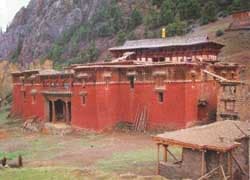
Karma Gön Monastery
Karma Gön Monastery, the original seat of the Karma Kagyu sect of Tibetan Buddhism, was founded in the 12th century by the 1st Karmapa Lama, Düsum Khyenpa. Located in eastern Tibet, it served as the cradle for the Karma Kagyu lineage and was a significant administrative and religious center. Although much of its historical structures and treasures were lost during the Cultural Revolution, efforts have been made towards its preservation and restoration, with some older buildings and retreat centers remaining.

Dorje Drak
Dorje Drak, also known as Indestructible Rock Vihara, is a significant Tibetan Buddhist monastery of the Nyingma school, recognized as one of its 'Six Mother Monasteries' in Tibet. Originally founded as Ewam Chogar Gompa, it was enlarged and renamed Dorje Drak following the discovery of auspicious natural signs. The monastery has a history marked by destruction and rebuilding, most notably its relocation in 1632 and subsequent destruction during the 1960s, leading to a new foundation in India.