
Katok
Katok Monastery, founded in 1159, is a significant "Mother Monastery" of the Nyingma school of Tibetan Buddhism, located in the Kham region of Tibet. It is renowned for its scholarship, its role in preserving the Anuyoga tradition, and its historical influence on the spread of Nyingma monasticism. The monastery's name originates from a sacred rock at its founding site, meaning "on top of the ka".
Key Facts
- ›Founded in 1159 by Kathok Kadampa Deshek.
- ›One of the "six Mother Monasteries" of the Nyingma school.
- ›Located at an altitude of 4,000 meters (13,000 ft) in Baiyu County, Sichuan, Tibet.
- ›Historically housed approximately 800 monks prior to 1951.
- ›Known for specializing in Nyingma Kama lineages and the Anuyoga tradition.
- ›Has 112 branch monasteries across Tibet, Mongolia, Inner China, Yunnan, and Sikkim.

- Sacred Rock Bearing A "Kaḥ" Syllable
- Location On Eastern Flanks of A Mountain Range
- 18 Hairpin Turns On Access Road
- Center For Anuyoga Tradition
- Center For Nyingma Kama Lineages
Kathog GöN, Kathog, Katog
Padmasambhava, Kathok Kadampa Deshek, Yeshe Tsogyal, Jampa Bum, DüDdüL Dorjé, Rigdzin Longsal Nyingpo, Moktsa Tulku, Khenpo Ngakchung Tulku, Katog Rigdzin-Tsewang-Norbu, Situ Panchen Chokyi-Jungney, Chonyi Gyatso, Chopa Lugu, Dzongsar Khyentse ChöKyi Lodrö, Gyurme Kelzang Tobgyel Dorje, Jamyang Gyeltsen, Gyurme Tenpa Gyaltsen, Katok Tsewang Norbu, Getse Mahapandita, Katok Situ ChöKyi Gyatso, Khenpo Ngawang Pelzang, Katok Situ ChöKyi Nyima
- Founded In 1159.
- Destroyed After 1966.
- Rebuilt Through Efforts of Moktsa Tulku and Khenpo Ngakchung Tulku.
- Expansion Completed In 2016.
About Katok
Katok Monastery
Katok Monastery, also transliterated as Kathog or Katog, is a historically significant "Mother Monastery" of the Nyingma school within Tibetan Buddhism. Founded in 1159 by Kathok Kadampa Deshek, it is one of the "Six Mother Monasteries" and played a crucial role in the development and dissemination of Nyingma traditions.
Location and Setting
The monastery is situated in Baiyu County, Garzê Tibetan Autonomous Prefecture, Sichuan, China, in the Kham region of Tibet. It is perched at an elevation of approximately 4,000 meters (13,000 ft) above sea level, on the eastern slopes of a mountain range. Access to the monastery involves a challenging dirt road with 18 hairpin turns. The nearest town is Horpo, located about 17 km to the north.
History and Significance
Katok's founding is attributed to Kathok Kadampa Deshek, who was prophesied by Guru Rinpoche (Padmasambhava) to be an emanation of Yeshe Tsogyal. The monastery was established on a sacred rock, referred to as "Dorje Gatramo," which features a "kaḥ" syllable, giving the monastery its name, meaning "on top of the kaḥ." This site is considered one of Guru Rinpoche's 25 sacred locations in Do Kham.
Historically, Katok was a renowned center for fine scholarship and monasticism, especially noted for its specialization in the Nyingma Kama lineages (oral transmissions) rather than Terma lineages. It was a bastion of the Anuyoga tradition when this practice became less emphasized elsewhere in the Nyingma school. Prior to the annexation of Tibet in 1951, the monastery housed around 800 monks.
Destruction and Reconstruction
The original gompa eventually fell into disrepair and was rebuilt in 1656. After 1966, the monastery suffered destruction during the Chinese period, with lamas being imprisoned. However, it was later rebuilt through the dedicated efforts of figures such as Moktsa Tulku and Khenpo Ngakchung Tulku. An expansion, including a new temple and assembly hall, was completed in 2016.
Legacy and Affiliations
Katok Monastery has been influential in the spread of Nyingma monasteries, with records indicating it has 112 branch monasteries not only within Tibet but also in Mongolia, Inner China, Yunnan, and Sikkim. Several esteemed scholars and figures have been associated with Katok, including Katok Tsewang Norbu, Getse Mahapandita, and the 4th Kathok Getse Rinpoche Gyurme Tenpa Gyaltsen, who was the 7th head of the Nyingma school.
Source: Wikipedia ↗
Frequently Asked Questions
When was Katok Monastery founded?
Katok Monastery was founded in the year 1159. Its founding was a significant event in the history of the Nyingma school of Tibetan Buddhism.
Where is Katok Monastery located?
Katok Monastery is situated in Baiyu County, within the Garzê Tibetan Autonomous Prefecture of Sichuan, China. It is located in the Kham region of Tibet, at an elevation of approximately 4,000 meters (13,000 ft) above sea level.
What is the significance of Katok Monastery?
Katok Monastery is recognized as one of the "Six Mother Monasteries" of the Nyingma school. It has been a prominent center for scholarship, particularly in preserving the Anuyoga tradition and Nyingma Kama lineages.
What does the name "Katok" mean?
The name "Katok" originates from a sacred rock at the monastery's founding site, which bears a syllable "kaḥ". The name translates to "on top of the kaḥ", signifying its placement upon this revered spot.
What is the history of Katok Monastery after its founding?
After its founding in 1159, Katok grew to include numerous branch monasteries. It faced destruction after 1966 but was subsequently rebuilt through the efforts of lamas like Moktsa Tulku and Khenpo Ngakchung Tulku.
Related Monasteries

Tsurphu
Tsurphu Monastery, also known as Tölung Tsurphu, is the historical seat of the Karmapa, the head of the Karma Kagyu lineage of Tibetan Buddhism. Founded in the 12th century, it served as a prominent monastic center until its destruction during the Cultural Revolution. Although rebuilt, it continues to hold significant spiritual importance and was the residence of the 17th Karmapa before his departure to India.
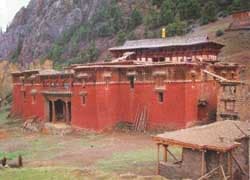
Karma Gön Monastery
Karma Gön Monastery, the original seat of the Karma Kagyu sect of Tibetan Buddhism, was founded in the 12th century by the 1st Karmapa Lama, Düsum Khyenpa. Located in eastern Tibet, it served as the cradle for the Karma Kagyu lineage and was a significant administrative and religious center. Although much of its historical structures and treasures were lost during the Cultural Revolution, efforts have been made towards its preservation and restoration, with some older buildings and retreat centers remaining.

Dorje Drak
Dorje Drak, also known as Indestructible Rock Vihara, is a significant Tibetan Buddhist monastery of the Nyingma school, recognized as one of its 'Six Mother Monasteries' in Tibet. Originally founded as Ewam Chogar Gompa, it was enlarged and renamed Dorje Drak following the discovery of auspicious natural signs. The monastery has a history marked by destruction and rebuilding, most notably its relocation in 1632 and subsequent destruction during the 1960s, leading to a new foundation in India.