
Ter Doest Abbey
Ter Doest Abbey was a significant Cistercian monastery located in Lissewege, Belgium, which played a crucial role in land reclamation and the wool trade. Founded in 1106 and later affiliating with the Cistercian order, it housed notable figures and was dissolved during the French Revolution. Today, its most prominent surviving structure is the massive tithe barn.
Key Facts
- ›Founded in 1106 as a Benedictine abbey, it became Cistercian in 1175.
- ›Played a key role in dyke construction and land reclamation in coastal Flanders, Zeeland, and Holland.
- ›Was an important center for the wool trade.
- ›Saint Thorfinn of Hamar, exiled bishop of Norway, died and was buried there in 1285.
- ›Willem van Saeftinghe, a lay brother, is historically linked to the Battle of the Golden Spurs.
- ›Dissolved in 1796 during the French Revolution.
Gothic
Tithe Barn, Abbey Farm 'T Groot Ter Doest, Octagonal Chapel, Monumental Porch
Abdij Ter Doest
Saint Thorfinn of Hamar, Willem Van Saeftinghe, Jan Van He, Johannes De Pascuis
- Affiliation With Cistercian Order
- Death and Burial of Saint Thorfinn
- Willem Van Saeftinghe's Involvement In the Battle of the Golden Spurs
- Revolt of Lay Brothers and Attack On Abbot
- Destruction of the Church By Calvinists
- Union With Ten Duinen Abbey
- Dissolution During the French Revolution
About Ter Doest Abbey
Ter Doest Abbey, also known by its Dutch name Abdij Ter Doest, was a prominent Cistercian monastery situated in Lissewege, within the present-day municipality of Bruges in West Flanders, Belgium.
History and Significance
The abbey's origins trace back to 1106 when Lambert, lord of Lissewege, bequeathed an estate with a chapel to the Benedictines, who subsequently established an abbey. In 1175, this institution affiliated itself with the Cistercian order, becoming a daughter house of Ten Duinen Abbey in Koksijde and tracing its lineage back to Clairvaux. Ter Doest Abbey played a vital role in the economic and environmental development of the region, actively participating in the construction of dykes and the reclamation of land in the coastal areas of Flanders, Zeeland, and Holland. Furthermore, it was a significant player in the lucrative wool trade.
The abbey served as a refuge for notable figures. Saint Thorfinn, the exiled bishop of Hamar in Norway, found sanctuary there after opposing King Eric II of Norway, and he died and was buried within its grounds on January 8, 1285. A lay brother of Ter Doest, Willem van Saeftinghe, is famously associated with the Battle of the Golden Spurs in 1302, where he is credited with unhorsing the French leader, Robert, Count of Artois. Later, in 1308, Willem was involved in a revolt of the lay brothers, during which he killed the abbey's cellarer and severely injured the abbot. Ter Doest Abbey eventually entered into union with Ten Duinen Abbey in 1624, with Ten Duinen relocating to Bruges in 1627. The abbey met its end with its dissolution in 1796 during the French Revolution.
Surviving Structures
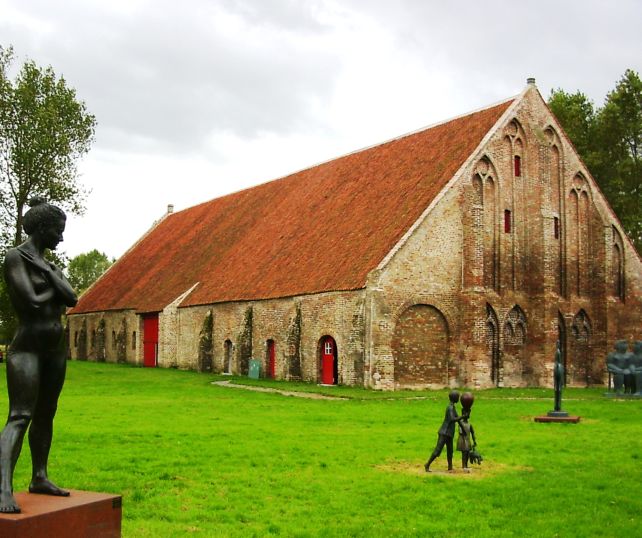
Of the once extensive monastic complex, the most substantial surviving structure is the impressive tithe barn, a monumental Gothic edifice dating from 1250. This barn measures approximately 50 meters in length and stands over 30 meters high. The abbey's vast church, which featured three aisles, was unfortunately destroyed in 1571 by Calvinists. Other extant buildings include the abbey farm, 't Groot Ter Doest, built in 1632, an octagonal chapel erected in 1687, and a monumental porch from 1662, all of which still stand and offer glimpses into the abbey's past.
Source: Wikipedia ↗
Frequently Asked Questions
When was Ter Doest Abbey founded?
Ter Doest Abbey was initially founded in 1106 as a Benedictine abbey. It later affiliated with the Cistercian order in 1175.
What is the most significant surviving building from Ter Doest Abbey?
The most significant surviving building from Ter Doest Abbey is the impressive tithe barn, which measures 50 meters long and over 30 meters high and was constructed in 1250.
What was the historical importance of Ter Doest Abbey?
Ter Doest Abbey was historically important for its contributions to land reclamation in coastal areas and its involvement in the wool trade. It also provided refuge to figures like Saint Thorfinn of Hamar.
When was Ter Doest Abbey dissolved?
Ter Doest Abbey was dissolved in 1796 during the French Revolution, marking the end of its operational monastic life.
Is there any record of notable monks from Ter Doest Abbey?
Yes, historical records mention notable monks such as Jan van He and Johannes de Pascuis, both noted theologians.
Related Monasteries

Villers Abbey
Villers Abbey, a former Cistercian monastery located in Belgium, was founded in 1146 and abandoned in 1796. Once a significant religious and economic center, the abbey's extensive ruins are now classified as part of Wallonia's Major Heritage. The site has undergone considerable restoration and is a popular tourist destination, hosting cultural events.
Villers-la-Ville Abbey
Villers Abbey, a former Cistercian monastery in Belgium, was established in 1146 and abandoned in 1796, with most of its structures now in ruins. Once a significant center with extensive lands and a large monastic population, it suffered decline from the 16th century onwards due to various conflicts and diminishing wealth. Today, its impressive ruins are a classified heritage site and a popular tourist destination, hosting cultural events.

Cambron Abbey
Cambron Abbey was a prominent Cistercian monastery founded in 1148 in Hainaut, Belgium. It grew to become one of the wealthiest abbeys in the region, known for its intellectual contributions and the popular devotion to Our Lady of Cambron. Despite periods of wealth and renovation, it was dissolved in 1789 by Emperor Joseph II, with its remnants now incorporated into the Pairi Daiza zoo and botanical garden.