
St. Catherine Greek Orthodox Monastery
Greek Orthodox·Egypt·Active monastery and UNESCO World Heritage Site·6th century
The Sacred Autonomous Royal Monastery of Saint Catherine of the Holy and God-Trodden Mount Sinai, commonly known as St. Catherine Greek Orthodox Monastery, is the world's oldest continuously inhabited Christian monastery, built between 548 and 565 AD in Egypt's Sinai Peninsula. Commissioned by Byzantine Emperor Justinian I, it was initially constructed to enclose the biblical burning bush site. Over centuries, it became a major Christian pilgrimage destination after the purported relics of Saint Catherine of Alexandria were brought there, leading to its renaming. The monastery is recognized for its immense historical and religious significance to Judaism, Christianity, and Islam, housing a vast collection of rare manuscripts and icons.
Key Facts
- ›Built between 548 and 565 AD by order of Byzantine Emperor Justinian I.
- ›World's oldest continuously inhabited Christian monastery.
- ›Houses the world's second-largest collection of early codices and manuscripts, including the Codex Sinaiticus.
- ›Recognized as a UNESCO World Heritage Site for its importance to Judaism, Christianity, and Islam.
- ›Contains the earliest known depiction of Christ Pantocrator and a unique collection of early Christian icons.
- ›Includes a Fatimid mosque built in 1106 AD that is still preserved and occasionally used.

Byzantine
Burning Bush Site, Well of Moses, Mount Sinai, Willow Peak, Jebel Arrenziyeb, Massive Fortifications, Oldest Known Surviving Roof Truss, Fatimid Mosque, Library With Rare Manuscripts and Icons, Charnel House
- Sacred Autonomous Royal Monastery of Saint Catherine of the Holy and God-Trodden Mount Sinai
- ιερά μονή αγίας αικατερίνης όρους σινά
- Dayr Al-QiddīSa KatrīN
Justinian I, Moses, Catherine of Alexandria, Constantine I, Empress Consort Helena, Egeria, Felix Fabri, Martin Von Baumgarten, Constantin Von Tischendorf, Agnes Smith Lewis, Margaret Dunlop Gibson, Francis Crawford Burkitt, Robert Lubbock Bensly, J. Rendel Harris, Muhammad, Abbot Symeon
- Construction Ordered By Emperor Justinian I
- Relics of Saint Catherine of Alexandria Brought To the Monastery, Increasing Pilgrimage.
- Fatimid Mosque Built .
- Increasing Interest From European Christians During the Crusades .
- Monastery Captured and Sacked By Bedouins .
- Discovery of Codex Sinaiticus By Constantin Von Tischendorf .
- Discovery of Syriac Sinaiticus By Agnes S. Lewis .
- Designated A Unesco World Heritage Site .
- Attack By Islamic State – Sinai Province .
- Egyptian Court Ruling On Monastery Lands .
About St. Catherine Greek Orthodox Monastery
Overview of St. Catherine Greek Orthodox Monastery
The Sacred Autonomous Royal Monastery of Saint Catherine of the Holy and God-Trodden Mount Sinai, more commonly known as St. Catherine Greek Orthodox Monastery, stands as a paramount historical and spiritual site in Egypt's Sinai Peninsula. Established between 548 and 565 AD by imperial decree of Byzantine Emperor Justinian I, it holds the distinction of being the world's oldest continuously inhabited Christian monastery. Its strategic location at the foot of Mount Sinai places it amidst significant biblical landscapes, including the site traditionally identified as the burning bush seen by Moses, and near the 'Well of Moses'.
Historical Significance and Religious Importance
Originally built to enclose the Chapel of the Burning Bush, the monastery's importance grew centuries later with the arrival of the purported relics of Saint Catherine of Alexandria. This event transformed the site into a major Christian pilgrimage destination and led to its renaming. The monastery's unique position is further underscored by its recognition as a UNESCO World Heritage Site in 2002, acknowledging its profound significance to Judaism, Christianity, and Islam. It notably houses a Fatimid mosque, built in 1106 AD, which remains preserved and is still used on special occasions, reflecting its historical role in interfaith coexistence.
Architectural and Cultural Treasures
The monastery is protected by massive fortifications that have ensured its preservation through turbulent periods. Architecturally, it features the world's oldest known surviving roof truss. Its library is a treasure trove, recognized by Guinness World Records as the oldest continuously operating library globally. It safeguards the world's second-largest collection of early codices and manuscripts, including the renowned Codex Sinaiticus and the Syriac Sinaiticus. The monastery also boasts an exceptional collection of early Christian icons, including the earliest known depiction of Christ Pantocrator, and is an important center for the study of Crusader art. The ongoing Sinai Palimpsests Project continues to reveal hidden layers of ancient texts, further illuminating the monastery's rich scholarly heritage.
Source: Wikipedia ↗
Frequently Asked Questions
When was St. Catherine Greek Orthodox Monastery founded?
The monastery was built by order of the Byzantine emperor Justinian I, with construction taking place between 548 and 565 AD. This makes it the world's oldest continuously inhabited Christian monastery.
What is the religious significance of St. Catherine Greek Orthodox Monastery?
The monastery is considered sacred by adherents of the three major Abrahamic religions: Judaism, Christianity, and Islam. It is built around the site traditionally identified as the biblical burning bush and also holds the relics of Saint Catherine of Alexandria, a major Christian pilgrimage draw.
What is housed in the monastery's library?
The monastery's library is recognized as the world's oldest continuously operating library. It preserves the world's second-largest collection of early codices and manuscripts, including unique and rare works like the Codex Sinaiticus and the Syriac Sinaiticus.
Is St. Catherine Greek Orthodox Monastery still an active monastery?
Yes, it is the world's oldest continuously inhabited Christian monastery. It is controlled by the autonomous Church of Sinai, which is part of the wider Greek Orthodox Church.
What are some of the most notable treasures within the monastery?
Notable treasures include the Codex Sinaiticus, the Syriac Sinaiticus, and a collection of early Christian icons, featuring the earliest known depiction of Christ Pantocrator. The monastery also possesses a copy of the Ashtiname of Muhammad.
What architectural features are significant at St. Catherine Greek Orthodox Monastery?
The monastery features massive fortifications built to preserve it, with access historically gained through a high door in the outer walls. Structurally, its king post truss is noted as the oldest known surviving roof truss in the world.
Related Monasteries
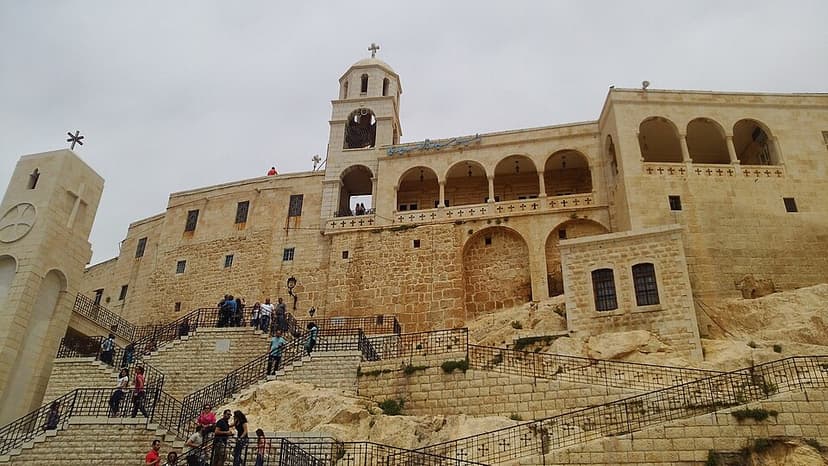
Our Lady of Saidnaya Monastery
Our Lady of Saidnaya Patriarchal Monastery is an ancient Greek Orthodox monastery located in Saidnaya, Syria, traditionally founded by Emperor Justinian I in 547 AD. It is renowned as a significant pilgrimage site, particularly for its icon of Saint Mary attributed to Saint Luke, known as Shaghoura. The monastery has a long history of veneration and has undergone various historical events, including damage from earthquakes and conflict, yet remains an important religious center.

Saint George Monastery
Saint George Monastery, also known as Deir Mar Georges, is a historic Greek Orthodox monastery located in the "Valley of the Christians" in northwestern Syria. Said to have been built by Byzantine Emperor Justinian I in the 6th century, possibly over an ancient temple, the monastery features Byzantine-styled stone architecture and houses significant religious artifacts. It plays a role in regional Christian life, particularly during pilgrimages, and was revitalized by Patriarch John X.

Saint Thekla Convent
The Convent of Saint Thecla, located in the Aramaic-speaking village of Maaloula, Syria, is a significant Greek Orthodox pilgrimage site administered by the Greek Orthodox Patriarchate of Antioch. Founded in 1935 around the grotto of Saint Thecla, the convent is built upon a legend of the saint's miraculous escape and subsequent life in the area. It remains an active monastic community and a major destination for Christian pilgrims seeking spiritual solace and healing from the grotto's sacred spring.